AI Search in Google: What It Means and How to Win

You search for an accountant, software platform or grant adviser in Dublin, and the result no longer begins with the familiar list of blue links. A generated summary appears first, followed by source links, suggested follow-up questions and sometimes local or product information. The page you spent years optimising is still present, but it may no longer control the first impression.
That change is already relevant to Irish businesses. Google expanded AI Overviews to Ireland on 25 March 2025, as part of a European rollout covering nine countries, including Ireland, according to The Irish Times' report on the launch. For an Irish SME, search visibility now has two connected jobs: earn a conventional ranking and become a useful, trusted source inside an AI-generated answer.
Table of Contents
The Search Result That No Longer Looks Like Google - Why the first impression has changed
What AI Search in Google Actually Is - What the searcher sees
How Google Builds an AI Overview Step by Step - The five gates
Where Ireland Stands on AI Search Right Now - The Irish benchmark
Why SEO Still Matters and Where AEO Fits - Two tracks, one foundation
A Practical Playbook for Irish Marketers - Technical work to ship first - Content changes with commercial intent - Measurement that reflects the new page
The Search Result That No Longer Looks Like Google
Take a query such as “best accountant for sole traders in Dublin”. A traditional result page might have shown a map pack, several organic listings, adverts and the familiar title tags and descriptions written by competing firms. With an AI Overview present, Google can place a generated explanation above those elements, drawing together information about services, suitability, considerations and sources.
On mobile, that summary can occupy much of the first screen before someone reaches an organic result. On desktop, it can sit prominently above the blue links while follow-up prompts encourage the searcher to refine the question. The map pack, adverts, organic listings and other familiar features haven't disappeared. They've been pushed into a page where the first interaction may happen inside Google's assembled response.
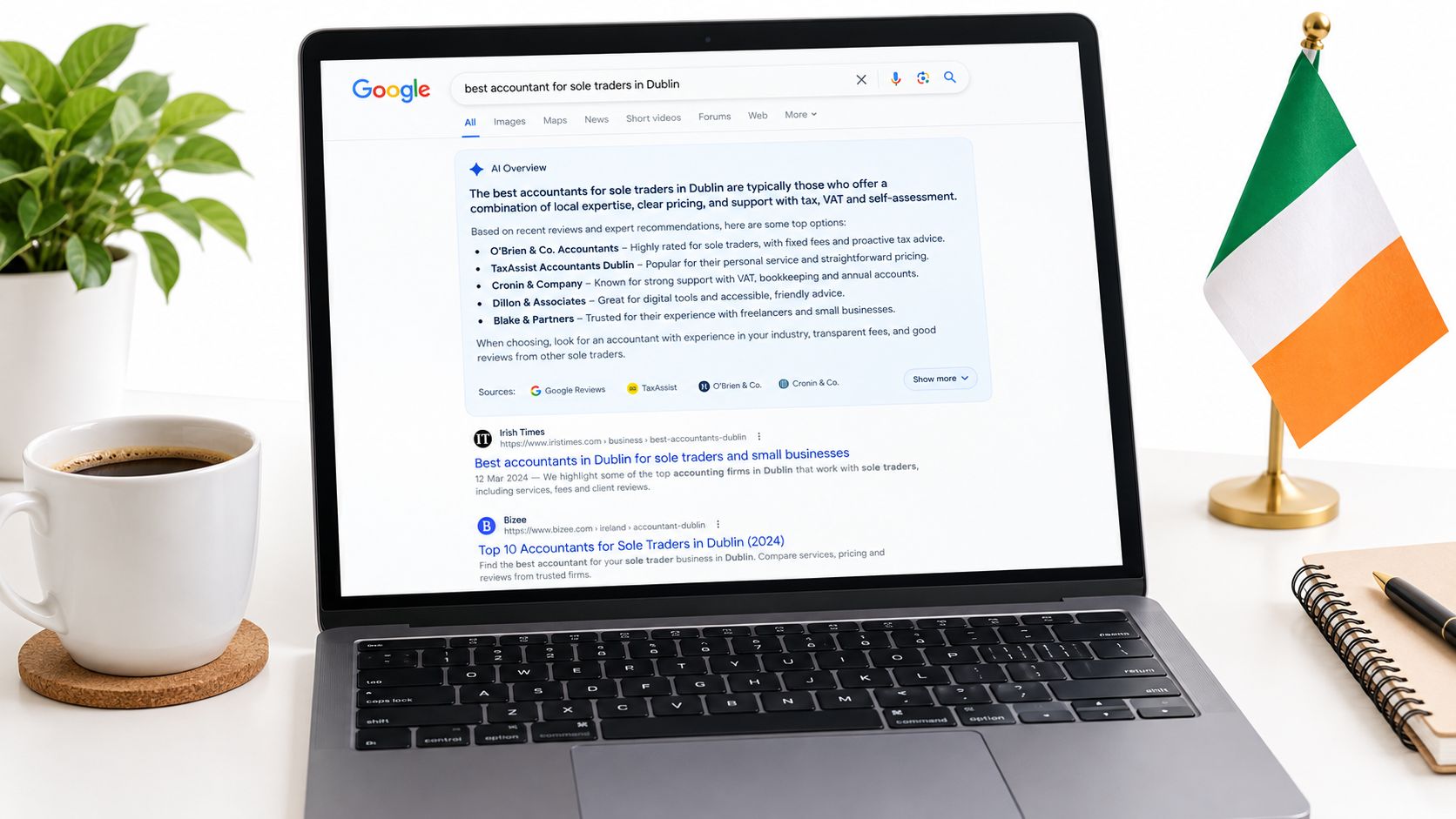
Why the first impression has changed
Your title tag and meta description still matter for the organic listing, but they no longer define the entire search experience. Google may extract a definition from one page, a comparison point from another and supporting evidence from elsewhere, then present those elements as a single answer.
That creates a different visibility question. Instead of asking only, “Are we ranking on page one?”, marketers need to ask:
Answer presence: Does the brand appear in the generated response?
Citation visibility: Does Google link to the relevant page as supporting evidence?
Follow-up relevance: Does the site answer the next question a searcher is likely to ask?
Commercial continuity: Can the visitor move from an answer to an enquiry, booking or sale?
Practical rule: Treat the AI Overview as a new layer above the result page, not as a replacement for the technical and content work that gets pages indexed.
The page no longer behaves like a list of ten results, so a 2019-style strategy is incomplete. Classic SEO still earns access to the search system, while answer-focused content helps Google understand, select and cite the business. That two-track approach is particularly important in Ireland, where the feature arrived in a market with established Google search habits.
What AI Search in Google Actually Is
The simplest analogy is a helpful librarian. Classic search points you towards shelves of books. AI search in Google reads across relevant shelves, prepares a plain-English summary and points you towards the pages that support it.
That summary is what Google calls an AI Overview. It's a generated response that can appear above traditional results for an eligible query. It may include explanatory text, links to sources, follow-up question chips, suggested searches, product information or other search features, depending on the query.
The terminology can feel more complicated than the user experience:
Search Generative Experience, or SGE, was Google's experimental name for generative responses in Search. The concept has developed into the AI Overview experience.
AI Overviews are the summary layer that appears within the familiar Google results page.
AI Mode is a more conversational search interface designed for deeper exchanges, follow-up questions and more complex exploration.
Gemini-powered features refer to the model capabilities Google uses across its AI experiences. They describe the underlying technology and product integration, not a separate organic ranking system.
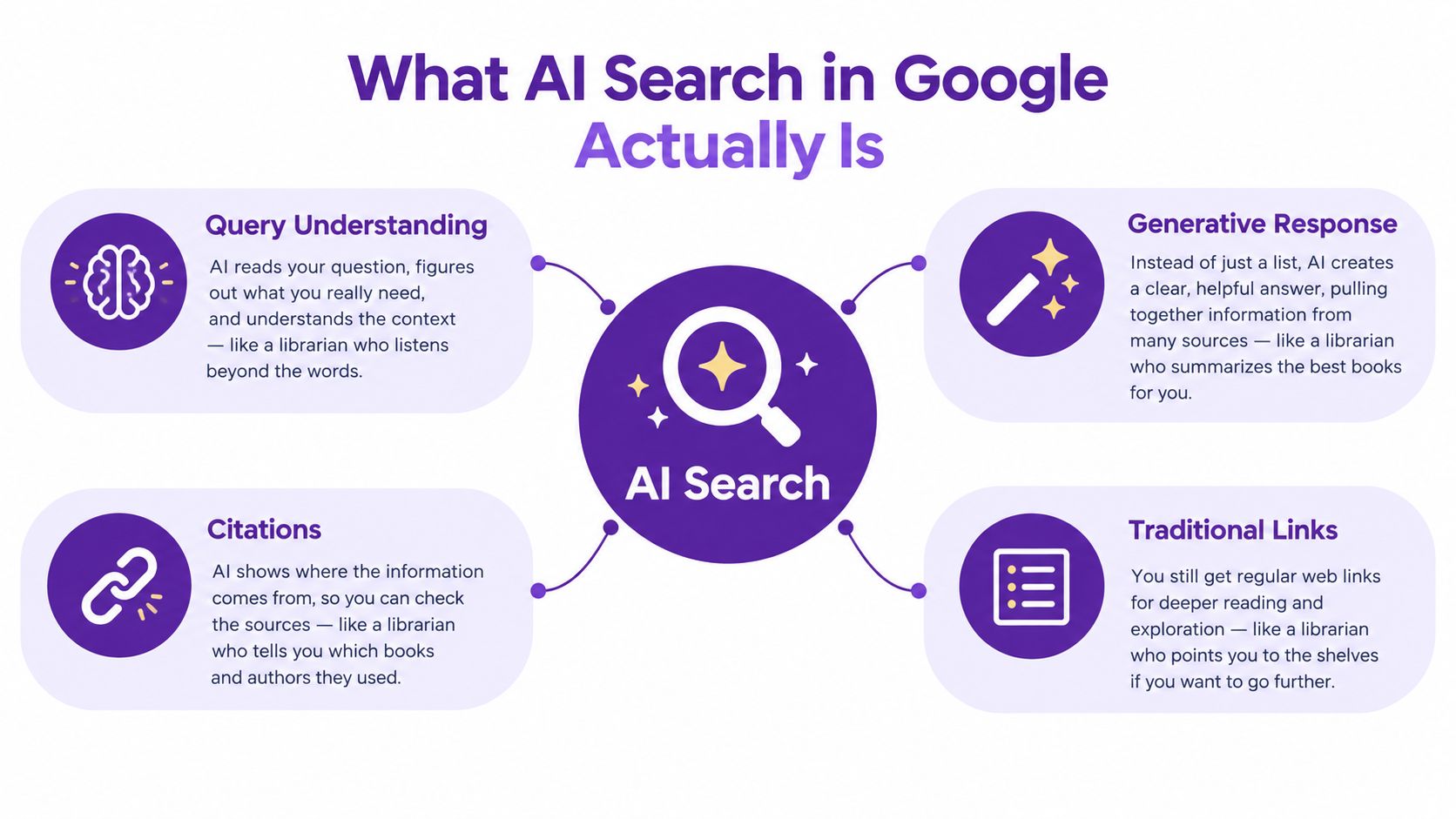
What the searcher sees
A user may start with a short question, then select a suggested follow-up such as “What does this cost?” or “Which option suits a small business?” Google can keep the conversational context and produce a more specific response. Source carousels and citations give the searcher routes to the underlying pages, although the initial answer may satisfy the immediate need without a click.
Product cards can appear when the query has shopping intent. Local elements may matter when the search involves services, locations or opening information. The exact presentation changes by query, device and feature availability, so marketers shouldn't design for one fixed screenshot.
The practical consequence is straightforward. Google is moving from returning links alone to returning assembled answers supported by links. A business page must therefore be discoverable, understandable and useful as evidence, not merely capable of winning a blue-link position.
How Google Builds an AI Overview Step by Step
Google doesn't publish a marketer-facing recipe that guarantees inclusion, and no page can force an AI Overview citation. It's more useful to think of the process as a series of gates that content needs to pass.
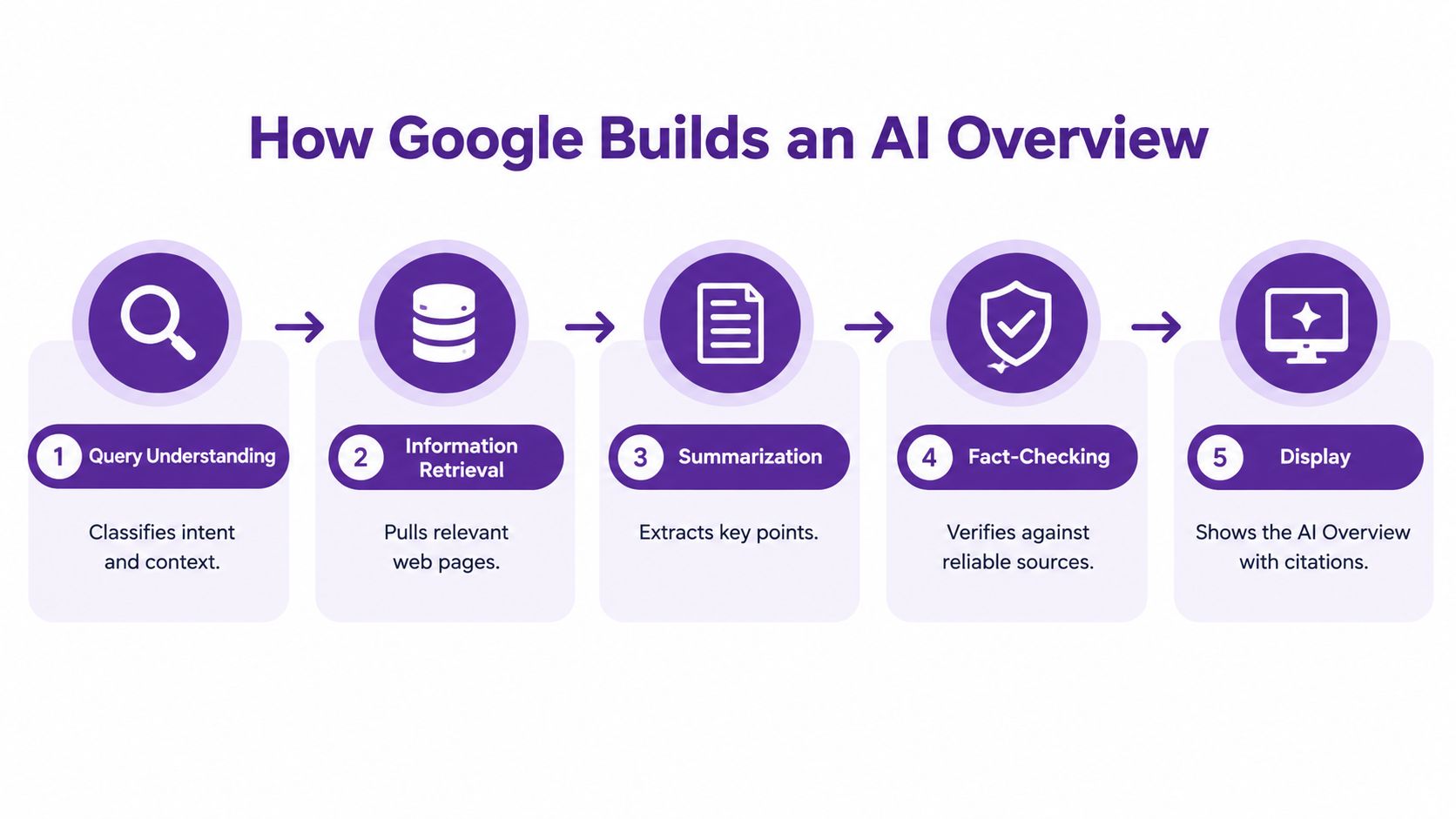
The five gates
Query understanding: Google interprets the searcher's intent, entities and modifiers. “Accountant Dublin sole trader” carries a location, service, audience and likely commercial purpose. A page with clear language about those same entities is easier to associate with the query.
Information retrieval: The system retrieves candidate pages and other information from its index. Crawlability, internal linking, useful page structure and established authority influence whether a page can enter that candidate set.
Summarisation: A generative model selects relevant points and composes an answer. Concise definitions, direct explanations and clearly separated sections give the system usable material rather than forcing it to interpret a long introduction.
Grounding and safety: Google applies quality, reliability and policy signals before displaying a response. Factual claims need support, especially where users could make financial, legal, health or purchasing decisions.
Presentation: The result is arranged with citations, follow-up prompts and any relevant product or local elements. A page can be useful at one stage but fail to become visible if its content is unclear, inaccessible or poorly matched to the final answer.
This is why technical SEO, structured data, factual writing and authority signals shouldn't sit in separate silos. They support different gates in the same system.
A clean page won't compensate for vague content. A well-written answer won't help if Google can't crawl or interpret the page. The strongest work connects both.
The model also needs a reason to cite your page. Original explanations, first-party evidence, clear authorship and a precise match to the query give it something more valuable than generic prose.
AI Search Compared With Classic Search and Rivals
The old blue-link page, Google's AI Overview, Perplexity and ChatGPT search all answer questions differently. The important distinction for marketers is not which interface sounds most advanced. It's where the user encounters the answer, how the source is credited and what action follows.
Interface | Where the answer sits | How sources appear | Marketing implication |
|---|---|---|---|
Classic Google Search | Across adverts, organic listings, maps and other result features | Individual results with titles, descriptions and links | Rankings, snippets, brand demand and click-through remain central |
Google AI Overview | Above the familiar result page | Supporting citations and source links within or around the summary | A page can earn visibility through inclusion in the answer as well as its organic position |
Perplexity | Answer-first interface that largely replaces a conventional SERP | Citations are integrated into the response | Source selection and answer relevance become highly visible |
ChatGPT search | Conversational response with follow-up interaction | Linked supporting sources may appear alongside the answer | Brand mention, authority and usefulness influence the next conversational step |
Google's advantage is continuity. AI Overviews sit above the established search page, so the searcher can still move into organic results, maps, shopping and other features. Perplexity and ChatGPT search feel more like answer environments, which changes how users browse and compare.
Google also retains the largest query environment, making its behaviour especially important for businesses that depend on search demand. That doesn't mean every query should be treated as an AI query. Transactional searches may still depend heavily on local results, product listings, adverts or conventional organic pages.
For teams working across platforms, the technical principles overlap but the measurement needs to differ. Microsoft AI search deserves its own monitoring rather than being treated as a simple extension of Google reporting.
The useful KPI isn't “AI” in the abstract. It's whether your brand is visible when a high-value prospect asks a question that could lead to revenue.
Classic SEO remains the foundation because candidate pages still need to be found and understood. Share of voice inside AI answers is the parallel metric worth adding to the monthly report, alongside rankings, clicks, qualified enquiries and assisted conversions.
Where Ireland Stands on AI Search Right Now
Ireland gives marketers a particularly clear reason to take this seriously. Google's search share in Ireland was reported at about 94% across all devices in a 2025 market summary, while the same Irish market overview from The Irish Times cited 5.22 million internet users in January 2025 and internet penetration of 98.9%. Those figures describe a market where changes to Google can affect everyday discovery at scale.
Google launched AI Overviews in Ireland on 25 March 2025, as documented in the same report. The feature therefore entered an established search environment rather than a market where Google was still trying to build habitual use.
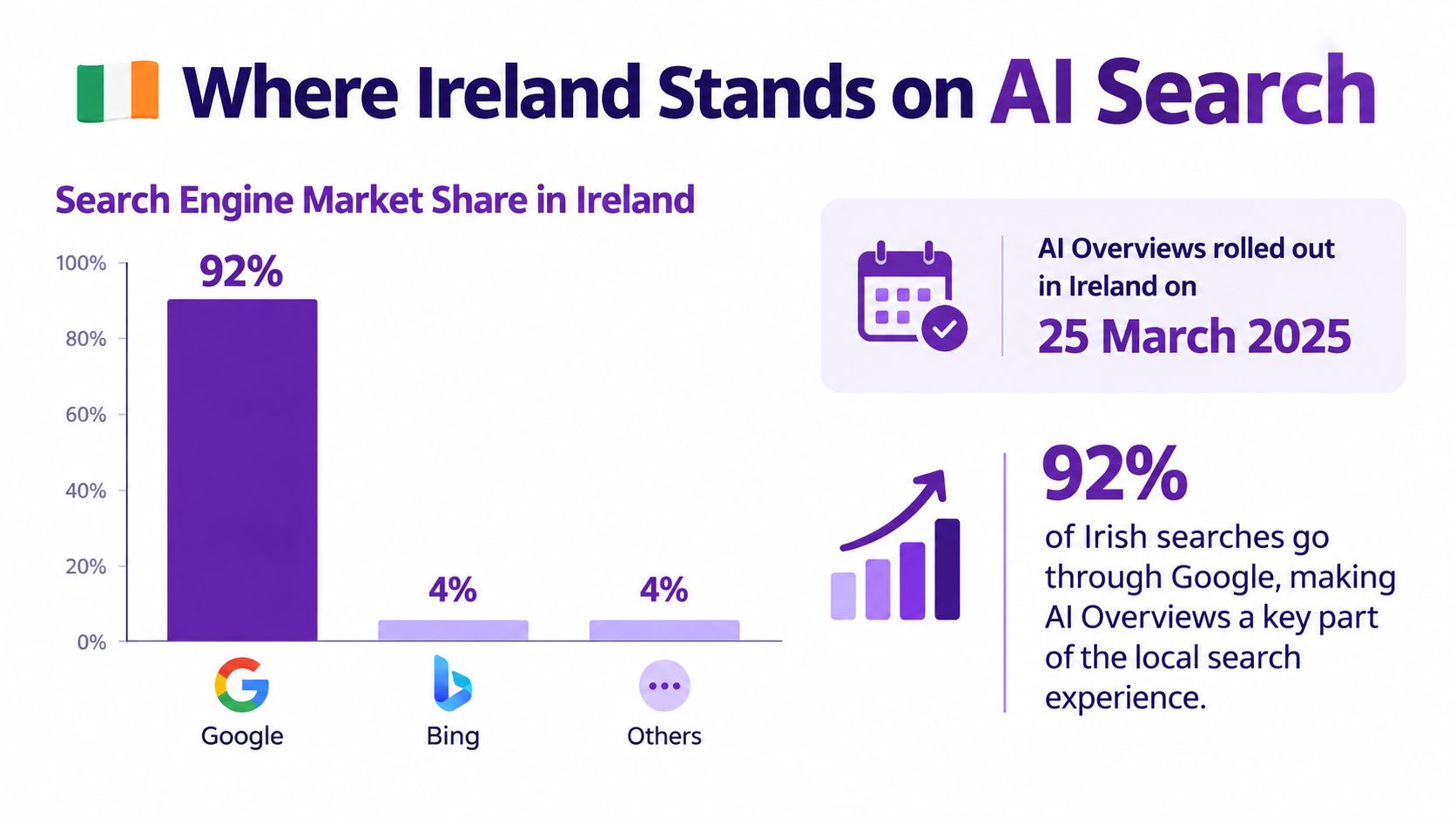
The Irish benchmark
An Ireland-focused analysis published in August 2026 reported that Ahrefs tracked 108 million AI Overview queries across 50 countries in November 2025. Within its Irish dataset, 12.00% of tracked queries triggered an AI Overview, based on 1.4 million keywords, with 168,000 keywords producing an overview, as detailed in the Ireland AI search analysis.
That source also placed Ireland 44th out of 50 countries for coverage. The result is neither a reason to ignore AI search nor evidence that traditional SEO has stopped working. Most tracked Irish queries in that dataset didn't trigger an overview, while a meaningful minority already did.
Irish search signal | Reported benchmark |
|---|---|
Google search share across all devices | About 94% |
AI Overview rollout | 25 March 2025 |
Tracked Irish queries triggering AI Overviews | 12.00% |
Irish keywords in the dataset | 1.4 million |
Keywords triggering an overview | 168,000 |
The analysis identified AI Overview exposure across informational and commercial-investigation searches, including topics such as tax, grants, regulations, software comparisons and travel. Those categories often involve explanation before action, which makes them natural candidates for an answer layer.
Irish SMEs still have room to influence how Google understands their brands. Clear service pages, authoritative local information and evidence-led answers can establish useful source material before competitors organise their content for the same questions. Irish AI search market share is a useful area to monitor, but each business should build its own query set rather than rely on a national average.
Why SEO Still Matters and Where AEO Fits
The “SEO is dead” reaction confuses a change in presentation with the disappearance of search fundamentals. Google still needs to discover pages, interpret their subject, assess their usefulness and connect them to user intent. Crawl access, internal links, structured data, quality content and authority signals remain relevant because they help determine which pages enter the information pool.
Answer Engine Optimisation, or AEO, focuses on being selected, cited or represented inside an AI-generated answer. It doesn't replace SEO. It adds a visibility objective that classic ranking reports don't capture.
Two tracks, one foundation
Classic SEO usually concentrates on elements such as:
Technical accessibility: Make important pages crawlable, indexable, fast and usable on mobile.
Page relevance: Align titles, headings, copy and internal links with the topic and intent.
Authority: Earn credible references and publish material that deserves to be cited.
Commercial usefulness: Give visitors a clear route to contact, compare, buy or enquire.
AEO adds a different emphasis:
Entity clarity: State who the organisation is, what it offers, where it operates and who it serves.
Answer-first writing: Put the direct response near the top, then provide context and detail.
Evidence: Support important claims with first-party information, credible sources and transparent methodology.
Machine-readable structure: Use appropriate structured data and well-labelled sections.
Author credibility: Show relevant authors, reviewers and qualifications where they apply.
A page can rank well without being the clearest source for a generated answer. Conversely, a concise answer block won't solve weak site architecture or absent authority. The work must address both conditions.
The relationship between SEO and AI search is best understood as a progression from eligibility to selection. SEO helps Google find and evaluate the page. AEO helps the page provide an extractable, trustworthy response.
Four principles survive feature changes:
Be the clearest answer.
Prove relevant expertise.
Structure content for people and machines.
Measure citations as well as clicks.
A blue-link ranking tells you where a page appeared. A citation tells you whether Google used the page to support an answer.
A Practical Playbook for Irish Marketers
An Irish SME doesn't need a speculative AI project. It needs a disciplined audit of the pages and questions that already matter commercially.
Technical work to ship first
Start with the pages that generate enquiries, bookings or sales. Check crawl access, canonicalisation, indexation, mobile experience, internal links and structured data. Use relevant , and markup where the page contains that information, and make sure the visible copy matches the markup.
Keep robots rules deliberate. Don't block important content from the crawlers and systems you want to understand it, but don't assume an file will compensate for weak information architecture or poor content. Add visible author details and reviewer information where expertise is material to the topic.
Content changes with commercial intent
Rewrite priority money pages so the first screen answers the central question. A strong opening usually includes:
A short answer: Summarise the service or recommendation in roughly 40 to 60 words, without hiding the conclusion behind scene-setting.
A clear definition: Explain what the offering is and who it suits.
Supporting detail: Cover process, limits, alternatives, location and decision criteria.
Evidence: Link to relevant first-party information and credible external sources.
A next step: Make the enquiry, booking or purchase action obvious.
Build supporting Q&A pages from real customer questions, Search suggestions and People Also Ask results. For an Irish audience, use local terminology and relevant context, including Dublin or regional service areas and prices in euros where the business publishes them.
Measurement that reflects the new page
Split reporting into conventional rankings and AI visibility. Track whether a monitored query produces an AI Overview, which brands and pages appear as citations, whether your answer is represented accurately and whether the resulting visit assists a conversion.
Run controlled content tests. Compare an answer-first introduction with a narrative introduction on similar pages, while keeping the offer and conversion path stable. Review the result through search visibility, engagement quality and commercial actions rather than one click metric.
Two simple rewrites illustrate the difference:
Before: “For years, businesses have faced complex challenges when choosing an accountant, and our team understands how difficult this process can be.”
After: “We help Dublin sole traders manage annual returns, bookkeeping and tax planning, with advice matched to the records and deadlines their business requires.”
The second version identifies the audience, location and service immediately. It gives Google and the reader clearer material to interpret.
Before: “There are many CRM options available, each with different features and benefits.”
After: “For a small Irish sales team, choose a CRM that handles lead stages, email activity and reporting without requiring a large implementation project.”
That opening answers the decision context first, then leaves room for a detailed comparison below it.
What to Stop, Start and Keep Doing
Stop treating average position as the primary success measure, writing long introductions before answering the question, blocking Google-Extended without testing the commercial impact and assuming that an AI Overview citation guarantees a visit.
Start auditing which money pages appear in Irish AI Overviews, adding answer-first blocks and appropriate FAQ markup, creating clear entity pages for the organisation and its authors, and recording visibility for specific prompts rather than relying on broad keyword averages.
Keep technical SEO hygiene, original research, first-party evidence, genuine customer stories and visible trust signals such as bylines, citations and reviewer credentials. These assets help both conventional search and generated answers because they make the business easier to understand and evaluate.
For the next 30 days, identify the commercial queries that matter and record their classic rankings, AI Overview presence and cited sources. Over the following 60 days, improve the priority pages and publish supporting answers. By 90 days, compare citation visibility with qualified enquiries and assisted conversions, then invest in the formats that produce useful commercial movement.
The one metric to watch this quarter is AI Overview citation share for your top twenty commercial queries. It won't replace rankings, but it will show whether your brand is becoming part of the answer layer where Irish prospects are already searching.
Scéaled helps Irish businesses improve visibility across Google AI Overviews and AI Mode through connected SEO, AEO, content, technical and measurement work. Visit Scéaled to discuss which commercial queries should lead your AI search plan this quarter.
Comments