SEO in Web Development: A Practical Guide for 2026

A stakeholder publishes a carefully researched service page, waits for enquiries, and finds that competitors with thinner content are still taking page one. The instinct is to rewrite the copy, add more keywords, or commission another article. Often, the page has a more basic problem: Google can't reliably crawl, render, or index what the team built.
That matters particularly in Ireland. Google held 94.01% of Ireland's search engine market in August 2026, while Bing held 3.51% and DuckDuckGo 0.93%, according to StatCounter's Ireland search market snapshot. On mobile, Google's share reached 97.85%, so technical decisions around mobile rendering, structured data, and crawlable architecture directly affect the platform most Irish businesses depend on.
Table of Contents
Core Technical SEO Fundamentals Every Developer Owns - Crawl permissions and index control - Canonicals and duplicate routes - Redirects and migration control
JavaScript Rendering and SEO Trade-Offs - Choose rendering per route - Validate the rendered result
Site Architecture and URL Design That Scales - Control ecommerce complexity - Build silos around user intent
Core Web Vitals as Performance Engineering - Diagnose by page group
Structured Data and Answer Engine Readiness - Generate from content, not strings
Accessibility, CI/CD, and Shipping SEO Safely - Put checks where code changes happen
Measuring SEO Outcomes Beyond Rankings - Track SEO debt beside product debt
Why Technical SEO Is a Development Problem
A service page can look complete in a browser and still fail to compete in Google. Before ranking matters, Google needs to discover the URL, retrieve and render its content, then decide whether that content belongs in the index. A failure at any stage leaves strong copy unable to perform.
I saw this after a technically sound redesign. The new site loaded its main text only after a client-side request, a staging directive reached production, and tracking parameters created several versions of one route. The copy team saw a finished page. Search systems encountered incomplete content, a blocked directive, or competing URLs.
Engineering rule: Never assess an SEO issue from the browser view alone. Inspect the HTTP response, rendered DOM, status codes, directives, canonical URL, and internal links.
Mobile usage exposes these faults quickly. An Irish user may reach a service page on a phone, wait for JavaScript to load the useful content, then leave before contacting the business. A polished desktop preview does not reveal that failure. Performance, rendering, and conversion need instrumentation across real templates and devices, not a visual check at the end of a project.
The same principle applies to routing and deployment. A developer determines whether a page returns useful HTML, whether a redirect resolves directly, whether the canonical identifies the intended route, and whether the next commercial page is reachable through internal links. SEO belongs in server configuration, templates, build output, and release checks because those layers decide what search systems can access and process.
A practical review should trace one important URL from request to conversion. Record the response status, HTML content, rendered output, indexing directive, canonical, linked destinations, and the point where a user can enquire or buy. This exposes the trade-off between a technically elegant implementation and one that search engines and customers can use.
Teams needing a structured review can use Scéaled's SEO programme to connect crawling, indexing, site structure, and commercial priorities. SEO in web development is part of the system, not a final checklist added after launch.
Core Technical SEO Fundamentals Every Developer Owns
The fundamental surfaces are small enough to define and important enough to test in every release. Treat each one as part of the application contract.
Crawl permissions and index control
controls crawler access to paths. It isn't a universal removal mechanism, and a disallowed URL can still be known to a search engine through external references. Use it to protect unnecessary crawl paths, such as internal search results or development endpoints, while using when a reachable page must stay out of the index.
Generate XML sitemaps from the canonical URL set. A sitemap should help search engines discover indexable, preferred URLs, not advertise every route your CMS happens to produce. Keep sitemap generation close to the publishing model so deleted, redirected, and draft pages don't remain listed.
Meta robots directives should come from typed page states. Product, article, campaign, search, preview, and account templates shouldn't each improvise their own tags. A single incorrect default can put an entire page type outside the index.
Canonicals and duplicate routes
Suppose a product page is available at , , and a staging path accidentally exposed through a proxy. The canonical element should point from each tracking or duplicate variant to the preferred production URL, while the preferred page should carry a self-referencing canonical. Canonicals are signals, not force fields, so internal links, sitemaps, redirects, and visible content should agree.
Paginated collections need a deliberate route model. Don't canonicalise every page in a series to the first page if later pages contain unique products or articles. Make the paginated URLs crawlable, link them consistently, and keep filtered combinations out of the index when they don't represent useful standalone search destinations.
Redirects and migration control
Use a 301 redirect when a URL has permanently moved. Use a 302 when the move is temporary and the original URL may return. Avoid chains such as old URL to intermediate campaign URL to final page. Map the old route directly to the relevant destination, preserve query behaviour where it matters, and test status codes in CI.
Issue | Engineering Fix | What It Protects |
|---|---|---|
Development paths indexed | Environment-specific , access control, and deployment tests | Index cleanliness |
Tracking URLs multiply | Consistent canonical generation and controlled parameter handling | Duplicate control |
Old URLs chain through several hops | A versioned redirect map with direct destinations | Crawl efficiency and user journeys |
Thin internal search pages rank | , controlled links, and excluded sitemap entries | Search quality |
Multilingual pages conflict | Complete, reciprocal annotations with valid language and regional values | Regional targeting |
Sitemap contains stale routes | Generate from published, canonical records | Discovery accuracy |
Hreflang belongs in the route and locale model, not in a spreadsheet maintained after launch. Each language or regional version should reference the others and itself, with a fallback where appropriate. Before a migration, store the redirect map in the repository, review it like code, and keep the approval path clear. These decisions ship in templates, middleware, and build pipelines, not in a marketing PDF.
JavaScript Rendering and SEO Trade-Offs
The useful question isn't whether a framework is “SEO-friendly”. It is: what does the crawler receive on the first request, and what remains after rendering?
Server-side rendering sends HTML generated for the request. Static site generation sends prebuilt HTML. Incremental regeneration combines cached output with controlled refreshes. Client-side rendering usually sends a shell and asks the browser to fetch and assemble the main content. Hydration then attaches JavaScript behaviour to HTML that already exists.
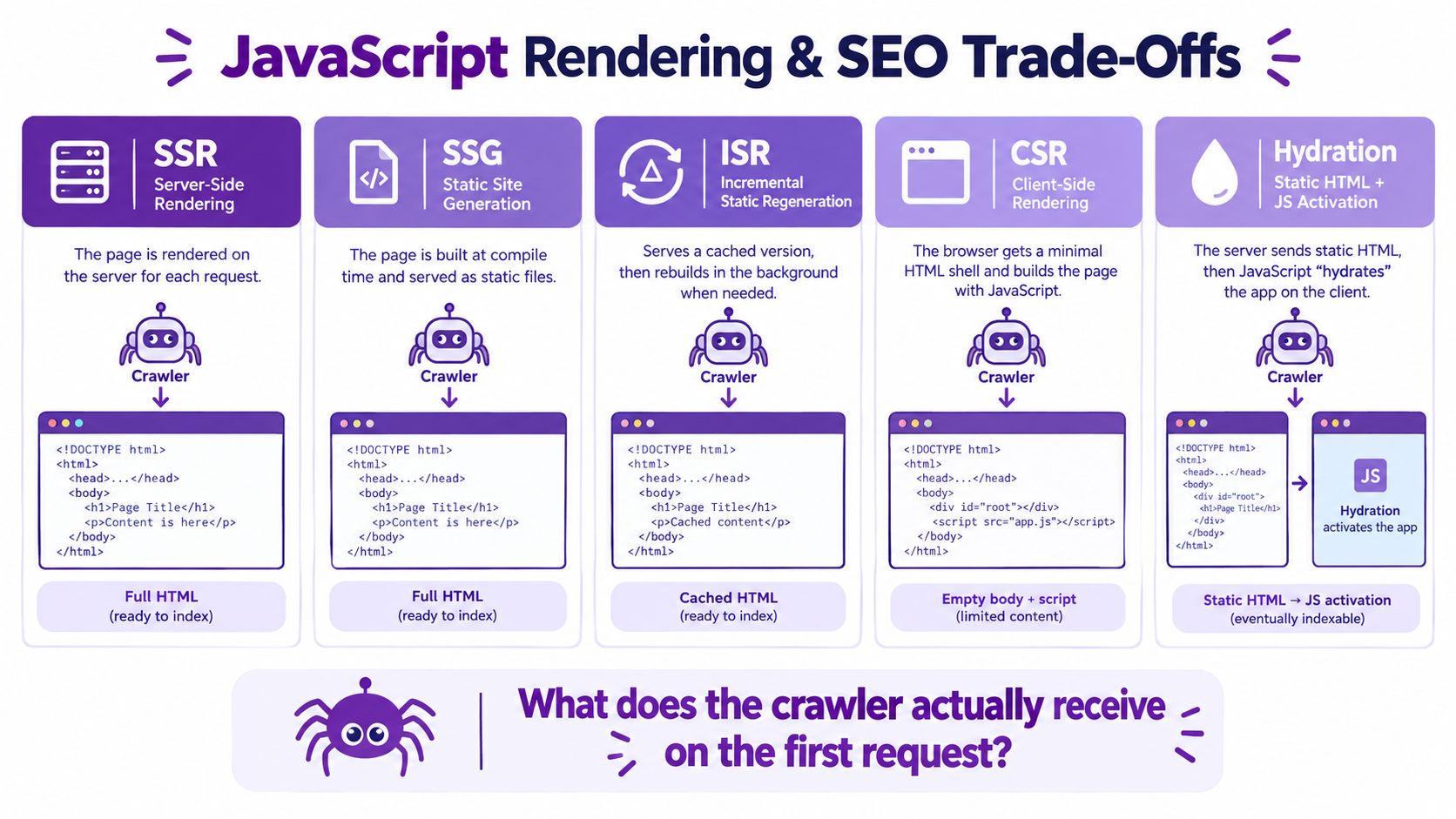
Google can process JavaScript, but deferred rendering adds work and time between discovery and a fully understood page. A browser may eventually display a complete product description, while the first response contains little more than a root element and script references. That gap affects indexing reliability and makes failures harder to diagnose.
Choose rendering per route
SSG usually wins for stable marketing pages, articles, and documentation. It produces crawlable HTML quickly, reduces server work, and gives teams a predictable performance baseline. SSR is appropriate when the page depends on request-time data, a frequently changing catalogue, or route parameters that must produce current content.
ISR is useful when a large site needs mostly static delivery with controlled regeneration. CSR can still suit authenticated dashboards and application screens that aren't intended to rank. The mistake is applying one rendering strategy globally because the framework makes it convenient.
In Next.js, a public service route can be statically generated while a catalogue route uses server rendering or revalidation. Nuxt provides a similar route-level choice through its server and static generation capabilities. Keep the initial HTML meaningful, then keep hydration focused. A large client bundle can consume CPU on mid-range phones, delay interaction, and compete with the content needed for LCP.
For teams using a visual builder or CMS, the same test applies. This practical guide to SEO in Wix is useful when the platform abstracts rendering decisions, because the output still needs inspection rather than assumptions.
Validate the rendered result
Use Search Console's URL Inspection tool on important routes and check:
The indexed URL and selected canonical.
The live test's rendered HTML and visible primary content.
Mobile usability and detected enhancements.
Whether links, headings, structured data, and key navigation appear after rendering.
Whether scripts fail when consent, API, or authentication conditions change.
The deployment decision should follow the output, not the framework label.
Site Architecture and URL Design That Scales
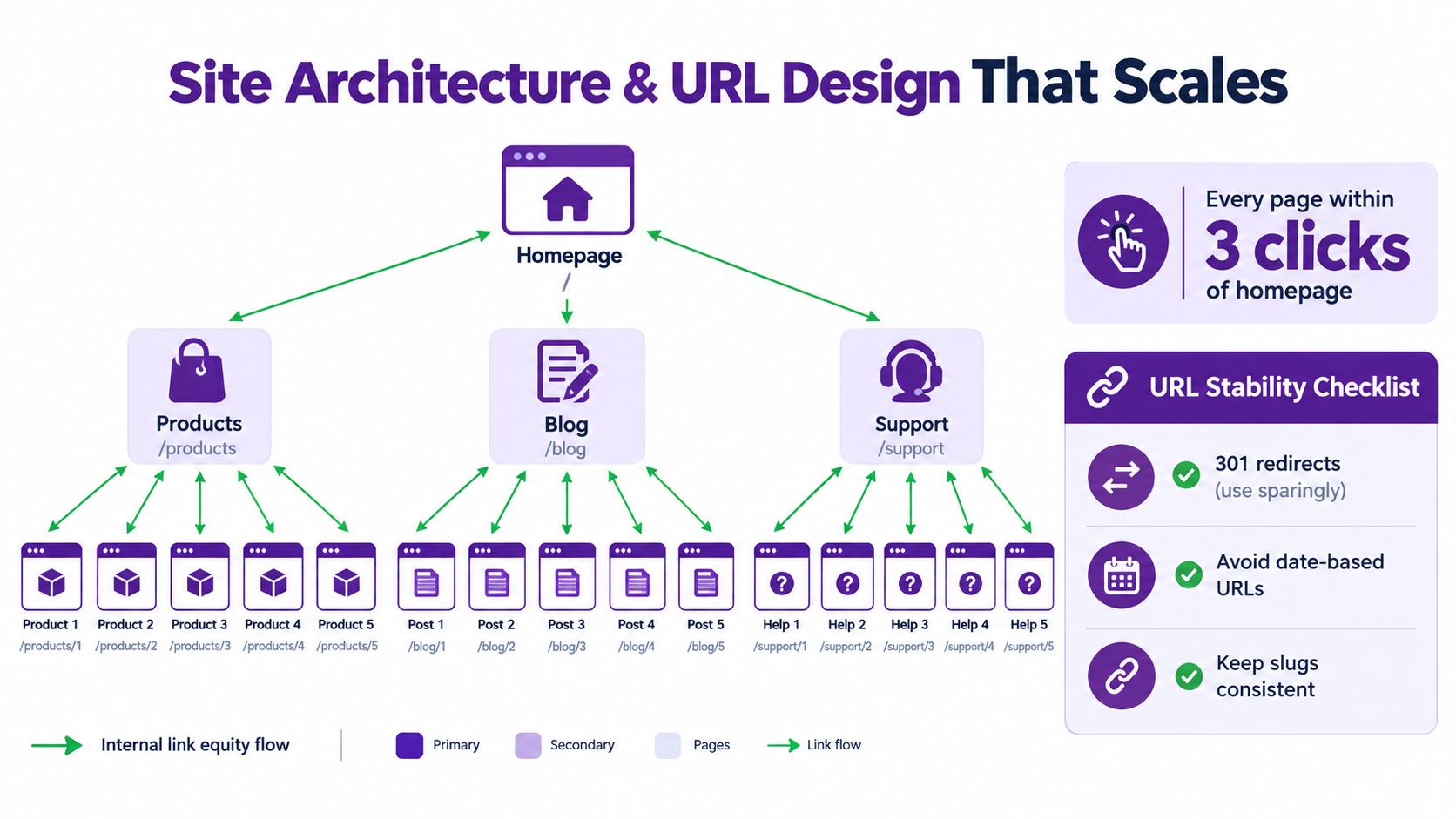
Architecture determines how users and crawlers move through a site. A page buried behind several category layers receives less internal prominence and may be discovered less reliably than a page linked directly from a relevant hub. For most commercial sites, aim for a structure where important pages are reachable within a small number of clicks from the homepage, while preserving meaningful topical relationships.
Use lowercase, human-readable, hyphenated slugs. Keep URLs stable, remove tracking parameters from internal links, and avoid session identifiers. A slug such as tells both the user and the crawler what the route represents. A URL containing opaque IDs and campaign parameters creates unnecessary ambiguity and migration risk.
Control ecommerce complexity
Irish ecommerce sites often expose combinations of size, colour, brand, price, availability, and sorting through query parameters. Left unmanaged, faceted navigation can generate a vast collection of near-duplicate URLs. The fix isn't to block every parameter automatically. Decide which filtered views deserve search visibility, then make the rest canonicalise, noindex, or remain out of crawl paths according to their purpose.
Pagination needs one coherent model. Link to the next and previous collection pages with ordinary crawlable links, give each indexable page a stable canonical, and don't create a loop where every page claims the first page as its preferred version. Check that filters don't remove the only links leading to deeper products.
Build silos around user intent
A SaaS site might organise routes as:
for core product capability.
for connected tools.
for guides and implementation material.
for documentation and troubleshooting.
for commercial proof and use cases.
Breadcrumbs reinforce this model in both navigation and structured data. Internal links should connect a guide to the relevant feature, integration, or support article, rather than leaving content in an isolated blog archive. The route folders, CMS content types, breadcrumb logic, and sitemap generator should all use the same taxonomy. That shared model keeps information architecture aligned as the product grows.
Core Web Vitals as Performance Engineering
Core Web Vitals belong in the release process, not on a marketing checklist. LCP, INP, and CLS measure different parts of the browser experience, with passing thresholds of under 2.5 seconds, under 200 milliseconds, and under 0.1 respectively, as documented in Google Search Console's Core Web Vitals guidance. These thresholds give developers a practical budget for protecting crawl-to-conversion journeys on mobile.
LCP records when the largest meaningful element becomes visible. On an SME landing page, that may be the hero image, headline block, or product panel. INP measures responsiveness across interactions, so a heavy navigation menu, form, or consent interface can reveal JavaScript problems that a static load test misses. CLS records unexpected movement, often caused by images, adverts, fonts, embeds, or carousels without reserved space.
An Ireland-focused audit of 100 SME websites found an average mobile load time of 4.8 seconds, with only 12 sites passing Core Web Vitals on mobile, according to Nexora's Irish SME website audit. The pattern points to template, hosting, and CMS decisions alongside page content.
Diagnose by page group
Start with Search Console's Core Web Vitals report. Grouped URL data can show whether an issue belongs to a template, device class, or route family. Compare that evidence with CrUX field data, then reproduce the affected journey with Lighthouse, WebPageTest, and real devices over realistic mobile connections.
Metric | Good Threshold | Common Cause | Engineer Fix |
|---|---|---|---|
LCP | Under 2.5 seconds | Oversized hero asset, slow server response, render-blocking CSS | Preload the correct image, serve responsive formats, reduce critical-path work |
INP | Under 200 milliseconds | Large client bundle, long event handlers, third-party scripts | Code-split, defer non-critical JavaScript, break up long tasks |
CLS | Under 0.1 | Missing image dimensions, font swaps, dynamic embeds | Reserve layout space, define dimensions, use stable font metrics |
Fixes should match the failing page group. Compress and resize images, remove unused plugins, defer chat and analytics scripts, and stop fonts from changing layout after paint. Test consent tools, forms, and menus as users operate them. A carousel may address a content request while introducing movement, extra JavaScript, and interaction cost.
Set the budget as a release gate. A pull request that worsens a critical template needs an explicit decision, just like a slower API endpoint or a larger database query. Performance earns its place when it preserves the mobile path from landing page to form completion or checkout, rather than producing a strong lab score that Irish users never experience.
Structured Data and Answer Engine Readiness
Structured data is a typed interface between the page and machines. Developers should generate it from the same content model that renders the visible page, inject JSON-LD during rendering, validate it before deployment, and monitor it after release.
For an SME or B2B site, useful schema types often include Organization for brand identity, BreadcrumbList for hierarchy, Article for editorial content, Product for genuine product pages, FAQPage where the questions and answers are visibly present, and LocalBusiness where a local entity and its details are accurately represented.
Generate from content, not strings
A typed model might provide a page title, canonical URL, author identity, publication date, product offers, breadcrumb items, and organisation details. A server-side builder can then assemble the correct JSON-LD for that route. This prevents a template from claiming an article is a product, or a page from publishing stale business information copied into hardcoded markup.
Use stable identifiers when entities recur. An article can reference its publisher and author, while a breadcrumb can connect the page to its parent section. That graph is easier to maintain than disconnected snippets scattered through templates.
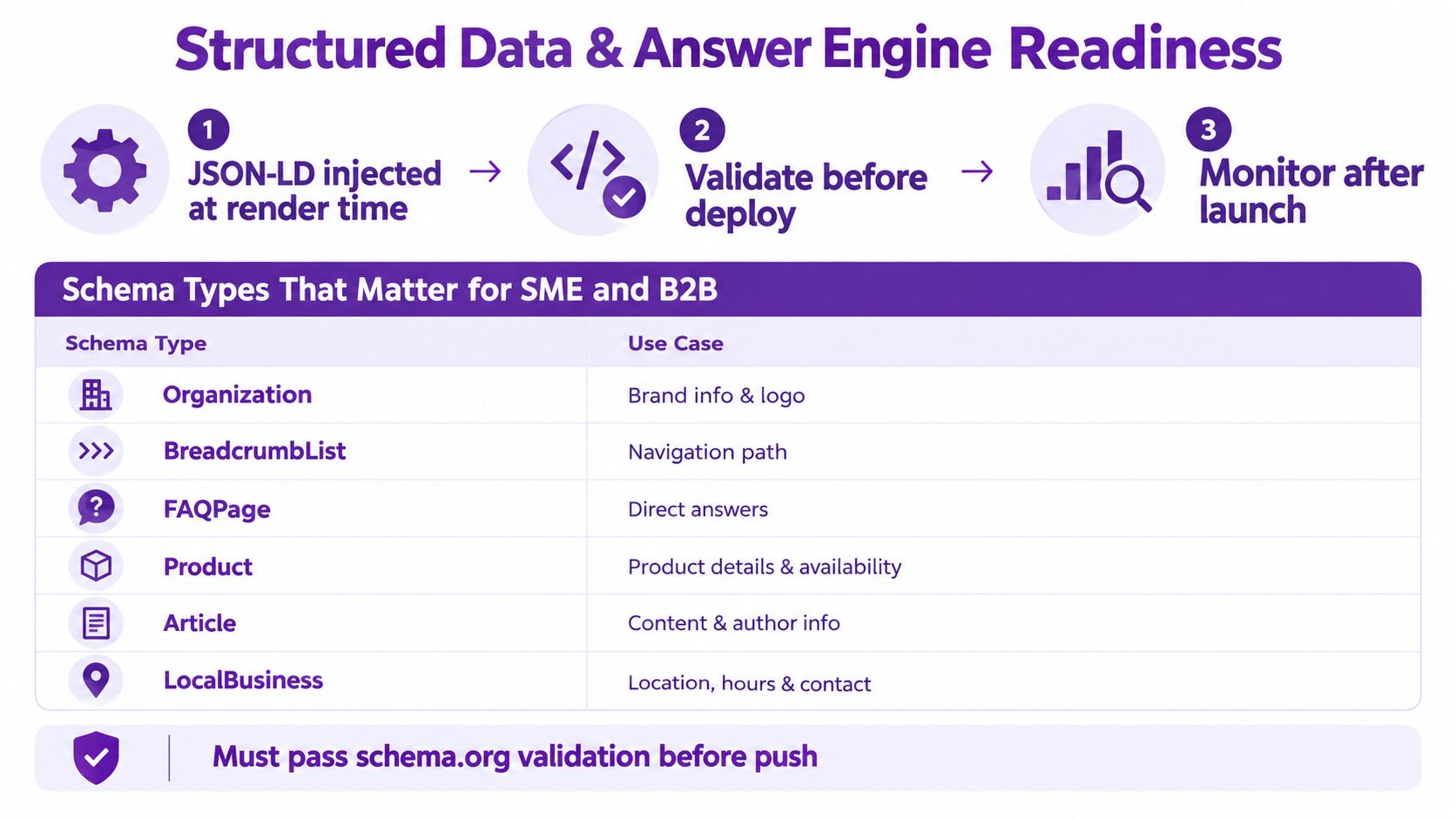
Validate JSON-LD with Google's Rich Results Test and the Schema.org validator. Put schema validation into CI, but also compare the payload with rendered content after launch. A syntactically valid object can still be semantically wrong.
The same discipline supports answer engine readiness. Search results, Google's AI Overviews, ChatGPT, and Perplexity need clear entities, relationships, headings, and direct explanations. Structured data won't guarantee inclusion, and it can't compensate for thin or contradictory content. It does give machines less work to do when identifying what a page is about.
Scéaled's SEO and AEO work is relevant where a team wants technical structure and content clarity considered together. Avoid schema theatre. Don't add nested types that aren't supported by visible page content, and don't mark up every possible property just because the specification allows it. Accuracy beats complexity.
Accessibility, CI/CD, and Shipping SEO Safely
Accessibility and SEO depend on the same engineering foundation: semantic, stable HTML that browsers, assistive technology, and Google can interpret consistently. During the 2025 monitoring period, Ireland's National Disability Authority reported that the average accessibility score for websites in simplified review rose from 46.1% to 55.25%, while pages with no errors fell from 58.9% to 47.87%, as summarised in Digital Bridge's Ireland SEO guidance. The figures show why averages are not a release criterion. Individual templates can still ship broken labels, poor keyboard flow, or heading structures that weaken both usability and crawlable meaning.
The European Accessibility Act began applying across the EU on 28 June 2025 and was transposed into Irish law. Accessibility therefore belongs in component design and deployment controls, not only in a late review. A shared component with an unclear name, missing focus state, or unstable markup can affect every route that inherits it, including mobile journeys where Irish users often search and convert.
Put checks where code changes happen
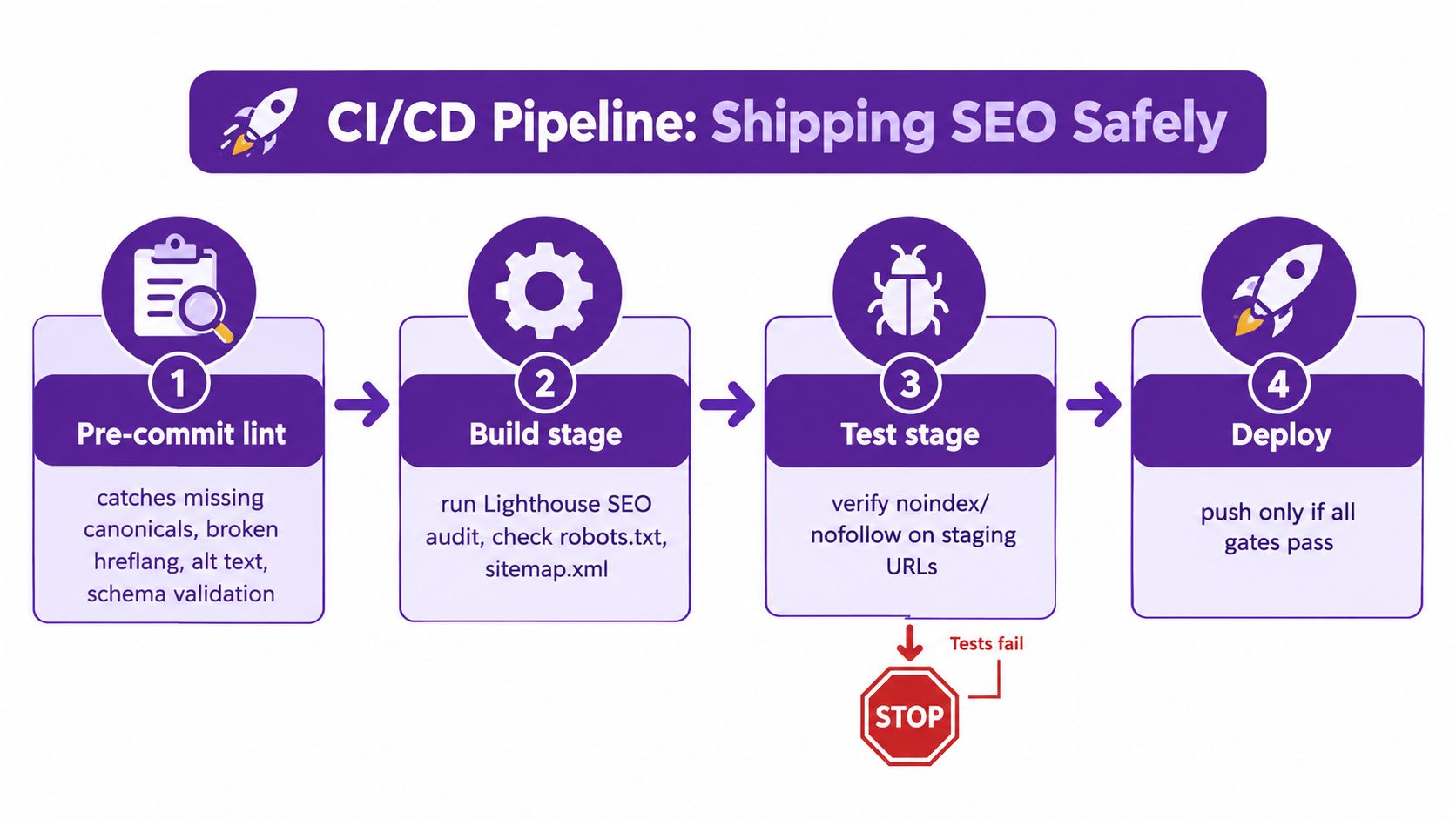
A pipeline should test the paths that can damage crawl, rendering, accessibility, or conversion:
Pre-commit linting: Flag missing titles, canonicals, alternative text, broken locale pairs, invalid links, and malformed schema payloads.
Build verification: Generate and inspect , XML sitemaps, route manifests, and production canonical URLs.
Preview testing: Protect preview deployments with , authentication, or equivalent controls so unfinished routes cannot enter Google.
Accessibility gates: Run axe-core and pa11y against representative templates. Check contrast, focus order, landmarks, form labels, and keyboard access.
Performance budgets: Run Lighthouse CI and compare field-informed targets for LCP, INP, and CLS before merge.
Release checks: Crawl the deployed environment, inspect important rendered routes, and confirm that production has no staging directives.
The runbook needs named owners. Record who approves a change on launch day, document rollback for a bad redirect, and keep the redirect map in the repository rather than one engineer's notes. Store fixtures for a service page, article, product page, filtered collection, and local landing page.
A release is safe when the team can prove what crawlers receive and reverse a bad change without guesswork.
Measuring SEO Outcomes Beyond Rankings
Rankings are a useful leading signal, but they aren't the commercial result. A developer's reporting layer should connect what search engines can access with what users do and what the business values.
Build the measurement model in three layers:
Layer | Primary Metrics | Tooling |
|---|---|---|
Crawl health | Indexed pages, excluded URLs, soft 404s, redirect errors, rendered content coverage | Google Search Console, server logs, scheduled crawls |
Engagement | Organic landing sessions, engaged visits, form starts, scroll behaviour, calls, bookings | GA4, consent-aware event tracking, Looker Studio |
Commercial outcome | Qualified enquiries, completed purchases, pipeline influence, lead quality | CRM, ecommerce platform, GA4, closed-loop reporting |
Search Console should feed a regular data pipeline so teams can compare clicks, impressions, queries, landing pages, and device categories over time. GA4 needs meaningful events rather than a generic pageview: a qualified form submission, phone interaction, booking completion, checkout milestone, or document request should have a defined name and owner.
Segment the dashboard by device and relevant Irish locations, such as city or service area, when the business sells locally. A national average can hide a broken mobile form or a weak landing page for an important commercial region. Keep the definitions visible, particularly for “qualified lead”, so marketing and sales don't interpret the same event differently.
Track SEO debt beside product debt
Create an SEO debt register in the same backlog as feature work. Each item should record the affected route group, crawl or render symptom, user and commercial risk, likely fix, owner, and validation method. “Improve technical SEO” isn't actionable. “Remove client-side rendering from public integration pages and inspect rendered HTML after deployment” is.
Review the register alongside roadmap commitments. Removing a redirect chain may be more valuable than publishing another article, while improving a slow form route may matter more than moving a keyword position. The team should be able to explain each trade-off in terms of discovery, user friction, qualified demand, or revenue.
A quarterly technical SEO report can then prioritise fixes rather than repeat an audit checklist. It should show what changed, which URL groups improved, what remains blocked, and whether organic visitors complete the actions that justify the investment. That is how SEO in web development becomes an engineering discipline with a business feedback loop.
Scéaled helps Irish SMEs and growth teams connect technical SEO, content, AEO, and conversion measurement, including audits of crawling, indexing, speed, mobile usability, redirects, and structured data. Visit Scéaled to discuss a practical programme that turns website improvements into measurable qualified demand.
Comments