AI Search Microsoft: Products, Differences, and Adoption

You search your own brand in Bing before a client meeting and find a paragraph answering the query before the familiar blue links. The answer mentions your category correctly, but the citations point to competitors you've never outranked for the most important terms. Your brand is visible, yet it isn't controlling the explanation.
That's the practical starting point for AI search Microsoft. The consumer layer, built around Copilot and Bing, changes how people discover businesses. The enterprise layer, built around Azure AI Search and Microsoft Search, changes how employees and applications find information. They're related, but they aren't interchangeable products, and treating them as one system leads to poor SEO priorities, confused technology decisions, and wasted media budget.
Ireland deserves particular attention. Microsoft says 48.4% of Ireland's working-age population used AI in Q1 2026, an increase of 3.8 percentage points from the previous quarter, in its AI Diffusion report for Ireland. Microsoft also lists Ireland among the countries where its consumer Copilot service is available, while Copilot Search in Bing was announced as available worldwide except Russia and China in Microsoft's Copilot availability information.
For an Irish SME or mid-market team, the response isn't to rebuild the entire marketing stack. It's to decide which Microsoft surface matters, make content easier to cite, assign the right internal owner, and test commercial impact over a focused rollout.
Table of Contents
The Moment Your Brand Becomes an AI Answer - Separate the public surface from the private engine
How Copilot Search in Bing Actually Works - The retrieval and answer sequence
Copilot, Bing Chat, and Copilot Search Compared - Copilot vs Bing Chat vs Copilot Search
Azure AI Search and Microsoft Search for Enterprise Teams - Azure AI Search vs Microsoft Search at a Glance
What Microsoft AI Search Means for SEO and AEO - Make pages easy to quote - Measure presence, not just position
Paid Media on Microsoft Advertising in an AI Search Era - Change the creative to match the answer environment
A 90-Day Adoption Plan for Irish Businesses - Sprint 1, days 1 to 30 - Sprint 2, days 31 to 60 - Sprint 3, days 61 to 90
Common Questions and a One-Page Decision Framework - Questions a Dublin marketing director will ask
The Moment Your Brand Becomes an AI Answer
The first reaction is usually tactical. The marketing manager checks the page that appeared, asks why the company wasn't cited, and sends the screenshot to the agency. That reaction is understandable, but it misses the bigger shift. Copilot Search isn't just adding a chatbot beside Bing. It creates an answer layer that can interpret a query, combine information from multiple pages, and present a new summary with linked sources.
Microsoft describes Copilot Search in Bing as a search experience that combines indexed results with large and small language models, matches content from millions of sources, and returns an AI-generated results layout with citations and follow-up exploration. The user may still visit a website, but the first decision happens inside the answer.
The commercial question has changed from “Are we ranking?” to “Are we being selected to explain the category?”
That distinction matters for a Dublin professional services firm, a B2B software company, and an e-commerce operator alike. Traditional SEO still determines whether Microsoft can discover and retrieve your pages. AEO, or answer-engine optimisation, adds another requirement. Your content needs to contain clear, self-contained passages that can be trusted and reused in an answer without losing meaning.
Separate the public surface from the private engine
Copilot in Bing is a consumer discovery surface. It influences how prospects research suppliers, compare products, understand problems, and decide which websites deserve a visit. The relevant work sits with marketing, content, SEO, and paid media.
Azure AI Search is enterprise infrastructure. Developers use it to retrieve information from an organisation's own sources and supply relevant material to applications, internal copilots, and customer-facing assistants.
Microsoft Search is the findability layer inside Microsoft 365. It helps users locate work information across services such as SharePoint, Teams, and other Microsoft 365 environments. It isn't the same thing as optimising a public website for Copilot citations.
For a team of five to fifty people, the sensible plan is narrow. Protect branded visibility, improve the pages that answer valuable commercial questions, and choose one internal search or Copilot use case that has a clear owner. Don't buy enterprise architecture before you know whether the business problem is public discovery, internal findability, or a custom application.
How Copilot Search in Bing Actually Works
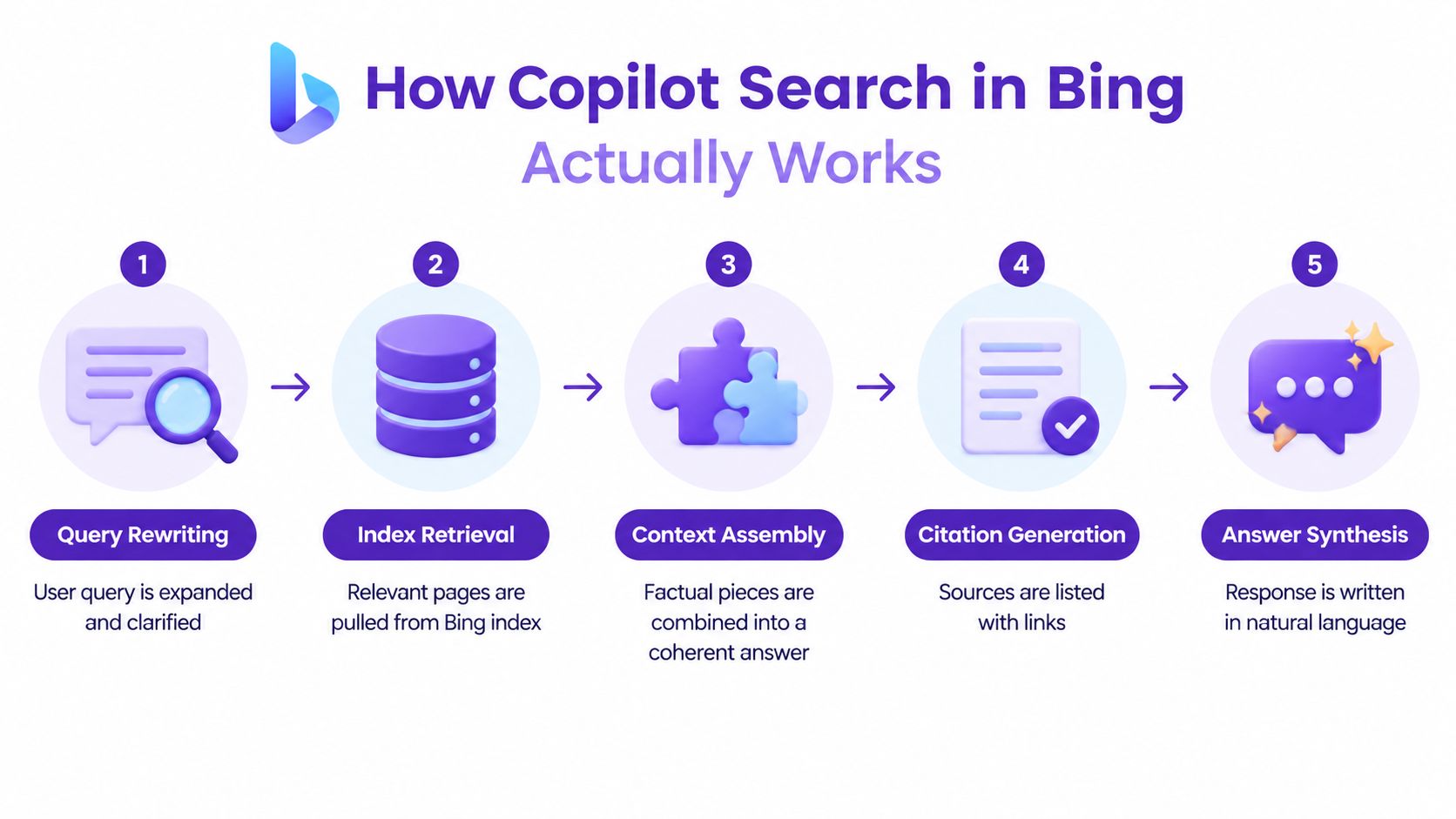
Think of Copilot Search as a librarian working with a research assistant. The librarian has access to Bing's index and knows where to look. The research assistant interprets the question, combines useful passages, and writes a readable response. Microsoft's introduction to Copilot Search in Bing describes this as a generative search layer that blends Bing results with language models, citations, and follow-up exploration.
The retrieval and answer sequence
Query rewriting A short or ambiguous query can be expanded into a more useful interpretation. Someone searching “Microsoft AI search for Irish business” may really be asking about availability, SEO implications, regional deployment, or enterprise implementation. The system needs to resolve that intent before it can gather useful material.
Index retrieval Bing retrieves pages that appear relevant to the interpreted query. Ordinary technical SEO still matters. If a page can't be crawled, understood, or considered authoritative, it has little chance of entering the evidence pool.
Context assembly The system selects passages and combines them into a working set of facts. It isn't necessarily reading every page in full. Clear headings, direct answers, consistent terminology, and well-organised supporting detail make it easier for a system to identify usable content.
Citation generation The answer includes source links so the user can inspect the underlying pages. A citation is valuable visibility, but it's not the same as a visit. Your page may influence the buyer's understanding even when the user doesn't click immediately.
Answer synthesis A language model turns the retrieved material into natural language. Microsoft's orchestration approach coordinates search and generation, while grounding comes from the retrieved web content rather than from an unsupported free-form response.
This is why AI search problems affecting visibility often begin with content that was written for a page, not for extraction. A polished article can still be difficult to quote if its answer is buried, its terminology changes from paragraph to paragraph, or its claims have no visible support.
The practical takeaway is straightforward. Don't write as if the page must be read from top to bottom before it becomes useful. Give each important question a compact answer, then provide the detail that proves and qualifies it.
Copilot, Bing Chat, and Copilot Search Compared
The names create unnecessary confusion. Bing Chat was the early conversational experiment inside Bing. Copilot became Microsoft's broader assistant brand across the web, Windows, and Microsoft 365. Copilot Search is the generative answer experience integrated into Bing's search journey.
They overlap in language interaction, but their jobs differ. A marketer researching a category, an employee finding a document, and a developer building a retrieval application shouldn't choose the same product.
Copilot vs Bing Chat vs Copilot Search
Product | Surface | Primary Job | Best For |
|---|---|---|---|
Copilot | Microsoft's consumer and productivity assistant surfaces | Help users research, create, summarise, and complete tasks | Individuals and Microsoft users who want a general AI assistant |
Bing Chat | Earlier conversational experience associated with Bing | Hold a conversational search interaction | Historical context and understanding the earlier Bing chat model |
Copilot Search | Generative layer within Bing search | Summarise web results, cite sources, and suggest further exploration | Public discovery, research, comparisons, and answer-led search |
For public SEO, focus on the surfaces that expose your website to prospects. That means Bing's index, Copilot answers, citations, and the commercial queries around your offer. You don't need a separate “Bing Chat strategy” as if it were an independent current channel. Treat it as part of the history of Microsoft's conversational search development.
For internal use, the question is different. A company might use Copilot to help an employee draft a proposal, while Microsoft Search helps that employee locate the relevant proposal template. Neither replaces Azure AI Search when the company wants to build a bespoke assistant over carefully selected business data.
Selection rule: Use Copilot and Copilot Search to understand public discovery. Use Microsoft Search for workplace findability. Use Azure AI Search when you're building the retrieval experience yourself.
That rule prevents a common mistake, buying or configuring an enterprise product when the immediate problem is that your public service pages don't answer buyer questions clearly.
Azure AI Search and Microsoft Search for Enterprise Teams
Azure AI Search and Microsoft Search sit at different levels of the stack. Azure AI Search is a developer-grade retrieval platform. Microsoft Search is an end-user search experience inside the Microsoft 365 environment.
Azure AI Search supports the construction of applications that retrieve relevant material before an AI model generates a response. A development team can build indexes, connect content sources, apply enrichment, and combine traditional keyword retrieval with vector or hybrid approaches. It's suitable for a customer-facing assistant, a product catalogue search experience, or an internal knowledge bot that needs application-specific rules.
Microsoft Search solves a more familiar workplace problem. An employee searches for a person, file, site, or piece of information from Microsoft 365 surfaces. Configuration sits primarily with administrators, content owners, and tenant governance teams rather than with application engineers.
Azure AI Search vs Microsoft Search at a Glance
Dimension | Azure AI Search | Microsoft Search |
|---|---|---|
Core job | Power custom retrieval and AI applications | Help people find information inside Microsoft 365 |
Typical content | Application data, product data, databases, files, and selected business sources | SharePoint, Teams, people, sites, and Microsoft 365 content |
Main users | Developers, architects, data teams, and product teams | Employees, administrators, and information owners |
Configuration | Index design, ingestion, enrichment, relevance, security, and application integration | Tenant settings, permissions, metadata, content organisation, and administrative controls |
Best fit | Customer-facing assistant, internal copilot, or bespoke search experience | Improving discoverability across the existing Microsoft 365 estate |
Buying motion | Technical architecture and Azure implementation | Microsoft 365 administration and adoption work |
The implementation trade-off is substantial. Azure AI Search gives you control, but control creates responsibility. Your team must decide what gets indexed, how documents are split and enriched, how permissions are respected, and how search quality is measured.
Microsoft Search is faster to evaluate when the data already lives in Microsoft 365. It won't give you the same application-level control, but it may address the actual issue without a new build.
Microsoft's Azure AI Search region support documentation also shows that feature availability varies across European regions. West Europe and North Europe support capabilities including AI enrichment, availability zones, agentic retrieval, confidential computing, semantic ranker, and query rewrite, while other regions support different subsets. Ireland-focused teams should check the target region and feature set before committing to an architecture. Microsoft lists English (Ireland) as a locale option, but localisation alone doesn't settle hosting, compliance, or feature-parity decisions.
What Microsoft AI Search Means for SEO and AEO
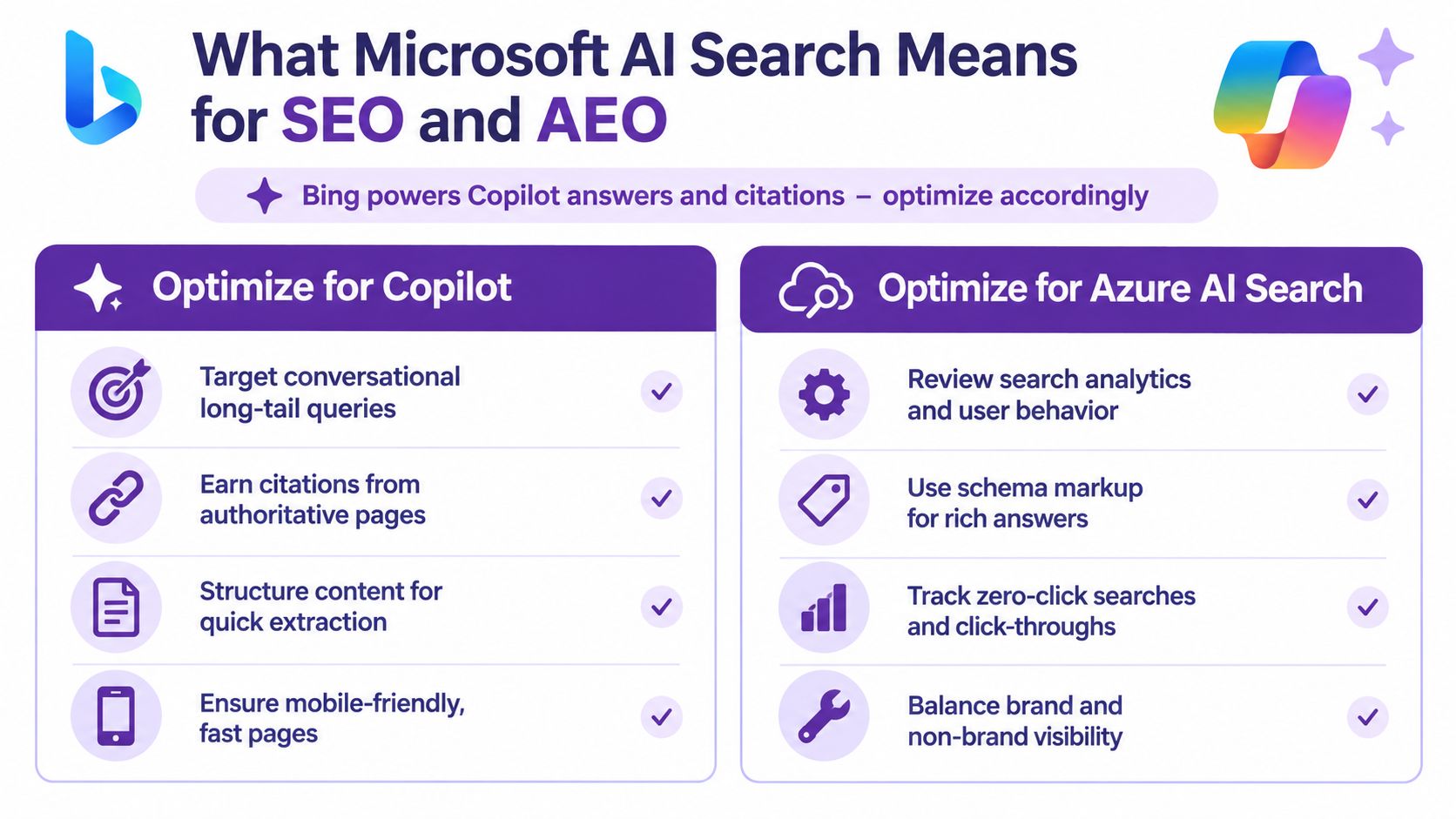
The public and enterprise layers meet marketing through retrieval. Bing supplies the indexed web material used by Copilot Search, so the fundamentals that help Bing discover and interpret a page also influence whether that page can become a cited source. That doesn't mean a traditional ranking guarantees an AI citation. It means technical accessibility and content clarity remain prerequisites.
Start with the foundations. Verify the site in Bing Webmaster Tools, monitor indexing, submit important updates through IndexNow where appropriate, and use structured data that accurately describes the page. Keep titles, descriptions, headings, author information, organisation details, and service terminology consistent.
Make pages easy to quote
AEO content should answer the question quickly, then earn the reader's attention with useful detail.
Lead with the answer: Put the direct response in the first two sentences of a relevant section.
Use explicit questions: Write headings that resemble the questions customers ask.
Build self-contained passages: Make each important paragraph understandable if extracted without the surrounding page.
Name supporting sources: Link to primary documentation, standards, or evidence where a claim needs verification.
Use suitable schema: Apply FAQ, HowTo, Article, Product, or other relevant structured data only when it matches the visible page content.
Microsoft's guidance on optimising content for inclusion in AI search answers emphasises crawlability, metadata, internal linking, structured content, clear headings, concise answers, and semantically precise language. The advice is practical rather than magical. No markup guarantees selection, but clean structure gives systems better material to retrieve and assemble.
Measure presence, not just position
Answer pages can reduce the need for a user to open several search results. Your reporting should therefore separate impressions, citations, visits, engaged visits, enquiries, and assisted conversions. A brand mention without a click may still matter, but you need a consistent way to record it rather than pretending every answer behaves like a standard organic result.
For an Irish team that wants a practical starting point, Scéaled's AI search optimisation service addresses the content, technical, and authority work involved in improving visibility across AI answer platforms. The sensible brief is specific: identify priority queries, audit the pages that should answer them, and establish a repeatable citation-monitoring process.
Paid Media on Microsoft Advertising in an AI Search Era
Copilot changes the shape of paid search more than it eliminates it. Informational queries can receive a useful explanation without a click, while the users who do click through are often further along in their research. That makes broad, vague keyword coverage less attractive and commercial intent more important.
Organise campaigns around the questions that indicate a buying decision. Comparison terms, supplier searches, implementation queries, pricing-related searches, and service-specific phrases deserve tighter control than generic educational traffic. Use negative keywords aggressively where the query is clearly research-only and your landing page has no realistic conversion path.
Microsoft Advertising can also use audience signals from LinkedIn, which is particularly relevant to B2B marketers selling by role, industry, or company context. Treat those signals as targeting inputs, not as a substitute for a clear offer. A weak landing page won't become persuasive because the audience definition is advanced.
Change the creative to match the answer environment
Slogan-only copy is a poor fit for users who have just read an AI-generated explanation. Ads should state what the business does, who it serves, and why the next step is worth taking. Concise factual claims give the user a reason to move from research to action.
Build separate tests for:
Commercial clarity: “Microsoft Ads management for qualified B2B leads” is more useful than a broad growth slogan.
Comparison intent: Address the distinction buyers are actively weighing, such as service scope, implementation support, or reporting.
Proof and qualification: State the relevant market, audience, process, or deliverable without making unsupported performance promises.
Landing-page continuity: Repeat the answer the ad promises, then provide evidence and a clear conversion route.
Measurement needs more than last-click attribution. Track native Microsoft Advertising conversions, assisted conversions, branded search behaviour, and the quality of leads generated after exposure. Where the budget allows, use controlled tests to estimate incremental value rather than assigning every later conversion to the last recorded click.
For Irish budgets, Microsoft Advertising is useful as a controlled proving ground because it can offer lower media costs than Google, but don't turn that observation into a blanket allocation rule. Channel economics vary by audience, query, placement, and competition. A focused Microsoft Ads management approach from Scéaled can help a team connect keyword intent, creative, landing pages, and conversion measurement before scaling spend.
A 90-Day Adoption Plan for Irish Businesses
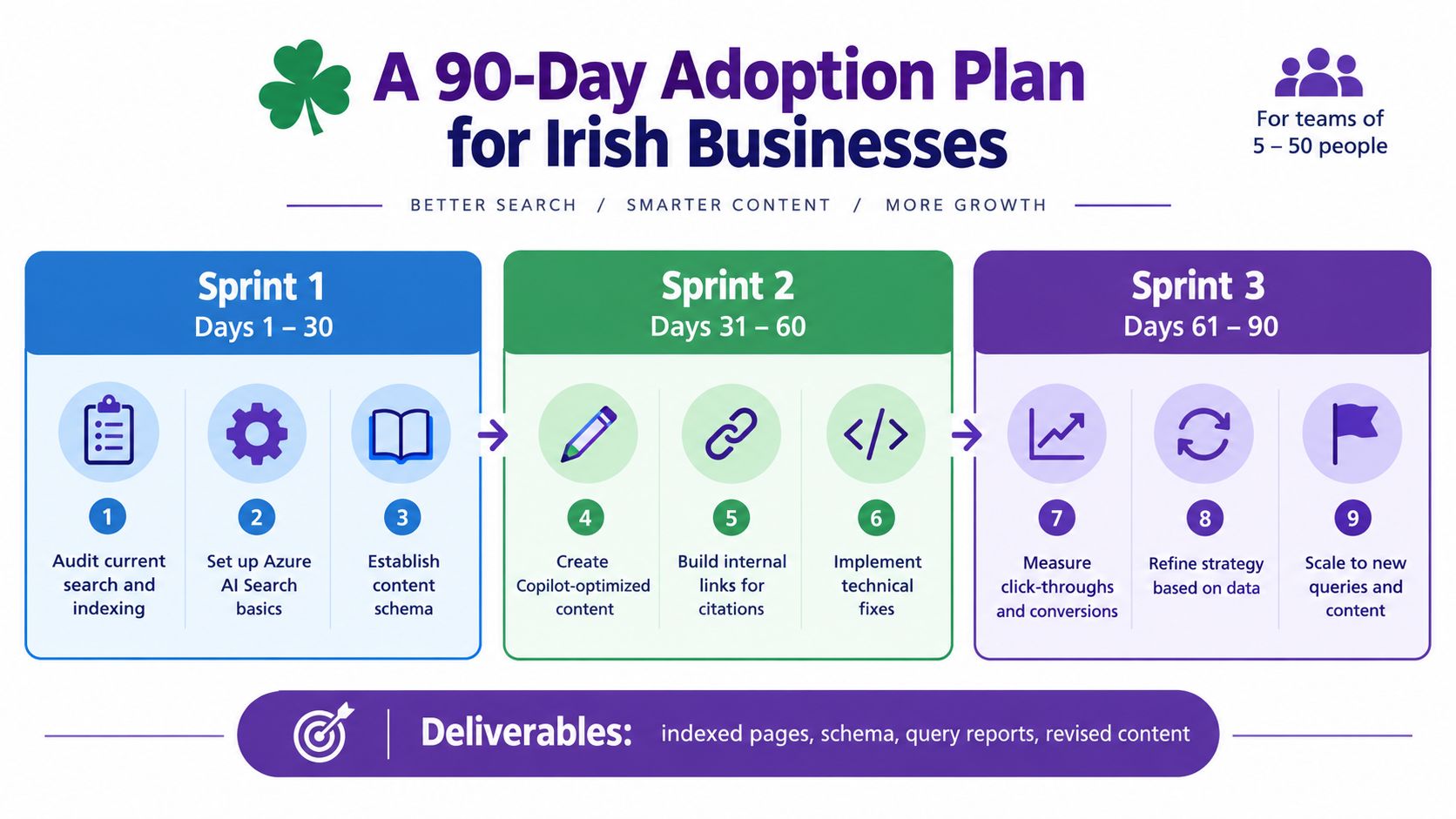
A small Irish team doesn't need a transformation programme. It needs a short list of decisions, an owner for each one, and evidence that the work is improving visibility or saving internal effort.
Sprint 1, days 1 to 30
Start with an audit, not a platform purchase.
Index the baseline: Verify Bing Webmaster Tools access, review indexed pages, and record branded and non-branded query visibility.
Capture current answers: Search priority brand, category, comparison, and service questions in Copilot Search. Record which sources appear and whether your organisation is mentioned or cited.
Map the workload: Decide whether the business needs public content improvement, Microsoft 365 findability, or a custom retrieval experience.
Check regional architecture: If Azure AI Search is relevant, review European region support and the features required by the proposed application.
The deliverables are a query list, a citation record, a technical issues log, and a consumer-versus-enterprise decision. The useful measures are branded impressions, indexed priority pages, and the number of priority questions with a documented answer result.
Sprint 2, days 31 to 60
Turn the findings into work your existing team can ship.
Create content templates with a direct answer block, clear headings, supporting evidence, internal links, and relevant schema. Prioritise pages that combine buyer intent with a realistic commercial outcome. Restructure Microsoft Advertising ad groups around conversational commercial queries, then align each group with a dedicated landing-page message.
Choose one internal Copilot or search use case. It might help staff locate approved sales material, summarise internal guidance, or retrieve product information. Define the time-consuming task, the permitted data sources, and the human review step before development begins.
Sprint 3, days 61 to 90
Measurement is the point of the rollout, not an afterthought. Instrument answer-engine referral traffic in analytics, create a repeatable Copilot mention and citation review, and examine assisted conversions alongside direct conversions. For the internal pilot, record hours saved and review quality, adoption, and permission handling.
Present leadership with a one-page recommendation covering:
Visibility: Branded impression movement and cited-answer count.
Commercial value: Cost per assisted conversion, qualified lead quality, and landing-page conversion behaviour.
Operational value: Hours saved, usage, and unresolved data-governance issues.
Next investment: The specific content, media, or enterprise-search work that deserves the next quarter.
Don't promise universal AI visibility. Promise a documented baseline, targeted improvements, and a decision based on observed evidence.
Common Questions and a One-Page Decision Framework
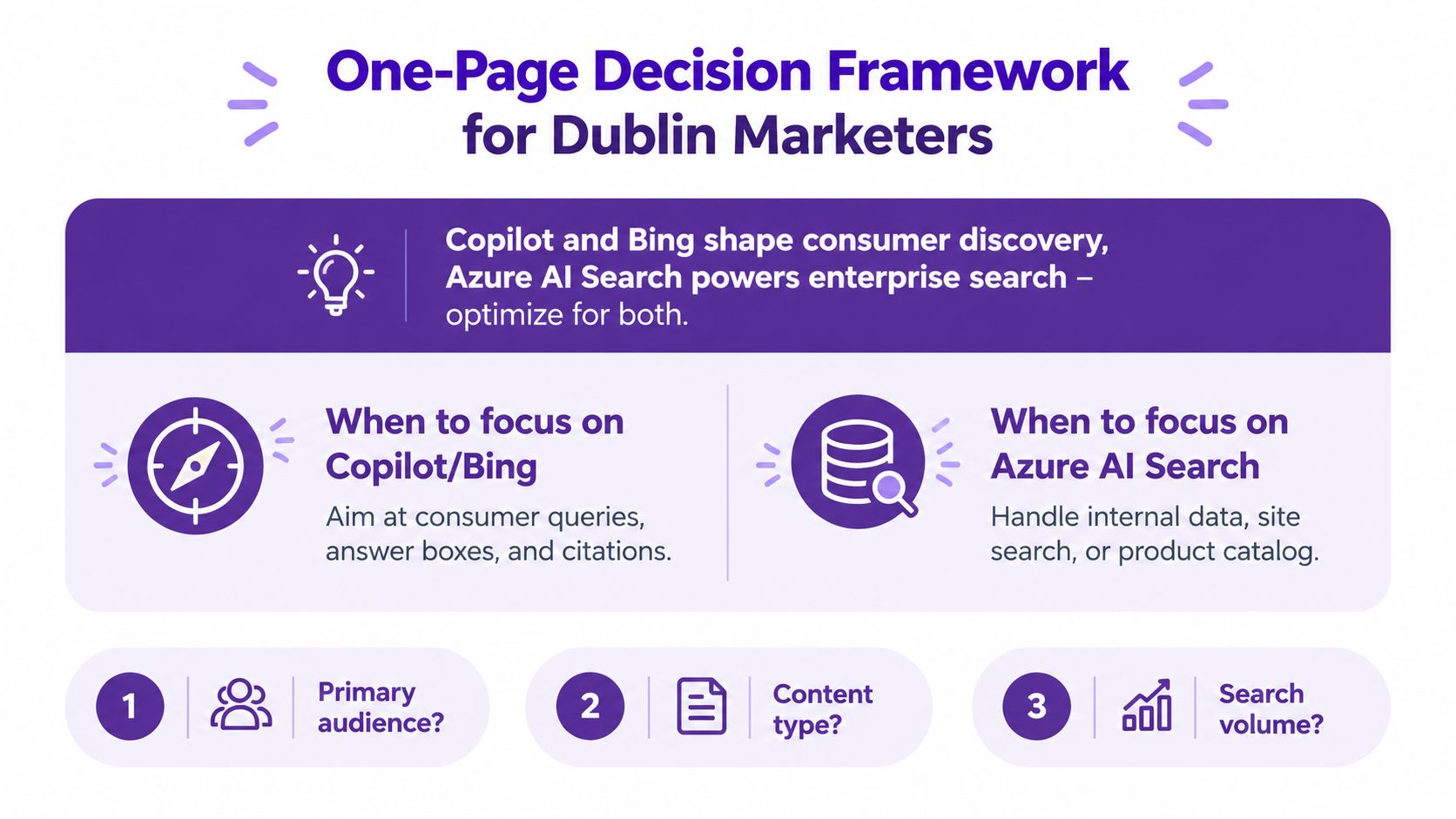
The simplest rule is the one every team needs. Copilot and Bing shape consumer discovery. Azure AI Search powers custom enterprise retrieval. Microsoft Search improves internal Microsoft 365 findability. Microsoft Advertising provides the paid layer around public search demand.
Questions a Dublin marketing director will ask
Does Copilot traffic appear in standard analytics?Some visits can appear as referral or organic traffic, depending on the user journey, browser behaviour, tracking parameters, and analytics configuration. Don't rely on one channel label. Add a manual citation review and compare branded demand, assisted conversions, and landing-page behaviour.
Is Bing worth the SEO effort for B2B SaaS?Yes, if your buyers use Microsoft's ecosystem or your product answers high-value business questions. The work is usually incremental rather than a separate SEO programme, because crawlability, structured content, authority, and clear explanations support broader search visibility too.
How should Azure AI Search be compared with a vector database?Compare the complete retrieval system, not just vector storage. Assess ingestion, hybrid retrieval, enrichment, relevance controls, security, monitoring, Azure integration, implementation effort, and the skills your team already has. A cheaper component can still create a more expensive application if your team must build every surrounding capability.
What will a realistic first-year cost be for a 25-person company?There isn't a responsible universal figure. Cost depends on whether you need content and SEO work, paid media management, Microsoft 365 configuration, or a custom Azure application. Scope the first ninety days, establish evidence, then budget the next stage.
Use this pre-flight checklist:
Confirm Bing Webmaster Tools access.
Choose consumer discovery or enterprise retrieval as the first priority.
Assign one AEO owner.
Add one AEO KPI beside the existing SEO KPI.
Schedule a quarterly review of Copilot mentions and citations.
Scéaled helps Irish businesses connect SEO, AEO, Microsoft Advertising, content, and conversion work into a measurable growth plan. If your team wants to know where Microsoft AI search affects demand generation and what to fix first, visit Scéaled and start with a focused assessment.
Comments