AI Search SEO Guide for Irish SMEs and B2B

Ireland has 97% internet penetration, and more than one million people were reported to use ChatGPT each week in 2025, roughly 28% of the population, according to the Reuters Institute's Ireland report. For Irish SMEs and B2B firms, AI-powered discovery is no longer a distant possibility. It's becoming part of how potential customers ask questions, compare suppliers, and decide which businesses deserve attention.
Traditional SEO still matters, but a blue-link ranking alone no longer guarantees visibility. Google AI Overviews and conversational tools can summarise information before a searcher visits a website, which makes Answer Engine Optimisation, or AEO, an important part of modern search strategy.
This guide explains how AI search works, how it changes SERPs, which technical and content priorities matter, and how to connect visibility with qualified leads and pipeline. You'll also find practical implementation steps for building content that search engines and AI systems can crawl, understand, trust, and cite.
Table of Contents
Understanding AI search and AEO - The difference between ranking and being selected
How AI changes rankings and SERP features - What changes on the results page
Measurable implications for SEO priorities - Prioritise the foundations
Tactical recommendations for AI search SEO - Fix technical access first - Reshape content around decisions - Build a measurement routine
Implementation checklist for technical content and measurement - Technical checks - Content checks - Measurement checks
Introduction
AI search SEO combines traditional search optimisation with techniques that help AI systems understand and reuse your content in generated answers. The distinction matters. Classic SEO aims to earn a position in a list of results, while AI search SEO also aims to make a page a reliable source for a direct response.
For an Irish SME, that response might answer whether a software platform integrates with a particular system, explain how a professional service works, or identify a local provider for a high-intent need. If the answer satisfies the searcher before they reach your website, your measurement model must look beyond sessions and rankings.
A useful starting point is Scéaled's guide to AI search, which sets out the wider shift from traditional result pages to answer-led discovery. The practical challenge is turning that shift into commercial progress, including better-qualified enquiries, stronger sales conversations, and clearer pipeline attribution.
Understanding AI search and AEO
Traditional SEO resembles a well-organised library. A visitor searches the catalogue for a phrase, receives a list of books, and chooses which one to open. Your website's job is to make its pages discoverable, relevant, and authoritative enough to appear near the top.
AI search behaves more like an interactive librarian. Instead of returning only a list of books, it reads across available material, interprets the question, connects related entities, and produces a concise answer. It may still show links, but the user can receive a summary before deciding whether to visit any source.
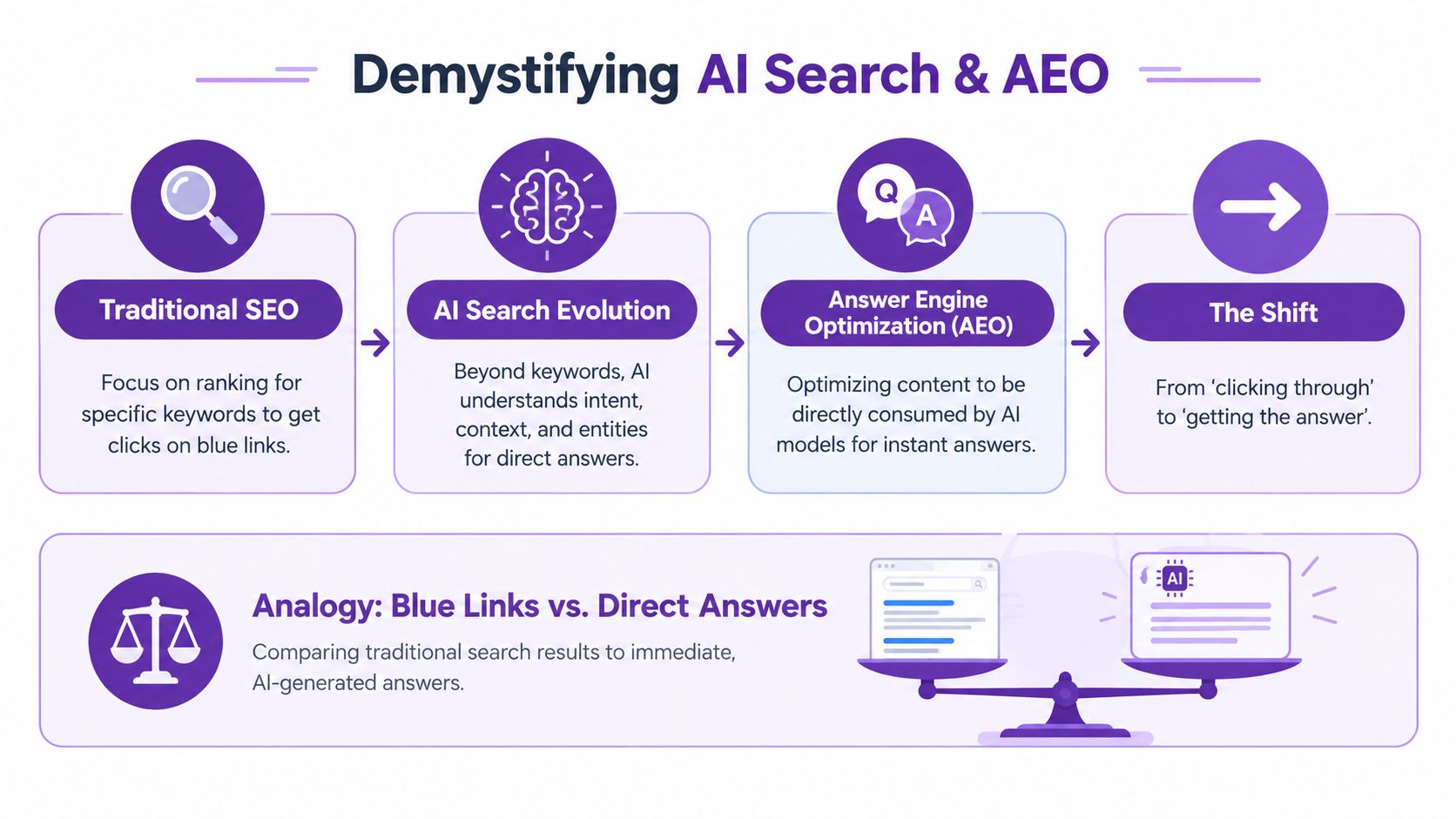
The difference between ranking and being selected
A search engine traditionally evaluates a page as a result. An AI system can also evaluate smaller sections of that page as possible building blocks for an answer. This makes clear, self-contained passages more valuable. A definition, process, comparison, or explanation should make sense even when separated from the surrounding article.
AEO extends SEO by answering the question in the format a person is likely to ask. Instead of repeating a target phrase, a page might include:
A direct definition: Explain the service or product in plain English.
A specific process: Describe what happens first, next, and last.
A useful comparison: Clarify which option fits a particular business situation.
Evidence and context: Identify the author, update date, sources, and relevant entities.
Language models can interpret intent and relationships, but they still need accessible web content. Your pages must remain indexable, technically sound, and explicit about what your business does. That's why Irish companies need a hybrid approach, preserving strong technical SEO while adding answer-focused structure.
How AI changes rankings and SERP features
Google announced the rollout of AI-generated overviews to Ireland as part of a nine-country European launch on 26 March 2025. The Digital News Report materials also report that Citizens Information experienced nearly a 20% fall in traffic after search engines began surfacing AI summaries.
That doesn't mean every Irish website will lose the same amount of traffic, or that traditional results have stopped mattering. It does show why businesses must distinguish between visibility and visits. A page can contribute to an answer without receiving the same click it would have earned from a conventional result.
What changes on the results page
AI search introduces several overlapping opportunities:
AI Overviews: A generated summary can answer an informational question and cite selected web pages.
Featured snippets: A concise paragraph, list, or table may appear above standard results.
Conversational modules: Follow-up questions can extend the original search and alter the user's journey.
Local discovery elements: Business information, services, reviews, and location signals can influence high-intent searches.
The selection process also changes the meaning of authority. A page needs more than a relevant keyword. It should demonstrate topical knowledge, use consistent terminology, provide current information, and make important facts easy to extract.
Practical rule: A ranking helps a searcher find your page. A citation helps an AI system use your page as evidence.
For an Irish B2B company, selection might happen when an AI answer compares suppliers or explains a procurement issue. The commercial value depends on the query. A broad educational answer may build awareness, while a cited service page or comparison page may influence a live buying decision.
That creates a measurement problem. Track rankings and organic clicks, but also monitor whether priority prompts mention your brand, cite your pages, represent your offer accurately, and lead users towards a meaningful next step.
Measurable implications for SEO priorities
AI search SEO works as a connected system. Technical access allows discovery, structured content supports interpretation, and consistent business information helps an AI system decide whether your organisation is the right entity to mention.
Irish businesses should treat entity consistency as a practical trust layer. Your company name, location, service descriptions, contact details, and areas of expertise should align across your website, Google Business Profile, and credible third-party listings. The Irish AI SEO guidance from BBMM also highlights direct answers, evidence, authorship, update dates, internal links, and structured data as useful components of citation-ready content.
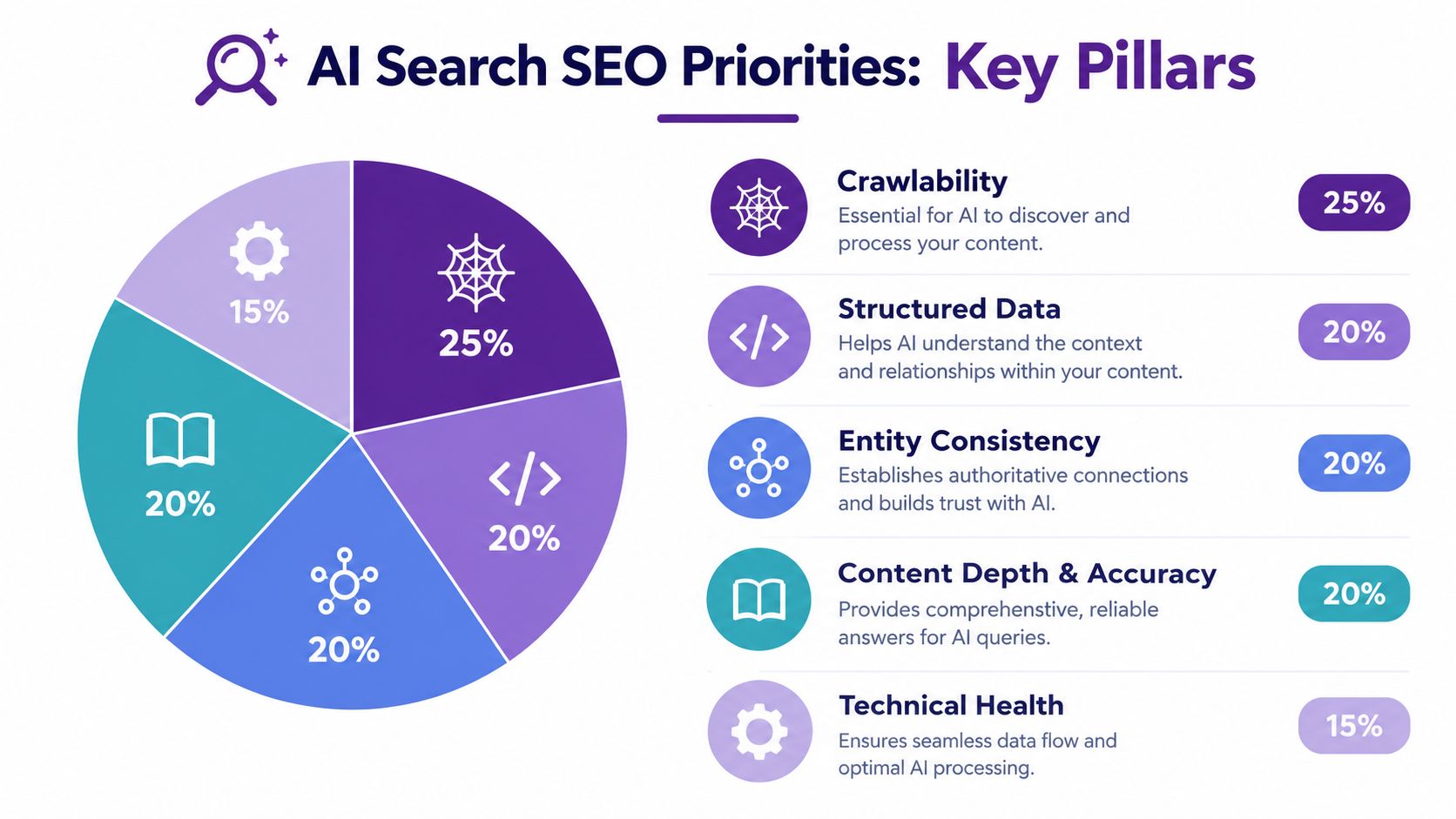
Prioritise the foundations
Start with the page itself. Important information should be available as readable HTML text, not only inside an image, a downloadable document, or an interface that crawlers can't access. Pages should return successful HTTP responses, use sensible canonical tags, and connect related topics through internal links.
Then improve interpretation. A service page should identify the service, the audience it serves, the problem it solves, and the evidence supporting its claims. Use structured data where it accurately describes the page, but don't treat schema as a substitute for useful visible content.
Finally, make measurement commercial. Useful indicators include:
AI citation rate: How often priority prompts cite your domain or specific pages.
Mention quality: Whether the generated answer describes your offer correctly.
Qualified enquiry volume: Whether AI-assisted visitors or branded searches produce relevant leads.
Pipeline contribution: Whether those leads progress into sales opportunities.
Zero-click exposure: Whether your brand appears in answers even when a visit doesn't occur.
The connection between these metrics matters more than any single dashboard number. A citation without qualified demand may reflect broad informational visibility. A smaller number of citations on high-intent prompts may deserve greater investment if those prompts support sales conversations.
Tactical recommendations for AI search SEO
Begin with changes that improve both conventional search and AI accessibility. Don't create a separate AI content universe. Strengthen the pages that already support important customer questions, then make their meaning easier to interpret.
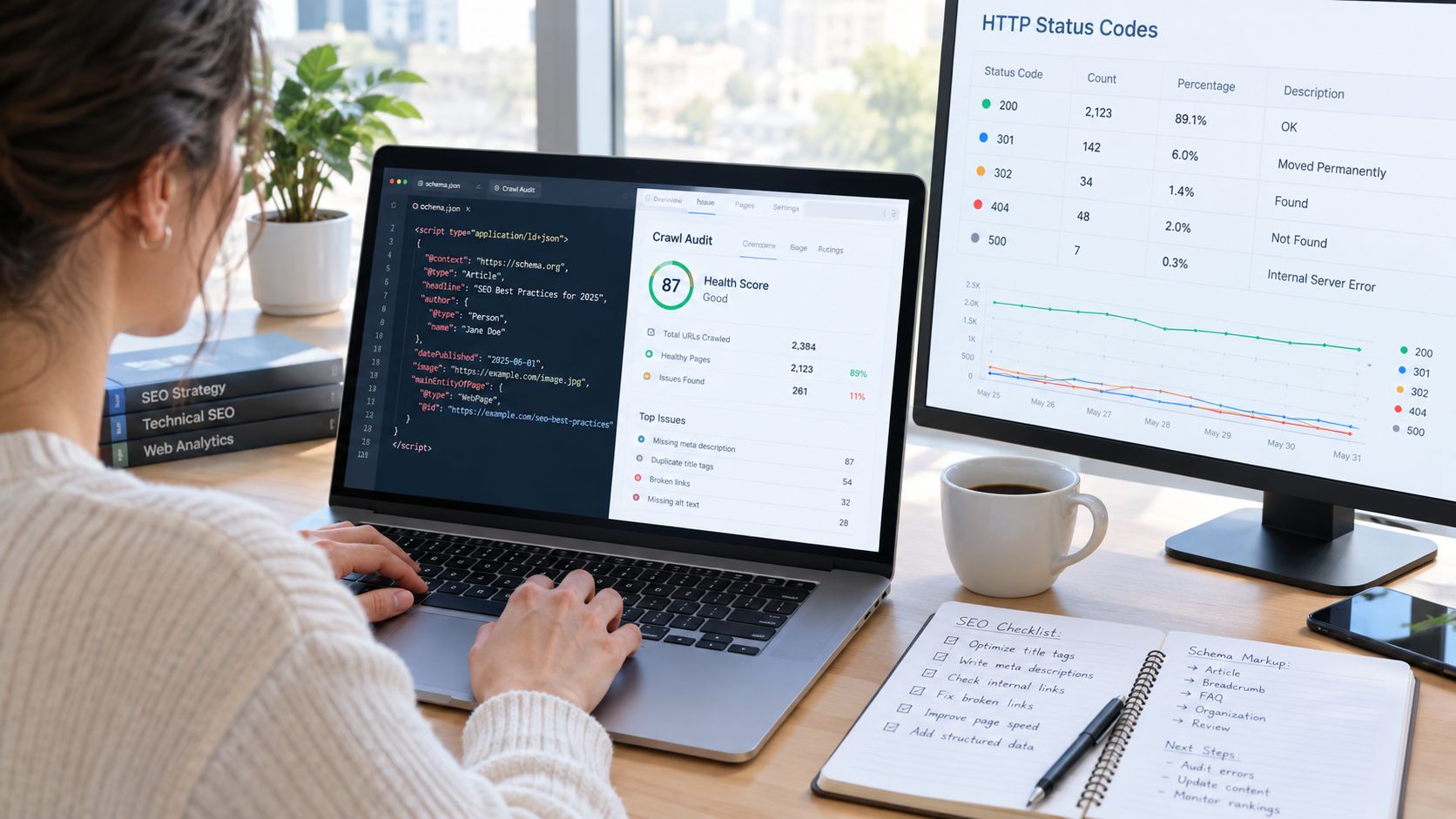
Fix technical access first
Run a crawl audit across priority pages. Check that important URLs are discoverable, return successful HTTP status codes, and aren't blocked by accidental directives. Review canonical tags, XML sitemaps, internal links, and Search Console coverage.
Use schema markup only when it reflects the visible page. A B2B service page might use organisation, service, and FAQ-related structured data where appropriate. The code helps systems interpret relationships, but the page still needs clear prose that answers the customer's question.
Reshape content around decisions
Write a short answer near the top of each important page. Follow it with detail, proof, limitations, and a clear next action. For example, a cybersecurity consultancy could answer “What does a managed security service include?” in a concise paragraph, then explain monitoring, incident response, reporting, and suitability for different organisations.
Use question-based headings when they match genuine customer language. Add author information, relevant credentials, evidence, update dates, and internal links to supporting pages. Avoid hiding essential facts in images or relying on vague claims such as 'next-generation' without explaining the actual service or outcome.
Scéaled's SEO and AEO services are one option for businesses that want support across conventional search and AI answer platforms, alongside in-house teams, specialist freelancers, and other agencies.
Test every answer for accuracy before publishing. AI systems can repeat ambiguous wording, so define your offer and limitations in language that remains correct when extracted from the page.
Build a measurement routine
Create a fixed set of prompts based on your sales funnel. Include category questions, problem questions, supplier comparisons, local searches, and branded prompts. Record mentions, citations, competitor visibility, answer accuracy, referral behaviour, assisted conversions, and lead quality over time.
The Ireland-focused AI search SEO guidance from Arekibo recommends monitoring monthly mentions, citations, competitor visibility, and answer accuracy across Google, ChatGPT, and Perplexity. Pair those observations with CRM data so visibility doesn't become a vanity exercise.
Implementation checklist for technical content and measurement
A rollout works best when each task has a verification method. Assign an owner, record the date of review, and connect the result to a business objective such as qualified enquiries or sales pipeline.
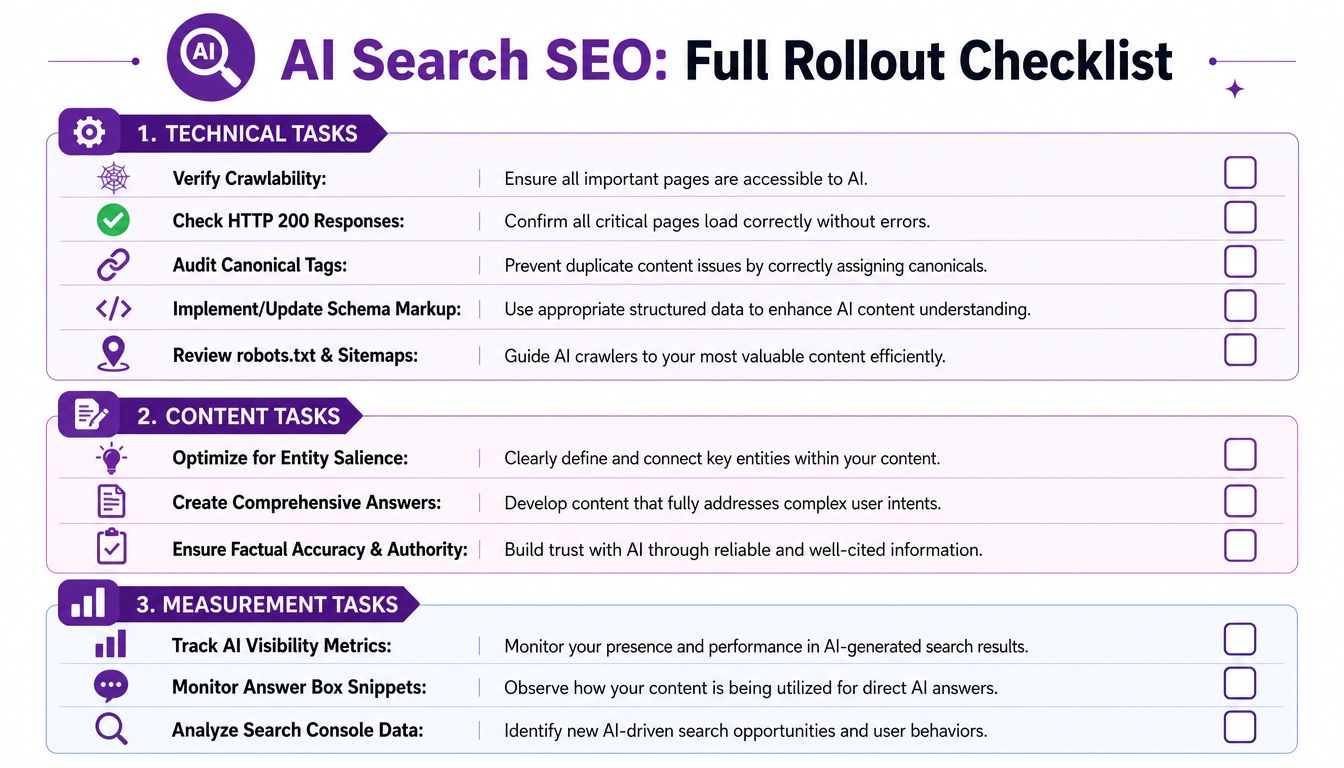
Technical checks
Verify crawlability: Confirm priority pages are accessible to search crawlers and contain important information as text.
Check HTTP responses: Test critical URLs and confirm they load successfully rather than returning errors or unexpected redirects.
Review canonicals: Make sure each important page identifies the preferred URL and avoids conflicting signals.
Validate schema: Check that structured data matches visible content and describes the page accurately.
Inspect robots.txt and sitemaps: Confirm valuable pages aren't unintentionally excluded and that search engines can discover them.
Content checks
Answer priority questions: Add concise, self-contained responses to the questions your customers ask before buying.
Clarify entities: Define your company, services, locations, industries, partners, and relevant technologies consistently.
Show authority: Include authorship, evidence, update dates, and links to supporting information.
Strengthen internal linking: Connect overview pages to detailed service, industry, comparison, and contact pages.
Measurement checks
Create prompt benchmarks: Save a consistent set of prompts and review them regularly rather than relying on occasional manual searches.
Track AI visibility: Record mentions, citations, competitor inclusion, and whether answers describe your business correctly.
Review Search Console: Look for changing queries, impressions, pages, and click behaviour.
Connect to CRM data: Compare AI visibility with enquiry relevance, sales acceptance, opportunity creation, and pipeline progression.
The AI search SEO programme from Scéaled can support this type of structured work across technical SEO, content, measurement, and conversion activity.
Irish SME and B2B case examples
Irish businesses need to judge AI search SEO by commercial outcomes, not only by whether a page appears in an answer. Irish coverage has identified a gap between tactical advice, such as FAQ schema and answer summaries, and evidence that those changes improve qualified leads or pipeline for SMEs and B2B firms, as discussed in Irish analysis of AI visibility and GEO.
Consider a Dublin SaaS company whose product pages explain features but leave integration questions scattered across support documents. A practical project would consolidate those answers into crawlable HTML, organise them under clear questions, identify the product and supported systems consistently, and connect each answer to a demo pathway. The team could then review priority prompts, citation quality, demo requests, and lead acceptance in its CRM.
A professional services firm might face a different problem. Its website, Google Business Profile, and third-party listings could describe the firm using inconsistent service names or locations. Aligning those entities, adding accurate organisation and service markup, clarifying practitioner authorship, and publishing evidence-led pages would give AI systems a more coherent picture of the business.
Neither example guarantees inclusion in an AI Overview or a particular commercial result. The lesson is more useful: connect every visibility change to a customer decision, then assess whether the resulting enquiries match your target market and sales process.
Conclusion and next steps
AI search SEO changes how Irish businesses earn attention. Traditional rankings remain valuable, but companies must also make their content easy for AI systems to crawl, interpret, verify, and cite.
Start by auditing technical access, then improve direct answers, entity consistency, evidence, authorship, and internal linking. Build a prompt benchmark and connect AI mentions with qualified enquiries, sales acceptance, and pipeline rather than treating citations as the final goal.
Review the results regularly, keep accurate answers current, and invest further where visibility supports commercial intent. Irish SMEs and B2B firms that link AEO activity to conversion measurement will make better decisions than those chasing exposure alone.
Scéaled brings together SEO, AEO, conversion optimisation, paid media, and measurement to help Irish businesses turn search visibility into qualified demand. Visit Scéaled to discuss an AI search SEO plan built around your priority audiences, customer journeys, and pipeline goals.
Comments