AI Search Market Share: A 2026 Guide for Growth Teams

ChatGPT accounted for 87.82% of Irish AI chatbot traffic in March 2025, while Perplexity held 8.8% and Gemini 2.28%, according to StatCounter-reported Irish AI assistant data. That sounds like a settled market, but it isn't. By June, ChatGPT's share had fallen to 83.9%, Copilot had risen to 7.75%, and Perplexity stood at 5.28%, showing that concentration and movement can exist at the same time.
The more important gap sits elsewhere. Microsoft reported that 48.4% of Ireland's working-age population used AI in the first quarter of 2026, while Similarweb-based reporting put AI assistants at only 0.9% of global referral traffic in March 2026. Usage, influence and measurable visits aren't the same thing, and growth teams that treat them as interchangeable will make poor budget decisions.
Table of Contents
What Counts as AI Search in the Numbers - Three measurements teams must keep separate
The Leading AI Assistants Compared - What the positions mean for Irish teams
AI Search versus Conventional Search in Ireland - The stacked dependency
Adoption versus Referral Share - Why referral data lags behaviour
What Growth Marketers Should Do About It - Build pages that support one decision - Protect the conventional search base
Strategic Outlook and Open Questions - Questions that should stay open - A monthly watchlist
Why AI Search Market Share Matters Now
Irish AI search is concentrated enough to guide an initial investment, yet changeable enough to make a one-off optimisation project risky. ChatGPT held 87.82% of Irish AI chatbot referral share in March 2025, then 83.9% by June, while Copilot gained ground, according to Irish AI assistant market-share reporting. The practical conclusion is narrow: start with the platform sending the most measurable referrals, then keep testing rather than treating that position as permanent.
For Irish SMEs, B2B firms and professional services businesses, share is a prioritisation signal, not a complete account of demand. It shows where tracked visits originate. It does not show which assistant shaped a shortlist, influenced a buying decision, earned a citation or prompted a later branded search. A growth team therefore needs referral reporting alongside brand-search, enquiry and conversion analysis.
Conventional search still supplies the main commercial gateway. Google held 94.01% of Ireland's search engine market share in August 2026, compared with Bing at 3.51%, DuckDuckGo at 0.93%, Yahoo at 0.86%, Ecosia at 0.34% and Yandex at 0.16%, according to StatCounter's Ireland search data. AI search is adding a research and comparison layer around that gateway, rather than replacing it.
The gap between adoption and referral traffic makes this distinction more important. AI use can affect consideration before a prospect visits a website, while analytics may record only the final Google search, direct visit or assisted conversion.
The practical reading: AI referral share measures captured visits. It does not measure all AI influence. Irish growth teams should report both, using referral data for channel prioritisation and broader demand signals for assessing visibility.
Scéaled's explanation of AI search gives teams a clear foundation for separating answer-engine discovery from conventional results. The strategic question is whether a business appears during initial shortlist formation and remains easy to find when the buyer shifts to Google, a branded query or a direct commercial action.
What Counts as AI Search in the Numbers
AI search is a conversational discovery experience in which an assistant interprets a question, retrieves or draws on information, and presents a synthesised response. The user may receive links, citations or follow-up prompts, but the primary interface is an answer rather than a conventional results page.
That definition separates three related categories:
Traditional search: A ranked results page, usually led by Google in Ireland.
AI-native answer engines: Services such as ChatGPT, Perplexity, Gemini and Copilot that respond conversationally.
AI features inside search engines: Generative answer surfaces added to an established search product.
Answer Engine Optimisation, or AEO, makes company information easier for answer engines to understand, select and cite. Traditional SEO remains relevant because many AI experiences depend on indexed web content. AEO adds a separate visibility question: can an assistant extract a clear, trustworthy answer from the page?
Three measurements teams must keep separate
Usage share describes how many people use a platform or how often they interact with it. Microsoft reported that 48.4% of Ireland's working-age population used AI in Q1 2026, up 3.8 percentage points quarter on quarter, in its Ireland AI adoption report. That adoption figure does not show how often users clicked from an AI answer to a company website.
Assistant share describes the distribution of traffic or referrals among AI platforms. The Irish figures cited earlier belong to this category. They show which assistants generate observed AI referrals, not the share of total Irish search activity or the proportion of people using AI.
Referral share measures visits arriving at a website from a tracked external platform. Teams can inspect referral sources in analytics, use tagged links where platforms permit them, and compare first-party logs with panel tools. Each method has blind spots. A chat answer that satisfies the user without a click creates influence but no referral session.
A useful reporting model therefore keeps separate fields for platform usage, mentions or citations, branded-search movement, AI referrals and assisted conversions. This separation exposes the gap between adoption, influence and measurable traffic. Irish AI use can be widespread while AI referrals remain a small recorded channel.
Scéaled's explanation of AI search provides a clear foundation for distinguishing answer-engine discovery from conventional results. Growth teams should assess whether their brand appears during shortlist formation, then remains easy to find when a buyer shifts to Google, a branded query or a direct commercial action.
The Leading AI Assistants Compared
The Irish data supports one firm conclusion: ChatGPT is the first platform Irish growth teams should prioritise, because it held the overwhelming majority of reported AI chatbot traffic in both March and June 2025. The same data also warns against treating that lead as permanent. Copilot gained distribution, while Perplexity and Gemini retained smaller positions.
The table below uses only the verified Irish figures available. It doesn't invent query-share or quarter-on-quarter values where the evidence supplied doesn't provide them.
Assistant | Share of AI referrals, IE | Share of AI queries, IE | QoQ shift |
|---|---|---|---|
ChatGPT | 87.82% in March 2025, 83.9% in June 2025 | Not provided | Lower share across the reported period |
Perplexity | 8.8% in March 2025, 5.28% in June 2025 | Not provided | Lower share across the reported period |
Gemini | 2.28% in March 2025 | Not provided | Not provided |
Copilot | Not provided for March, 7.75% in June 2025 | Not provided | Rose across the reported period |
This isn't a complete competitive panel. It is a decision-quality snapshot, and that distinction is important. The figures are referral-share observations reported from StatCounter data, not first-party disclosures from every assistant. They also describe AI chatbot traffic, not the entire universe of AI-mediated search behaviour.
What the positions mean for Irish teams
ChatGPT deserves the first testing budget because its reported share makes it the largest available entry point. Start by checking whether the assistant surfaces your brand for the questions that shape a shortlist, then improve the source pages that answer those questions.
Copilot deserves attention from B2B teams even though the verified data only gives a June share. Its rise is a reason to monitor the Microsoft ecosystem rather than ignore it. Teams working through Microsoft's AI search implications should assess whether their content is clear, current and technically accessible across the wider search environment.
Perplexity's smaller reported position doesn't make it irrelevant. An answer engine with a smaller audience can still matter if its users conduct high-consideration research and its citations send meaningful commercial visitors. The same principle applies to Gemini. Market share sets reach, not value per visitor.
AI Search versus Conventional Search in Ireland
Ireland's search economy has two different concentration patterns. Conventional search is dominated by one gateway, while AI referral traffic is concentrated within a smaller, still-developing channel. Google's position gives it the larger immediate demand pool, but AI assistants can influence which brands users consider before they return to a search engine, visit a site directly or contact a supplier.
The available figures should be read as directional evidence rather than a unified market-share table. Google's measure covers search-engine activity in Ireland. The AI figures cover the distribution of reported chatbot referrals. Their denominators differ, so the percentages cannot be combined or treated as competing slices of one market.
Channel | Approx. share | Type | YoY change |
|---|---|---|---|
Google search in Ireland | Dominant conventional search position | Conventional search engine share | Not provided |
Bing in Ireland | Smaller conventional search position | Conventional search engine share | Not provided |
ChatGPT among Irish AI chatbot traffic | Largest reported AI referral position | AI chatbot referral share | Not provided |
Perplexity among Irish AI chatbot traffic | Smaller reported AI referral position | AI chatbot referral share | Not provided |
This distinction changes how Irish growth teams should allocate effort. Conventional search should continue to receive the larger share of performance and demand-capture investment because it reaches established search behaviour at scale. AI search needs a separate test budget focused on visibility, citations and assisted conversions, rather than being judged by the same last-click targets.
The stacked dependency
AI search does not replace SEO. Assistants can retrieve, assess or cite pages that are available in the conventional web index. Users may then move to Google to find a local provider, compare products or confirm an answer independently. A company missing from conventional search can therefore struggle to supply the information AI systems use, while a company absent from assistant responses can miss the research stage that precedes a conventional query.
The practical implication is a two-layer visibility requirement. Teams should protect rankings for high-intent searches, then examine whether the same brand appears in answers to broader questions about categories, suppliers, problems and comparisons. The second check requires different evidence, including assistant prompts, cited URLs and referral quality.
The honest Irish picture: Google remains the main entrance. AI assistants form a smaller route that can shape consideration before a prospect returns to conventional search, visits directly or contacts a supplier.
The immediate risk is not that one platform has displaced Google. It is that a business can perform well for ranked queries while remaining absent from the conversational research that influences those queries. Irish growth teams should therefore measure conventional search for demand capture and AI visibility for influence, assisted visits and the quality of resulting prospects.
Adoption versus Referral Share
Ireland's AI adoption is already far larger than the traffic AI assistants send to websites. Microsoft reported that 48.4% of the Irish working-age population used AI in Q1 2026. Broader survey coverage cited in that reporting found 18% of adults using generative AI regularly and 25% using ChatGPT weekly. By comparison, Similarweb-based reporting measured AI assistants at only 0.9% of global referral traffic in March 2026, as noted earlier.
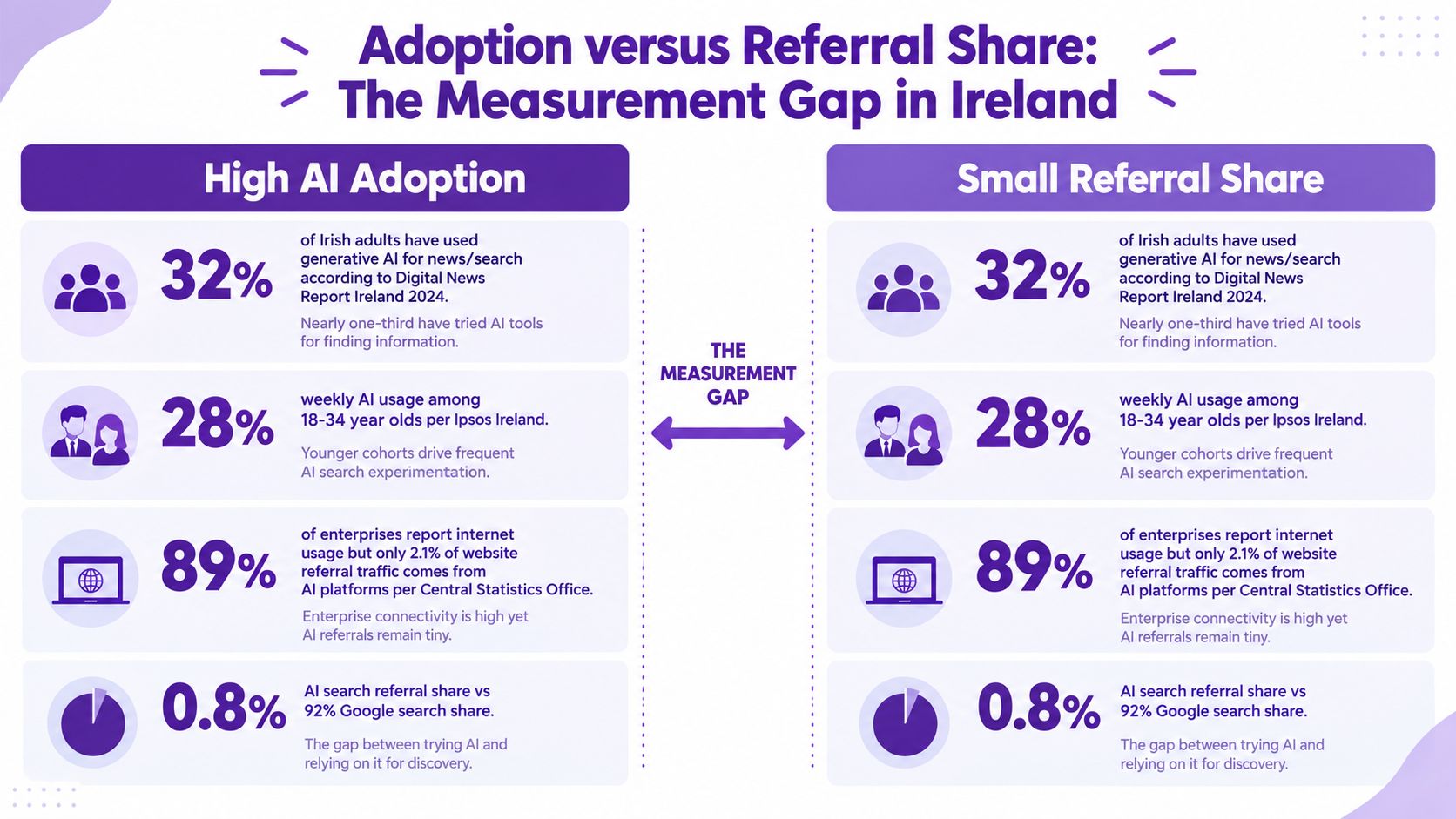
The gap reflects different behaviours, not conflicting results. People use assistants to draft emails, summarise documents, explain concepts and help with code. Those interactions can shape a later purchase without creating a website session. An answer may also resolve the question before a commercial click happens.
Why referral data lags behaviour
Referral analytics captures a narrow event, a visit from a platform to a website. Adoption surveys cover a much wider set of activities, including non-commercial tasks. For ai search market share analysis, that distinction prevents marketers from treating low referral volume as evidence of low influence.
A buyer could ask an assistant to compare providers, search a shortlisted brand on Google, click a paid advert, return through a bookmark or contact the company after remembering its name. Last-click reporting assigns credit to the final channel, not necessarily to the answer engine that shaped the shortlist.
Irish growth teams should measure the two outcomes separately:
Track AI referrals separately: Create an analytics segment so small changes remain visible rather than disappearing within total referral traffic.
Monitor brand demand: Compare assistant visibility checks with branded search activity and direct enquiries.
Record citations: Store the prompt, assistant, answer, cited page and date to identify recurring source patterns.
Ask sales teams: Add a simple discovery question about how prospects first heard of the business.
This produces a leading and lagging view. Adoption shows that AI use is becoming routine. Referral share shows when that behaviour creates a measurable handoff. The strategic gap is the point: assistants may influence consideration well before they generate enough outbound visits to appear significant in acquisition reports.
Regional Differences Across English-Speaking Markets
The verified evidence is strongest for Ireland. Comparable, verified market-share figures for the United States and United Kingdom are not supplied here, so importing country percentages would create false precision. That gap matters for strategy. Differences in device use, publisher ecosystems, assistant defaults and distribution can change how people discover businesses, meaning a US or UK benchmark cannot automatically serve as an Irish target.
Ireland's conventional search baseline is highly concentrated. Google held 94.01% of search engine market share in August 2026, while Bing, DuckDuckGo, Yahoo, Ecosia and Yandex occupied much smaller positions, according to StatCounter's country data. AI assistant activity was concentrated as well, with ChatGPT leading reported AI chatbot traffic in March and June 2025, according to the Irish assistant market analysis.
That comparison still needs careful measurement. Search-engine share, AI chatbot share, referral share and adoption share describe different behaviours:
Search-engine share may include searches across devices or selected device groups.
AI chatbot share may measure visits to assistant services, rather than every AI-mediated question.
Referral share records outbound website visits and misses answers that influence a buyer without producing a click.
Adoption share includes tasks unrelated to website discovery, such as drafting, research or general assistance.
A regional dashboard should show the denominator, date, device scope and source beside every value. Otherwise, a table can compare unlike measures while appearing exact.
For Irish businesses selling across English-speaking markets, one global AEO page is unlikely to deliver identical visibility everywhere. Keep core facts, entities and evidence consistent, then test local question wording, provider evaluation and the path from answer to action. Irish regulatory context, local service pages and country-specific commercial terms may affect referral performance more than an international assistant ranking.
The practical conclusion is narrow: Ireland needs its own measurement baseline. Use Irish search and assistant evidence for Irish investment decisions, while treating overseas observations as hypotheses to validate. This separates regional usage from actual influence and measurable referral traffic.
What Growth Marketers Should Do About It
Irish growth teams should run SEO and AEO as connected workstreams. Conventional search still sends the larger share of measurable demand, while assistant use is broad enough to justify controlled testing. The right starting point is a commercial question, not a generic instruction to “optimise for AI”.
Build pages that support one decision
Prioritise pages that help buyers compare services, assess implementation requirements, understand pricing logic, check regulatory obligations or select suppliers. Place the direct answer near the relevant heading, define specialist terms, use the business or product name consistently, and support material claims with accessible evidence.
Use FAQ schema only where the visible page contains the questions and answers. Clear author, organisation and update signals can improve confidence in the source, but structured data cannot substitute for useful content. An assistant still needs a page it can interpret, cite and trust.
Protect the conventional search base
Ireland's conventional search market remains concentrated, so technical SEO, internal linking, local relevance, search intent and conversion paths should continue to receive active investment. Do not transfer budget from pages that generate qualified demand because AI search attracts attention. The gap between assistant usage and referral traffic makes that shift premature.
A practical testing cycle is:
Choose one query cluster each month: Focus on commercially relevant questions and test them across ChatGPT, Perplexity, Gemini and Copilot.
Record the evidence: Save the prompt, answer, cited domains, brand mention and source page.
Improve the source: Clarify the answer, strengthen proof, add useful internal links and resolve access problems.
Measure business outcomes: Compare AI referrals, assisted conversions, branded demand and sales feedback.
Review quarterly: Retain work that produces evidence, stop activity that creates only vanity reporting and expand successful themes carefully.
Priority | Irish SME action | B2B SaaS action | Ecommerce action |
|---|---|---|---|
Answer clarity | Create concise service and location answers | Explain use cases, integrations and buying criteria | Clarify product attributes, delivery and suitability |
Authority | Add named expertise and trustworthy local proof | Publish technical documentation and original viewpoints | Maintain accurate product, brand and policy information |
Measurement | Segment AI referrals and enquiry sources | Track citations against pipeline stages | Compare AI-assisted discovery with product-page visits |
SEO foundation | Protect local and service-page rankings | Maintain technical content and comparison visibility | Strengthen category, product and structured content |
Testing cadence | Review one priority question set monthly | Test high-intent research themes | Test product and comparison prompts |
The reporting layer should connect visibility with commercial progression. A brand mention without a citation, referral, branded search or sales conversation may indicate influence, but it should not be reported as demand. Track those signals separately so teams can see whether assistant visibility is creating measurable value or merely expanding awareness.
Document the problems that prevent content from being understood, retrieved or trusted. Scéaled's AI search problem analysis can inform technical audits, content reviews and conversion analysis. The objective is to make commercially important information clear and verifiable wherever buyers look, while preserving the search foundations that already produce results.
Strategic Outlook and Open Questions
The strategic posture for the next year should be measured optimism. AI use in Ireland is already substantial, and AI assistant referral share is still small. That combination means the market has room to develop, but it doesn't justify replacing a channel that remains responsible for most conventional search activity.
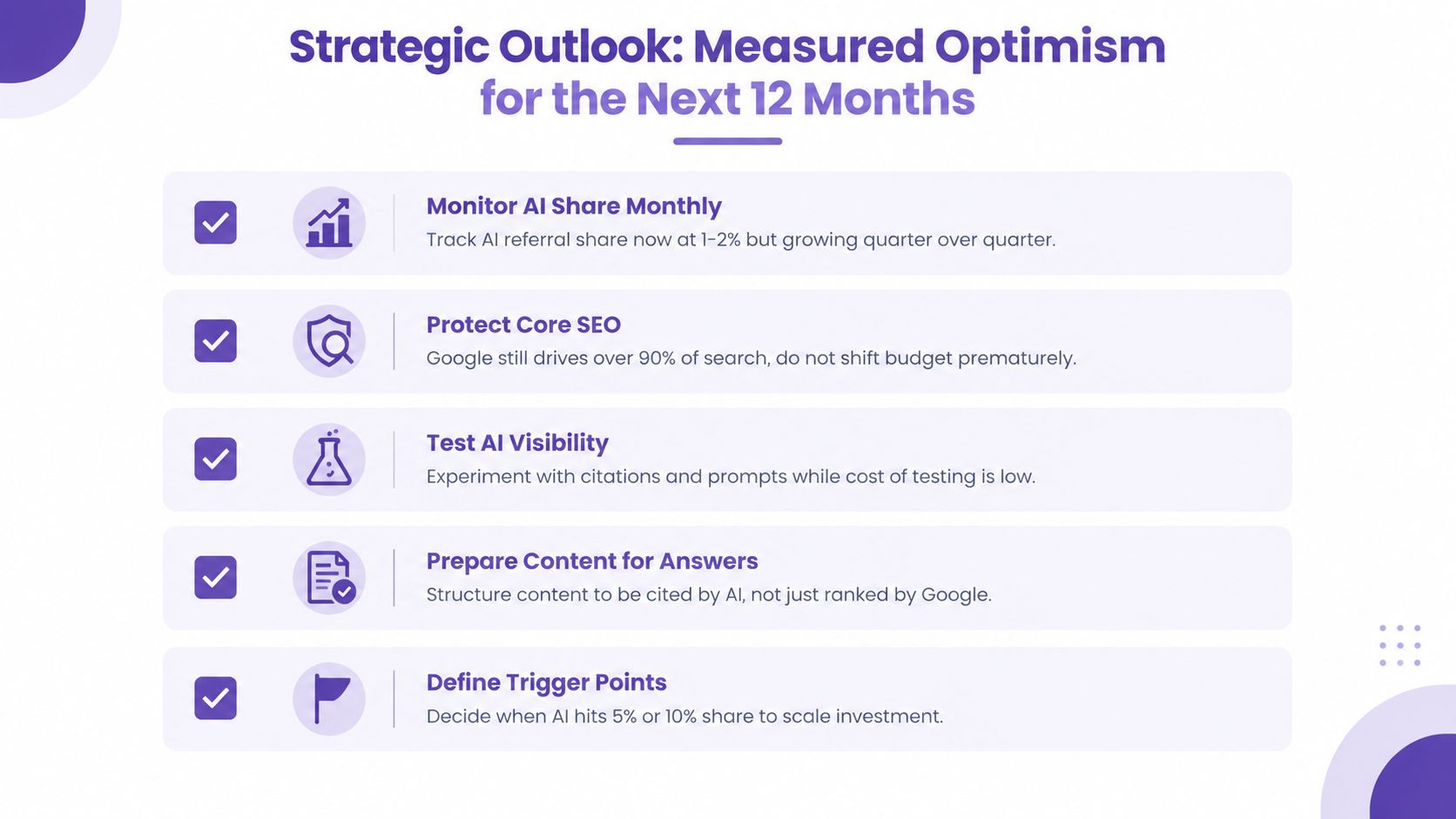
The most useful question isn't “Will AI replace Google?” It is “Which parts of the buying journey will move first, and how will we know?” Irish evidence currently shows a difference between broad AI adoption and outbound referral behaviour. That gap may narrow, remain stable or develop differently by sector, but teams can track it without making a forecast.
Questions that should stay open
Will adoption become measurable referral demand? AI use can grow through task-based activity without producing equivalent website visits. Growth leaders should watch whether citations, branded searches, direct enquiries and AI-referred sessions begin moving together.
Will Google absorb more of the answer experience? Google's dominant Irish search position means changes inside its own ecosystem may affect traffic more quickly than external assistant competition. A business may gain visibility in an answer while receiving fewer clicks, so impressions and visits need separate reporting.
Will Ireland diverge from larger English-speaking markets? Ireland's market is small and concentrated, and its users may encounter different distribution routes from those in the United States or United Kingdom. International benchmarks should be validated locally before they influence budget.
A monthly watchlist
AI referral sessions, separated by assistant and landing page.
Citations and brand mentions, recorded against priority prompts.
Branded search activity, reviewed alongside campaign and sales data.
Google search visibility, especially for commercial and local terms.
Assisted enquiries or opportunities, where sales teams can identify earlier research behaviour.
Content coverage, including unanswered questions and outdated source pages.
Strategic rule: Test while the cost of learning is manageable, but don't make a major channel reallocation until Irish evidence shows that AI visibility is influencing qualified demand.
The companies best placed for this shift won't be the ones with the loudest AI claims. They'll be the ones that preserve strong search fundamentals, publish information worth citing, and connect visibility data to revenue rather than treating market share as an end in itself.
Scéaled helps Irish SMEs, B2B technology firms, professional services providers and ecommerce teams connect SEO, AEO, paid media, content and conversion measurement. Visit Scéaled to discuss an evidence-led plan for protecting Google visibility while testing how AI search can influence qualified demand.
Comments