SEO in AI: A Practical Guide for Irish Businesses

A Galway accountancy practice can have a healthy flow of website impressions and still feel its pipeline weakening. The owner sees visibility rising in Google Search Console, but click-through rate falling. Her CRM shows referrals from chatbot platforms that she can't easily identify, and the enquiries that do arrive are less consistent with the firm's ideal client profile.
That pattern is becoming familiar to Irish SMEs, B2B SaaS companies and professional services firms. Buyers increasingly ask ChatGPT, Perplexity, Copilot or Google's AI features to explain a category, compare providers and recommend a next step before they visit a company website. The search result hasn't disappeared, but the route from question to commercial conversation has changed.
Ireland's enterprise adoption of AI rose from 8% in 2023 to 15% in 2024, while 51% of large enterprises with 250 or more employees used AI in 2024, according to Ireland-focused reporting on enterprise AI adoption. Consumer behaviour is moving in the same direction. ChatGPT accounted for 87.82% of Irish AI chatbot referral traffic in March 2025 and 83.9% in June 2025, based on StatCounter data reported for Ireland.
This doesn't mean traditional SEO has stopped working. It means ranking alone no longer describes the whole visibility problem. Irish businesses need content that can rank, answer, earn citations and make the brand behind the answer unmistakable.
Table of Contents
The Search Shift Irish Businesses Cannot Ignore - The practical consequence for search teams
How Search and Answer Engines Use AI Today - Where Irish data changes the priority - Retrieval is only the first filter
The Practical Optimisation Playbook - Start with a query and content audit - Make retrieval boringly reliable - Add structured data with a reason - Use prompts as a research aid, not an editorial substitute - Measure the journey, not just the mention
Tailoring the Approach Across B2B SaaS SMEs and Ecommerce - B2B SaaS - Professional services - Ecommerce and lean SMEs
Common Misconceptions That Waste Budget - More AI content doesn't mean more citations - Schema isn't a replacement for content - AI traffic isn't automatically untrackable - Governance belongs in the workflow
Your First 90 Days of SEO in AI - Sprint one, audit and baseline - Sprint two, foundation and content - Sprint three, expand and measure
The Search Shift Irish Businesses Cannot Ignore
For the Galway practice, the immediate risk is not fewer clicks. A chatbot can combine information from several websites, answer a prospective client's question and recommend a type of provider without sending visitors to every source. If the practice's page contains useful expertise in vague, poorly structured paragraphs, another site may provide the extractable answer.
The commercial trade-off is clear. Stable impressions can coexist with reduced influence earlier in the buying journey. Referral visits may also appear in analytics under unfamiliar or incomplete source labels, making it difficult to connect an AI interaction with a later enquiry or qualified lead.
Irish audiences are already using AI interfaces for research and decisions. One Irish consumer survey reported that 42% of internet users aged 16 and over had used generative AI in the previous three months. Another reported 53% of Irish adults using AI tools by November 2025, with 69% of those users turning to AI platforms weekly or more often, as summarised in Irish consumer AI usage reporting.
The practical consequence for search teams
A commercially useful page now has to do several jobs at once:
Earn organic visibility: Match the intent, subject coverage and authority signals that support visibility in classic search.
Supply usable answers: Present important information clearly enough for a system to extract a self-contained passage.
Support entity recognition: Make the organisation, people, products, locations and services easy to distinguish.
Create a credible recommendation: Show assistants that the business is relevant, trustworthy and suitable for the query.
Google's AI Overview layer appears often enough in Ireland to affect planning. Ahrefs' analysis of 108 million AI Overview queries across 50 countries found AI Overviews on 12.00% of tracked Irish queries, with 168,000 of 1.4 million Irish keywords returning an AI Overview, according to Ireland AI Overview analysis.
Metric | 2024 | 2025 |
|---|---|---|
Irish enterprise AI adoption | 8% | 15% |
ChatGPT share of Irish AI chatbot referral traffic | Not provided | 87.82% in March, 83.9% in June |
Irish internet users aged 16+ using generative AI in the prior three months | Not provided | 42% |
The response is not panic publishing or a separate AI programme. It is an extension of SEO, with closer attention to passage quality, source selection, entity clarity and commercial attribution. Measure success through qualified enquiries, assisted conversions and identifiable chatbot referrals, not rankings alone.
What SEO in AI Actually Means
SEO in AI is the practice of improving content, technical structure and brand signals so that both search engines and AI answer systems can find, understand and surface a business. Answer engine optimisation, or AEO, focuses more specifically on earning inclusion in direct answers, summaries and citations.
The distinction is useful, but it shouldn't create two isolated marketing programmes.
Three visibility layers
Traditional SEO signals help systems discover and retrieve a page. Crawlability, relevant page copy, internal links, backlinks, metadata and user experience still matter because answer engines need a dependable body of content to search. If a page is blocked, thin, disconnected or unclear, there's less opportunity for any system to use it.
AI-era signals influence whether a particular passage is selected. A citation-worthy passage answers one question directly, includes enough context to stand alone and avoids ambiguous claims. Entity clarity, structured data, descriptive headings, tables and concise answer blocks help systems understand what a page says and who is responsible for the information.
Prompt-driven discovery happens when a buyer asks an assistant to recommend a provider, compare options or identify a suitable solution. Brand mentions, third-party corroboration, local relevance and consistent business information can influence whether the assistant recognises your organisation as a credible candidate.
The simplest working distinction is this:
SEO earns the opportunity to be found. AEO improves the chance of being mentioned or cited. SEO in AI engineers both outcomes together.
That means a page can rank well yet underperform in AI answers if its important claims are buried, its organisation is difficult to identify or its content doesn't answer the conversational form of the query. Conversely, a well-structured answer page won't compensate for serious technical problems that stop search systems reaching it.
The label matters less than the operating model. Terms such as GEO and LLMO are often used for related activity, but they can encourage teams to buy a new tool before fixing their existing information architecture. A better approach is to optimise the website and the wider brand footprint as one connected search asset.
The commercial measurement should reflect that combined model. Track rankings and organic conversions, but also monitor branded demand, referral sessions from AI platforms, assisted conversions and the pages that appear in cited answers. No single metric proves visibility on its own.
How Search and Answer Engines Use AI Today
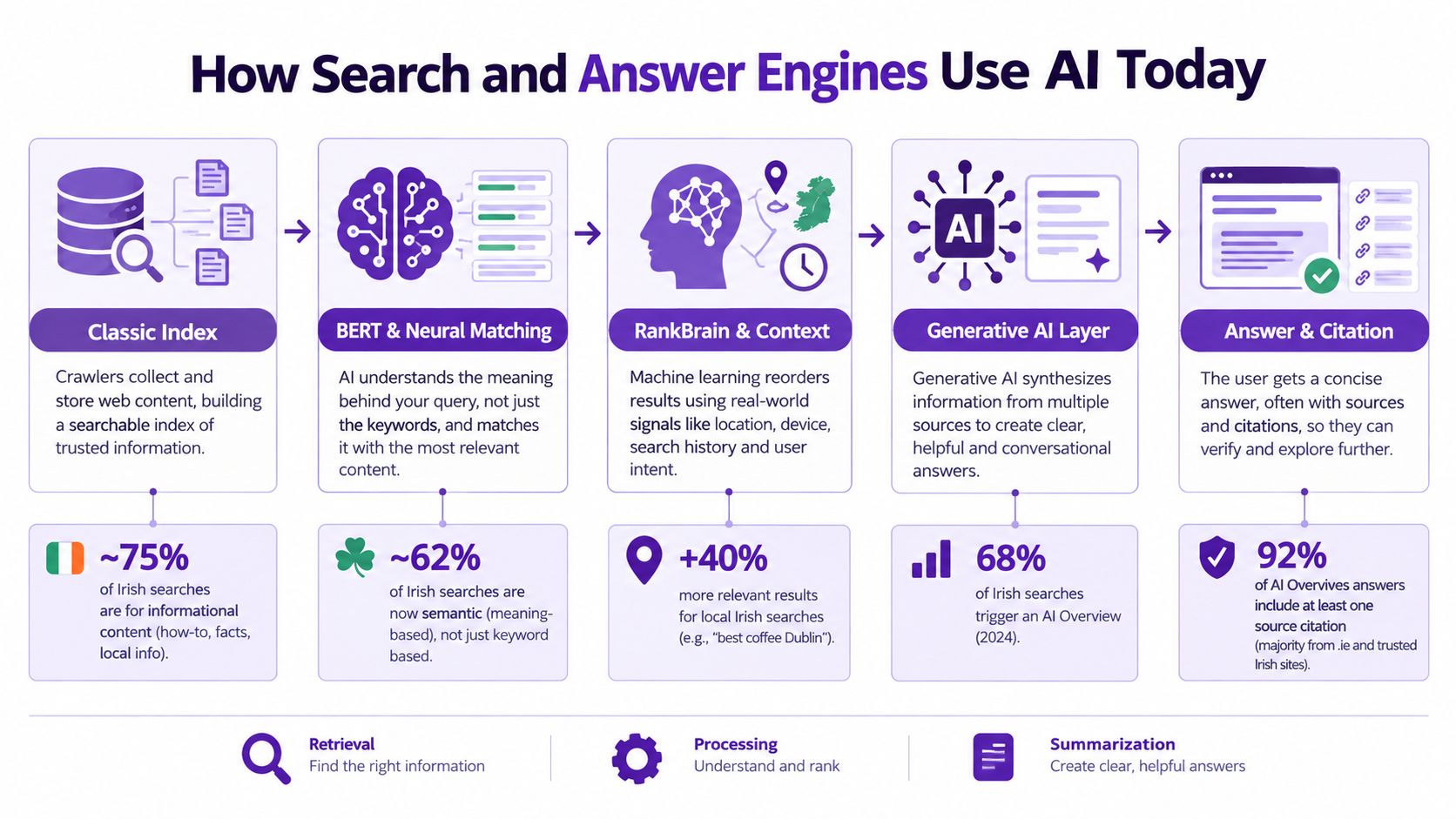
A buyer searching for an Irish software provider may see a conventional result, an AI-generated summary, or both. Modern search experiences combine retrieval, ranking and synthesis. An index supplies candidate documents, machine-learning systems assess relevance and context, and a generative layer can assemble an answer from selected passages. Google, ChatGPT, Perplexity, Copilot and Gemini apply these stages differently, so no formatting change guarantees inclusion.
The practical point is that AI systems often evaluate passages rather than whole pages. They locate sections that address the query, compare them with other sources, then judge whether the wording is clear and credible enough to cite or summarise. A page therefore needs useful standalone sections, not only a strong title and a broad topic.
Where Irish data changes the priority
The Irish AI Overview coverage cited in the previous section shows that the answer layer is significant, but not universal. Coverage at that level means optimisation should focus on the queries where an explanatory result is most likely, including definitions, comparisons, processes and recommendations. It also means passage quality matters. A page can rank conventionally while a concise, well-supported section from another source receives the first answer-layer interaction.
For Irish businesses, the opportunity is selective rather than a reason to rebuild every page. Prioritise passages tied to commercial intent, local relevance and questions customers ask.
Retrieval is only the first filter
Before selecting a passage, a system may assess:
Topical relevance: Does the section answer the user's question rather than collect related keywords?
Passage completeness: Can the extracted text make sense without missing context?
Entity clarity: Is it clear whether the passage refers to the company, product, location or another organisation?
Corroboration: Do credible sources support the description or claim?
Format suitability: Can headings, lists, tables and structured data be interpreted reliably?
Conventional rankings still affect what can be retrieved. Trust signals may then differ by query and source type. An assistant could weigh a local provider, national publication, directory or recognised global source differently, especially where the query carries location or purchase intent.
For Irish SaaS and ecommerce brands, that creates a measurable distinction between being present in the source set and being named in the answer. ChatGPT accounted for the largest share of Irish AI chatbot referral traffic in the periods covered earlier, while Perplexity and Copilot followed. Report referrals by assistant rather than placing every unfamiliar visit in a generic “other” channel. Compare sessions, engaged visits, assisted conversions and qualified enquiries across those sources.
A first organic position remains useful, but it cannot compensate for ambiguous branding, difficult page structure or evidence trapped in an image or disconnected PDF. Teams should make important claims visible in crawlable HTML and place the supporting context beside them. The wider mechanics are explained in this guide to how AI search works.
The Practical Optimisation Playbook
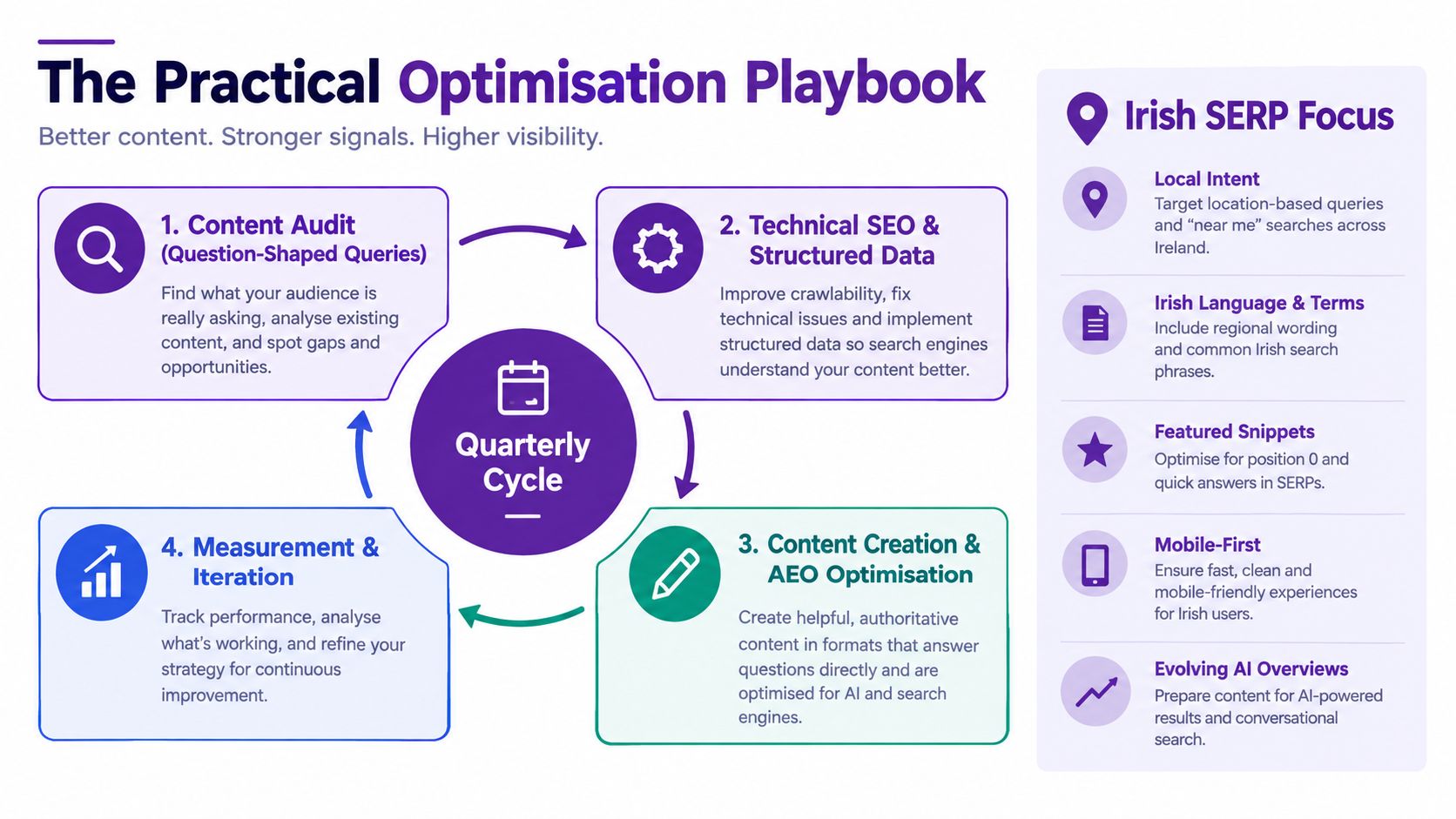
A useful quarterly programme starts with the existing site, not a new content factory. The objective is to identify pages with commercial relevance, remove the barriers that prevent reliable retrieval and improve the sections most likely to answer real questions.
Start with a query and content audit
Export priority queries from Google Search Console and group them by intent. Look for question-shaped searches, comparisons, definitions, implementation queries and location modifiers. Then inspect the pages that currently receive impressions but have weak engagement or unclear conversion paths.
For each priority page, record:
The question the page answers.
The shortest accurate answer that could stand alone.
The evidence supporting the answer.
The person, organisation, product or location being discussed.
The next action a qualified visitor should take.
Don't rewrite every page. Start with pages that already attract relevant demand, support a profitable service or sit close to a buying decision.
Make retrieval boringly reliable
Technical SEO is still the admission ticket. Check that important HTML pages are crawlable, indexable and internally linked. Review canonicalisation, redirects, page templates, mobile rendering and Core Web Vitals. Irish users may access pages through a wide range of mobile connections and devices, so a technically heavy experience can hurt both human engagement and the quality of the signals collected from that visit.
Keep core information in visible HTML. Don't put a service definition only inside an image, a PDF or an interface element that requires complex interaction. Use descriptive title tags, a clear H1 and headings that describe the question answered by each section.
Add structured data with a reason
Schema won't turn weak content into a citation. It can, however, help machines classify the content and connect it with the correct entity.
Prioritise markup according to the business model:
Organisation: Identify the business, logo, contact details and relevant profiles consistently.
Product: Clarify products, offers and attributes on ecommerce or software pages.
FAQPage: Use only where genuine questions and answers are visibly present and appropriate.
HowTo: Mark up real procedures that are published as accessible instructions.
Article: Connect editorial content with its headline, author, publisher and publication details.
Validate the implementation and keep the visible copy aligned with the structured fields. Overstated or contradictory markup creates ambiguity instead of trust.
Use prompts as a research aid, not an editorial substitute
AI tools can help cluster queries, identify missing subtopics, draft alternative headings and turn a long explanation into a concise answer block. They shouldn't invent customer evidence, regulatory details, product capabilities or local claims.
Give the tool a defined source pack, a target audience and a list of facts it must not alter. A subject-matter expert should review every commercial page, particularly for accountancy, legal, financial, healthcare and technical services. Record the prompts, source material and approval decision so the workflow remains governed rather than improvised.
Editorial rule: Use AI to increase the number of useful options your team can review. Don't use it to remove accountability for what gets published.
Measure the journey, not just the mention
Search Console can show changes in impressions, clicks, queries and page performance, although it won't provide a complete view of every AI answer. Create a reporting segment for referrals from ChatGPT, Perplexity and Copilot, and preserve the original landing URL where analytics allows it.
Use tagged canonical URLs in campaigns and partner content, inspect server logs when referral data is incomplete and connect landing pages to CRM stages. The key question is not merely whether an assistant mentioned the brand. It's whether AI-influenced discovery produced a useful session, a sales conversation or a qualified opportunity.
Teams looking for a service-based implementation can review AI search optimisation support from Scéaled alongside an internal programme or another specialist provider. The selection criterion should be the quality of the audit, implementation and measurement plan, not the novelty of the label.
Tailoring the Approach Across B2B SaaS SMEs and Ecommerce
The same foundations apply across sectors, but the content that earns useful visibility changes with the buying journey. A SaaS company needs to be understood in technical and use-case terms. A professional services firm needs credible people and local context. An ecommerce site needs product facts that can survive comparison.
B2B SaaS
SaaS teams should prioritise integration pages, use-case pages, technical documentation and honest comparison content. A page explaining how a platform connects with a named tool can answer a high-intent question more effectively than a broad article about innovation.
Comparison pages should state the decision criteria clearly. Include the use case, limitations, implementation requirements and the type of customer each option suits. AI systems can summarise a balanced comparison more confidently than a page that repeats promotional adjectives.
Professional services
Accountancy, legal, recruitment and consultancy firms should make practitioner expertise visible. Author bios, service-specific pages, local proof points, explanatory articles and consistent organisation details give answer systems more context when a user asks for a provider in a particular Irish region.
Dublin shouldn't be the default location for every national query. A firm serving Galway, Cork, Limerick or smaller communities should publish useful location-specific information rather than creating near-identical pages with swapped place names.
Ecommerce and lean SMEs
Ecommerce teams should focus on product schema, clear attributes, comparison tables, delivery information and “versus” content where the comparison is commercially relevant. Keep product facts consistent between product pages, feeds, reviews and supporting editorial content.
Small teams need a narrower scope. A handful of strong pillar pages, sound homepage organisation markup, accurate service or product information and a consistent review process will usually create a better base than a large batch of generic AI-written articles.
Tactic | B2B SaaS | Professional Services | Ecommerce | SME |
|---|---|---|---|---|
Comparison content | High priority for category and use-case decisions | Useful for explaining service options | High priority for product alternatives | Select only commercially important comparisons |
Integration or process pages | Core asset for technical evaluation | Explain the client journey and deliverables | Explain fulfilment, returns and product use | Focus on the main service process |
Entity and author clarity | Connect product, company and technical team | Make practitioners and locations explicit | Connect brand, products and policies | Keep organisation details consistent |
Structured data | Organisation, Product and Article where relevant | Organisation, Article, FAQPage or HowTo where justified | Product and Organisation | Start with Organisation and the primary offer |
Trust signals | Customer evidence and credible documentation | Reviews, professional profiles and local mentions | Reviews, policies and product evidence | Consistent reviews and local relevance |
The convergence is clear, crawlable content and accurate business information. The divergence lies in what buyers need to verify before they contact or purchase.
Common Misconceptions That Waste Budget
The most expensive misconception is that AI visibility requires a completely separate channel. It usually doesn't. A business that invests in relevant content, reliable technical foundations, clear entities and credible evidence is already improving the inputs that answer systems need.
The mistake is treating the AI layer as a reason to abandon fundamentals. A poorly linked site with vague service pages won't become authoritative because a team adds a chatbot-monitoring subscription.
More AI content doesn't mean more citations
Raw AI output tends to repeat familiar phrasing, flatten useful distinctions and introduce unsupported details. Search systems assess usefulness and quality, so publishing large volumes of unreviewed material can dilute topical focus and create editorial risk.
Use AI for research support, clustering and drafts. Add original experience, accurate examples, expert review and a clear reason for the page to exist. A smaller library of specific pages is more defensible than a large archive that says little.
Schema isn't a replacement for content
Structured data helps describe a page, product or organisation. It doesn't prove that the underlying information is accurate, useful or worthy of citation. Treat schema as a machine-readable label attached to visible, maintained content.
AI traffic isn't automatically untrackable
Referral reporting can be incomplete, but that's different from invisible. Analytics platforms may show referrals from ChatGPT, Perplexity or other assistants when the visit passes referral information. Tagged URLs, landing-page analysis, server logs and CRM attribution can fill gaps.
Track the limits. Don't claim that every AI-influenced lead is measurable, but don't give up on measurement because attribution isn't perfect. A practical discussion of the implementation risks appears in guidance on AI search problems.
Governance belongs in the workflow
Create an approval process for factual claims, regulated topics, customer data and brand representation. Keep a source record for important pages, assign a human owner and review content when products, policies or market conditions change.
Budget test: If a proposed AI SEO activity can't identify the page, query, audience and commercial metric it should improve, it isn't ready for investment.
Your First 90 Days of SEO in AI
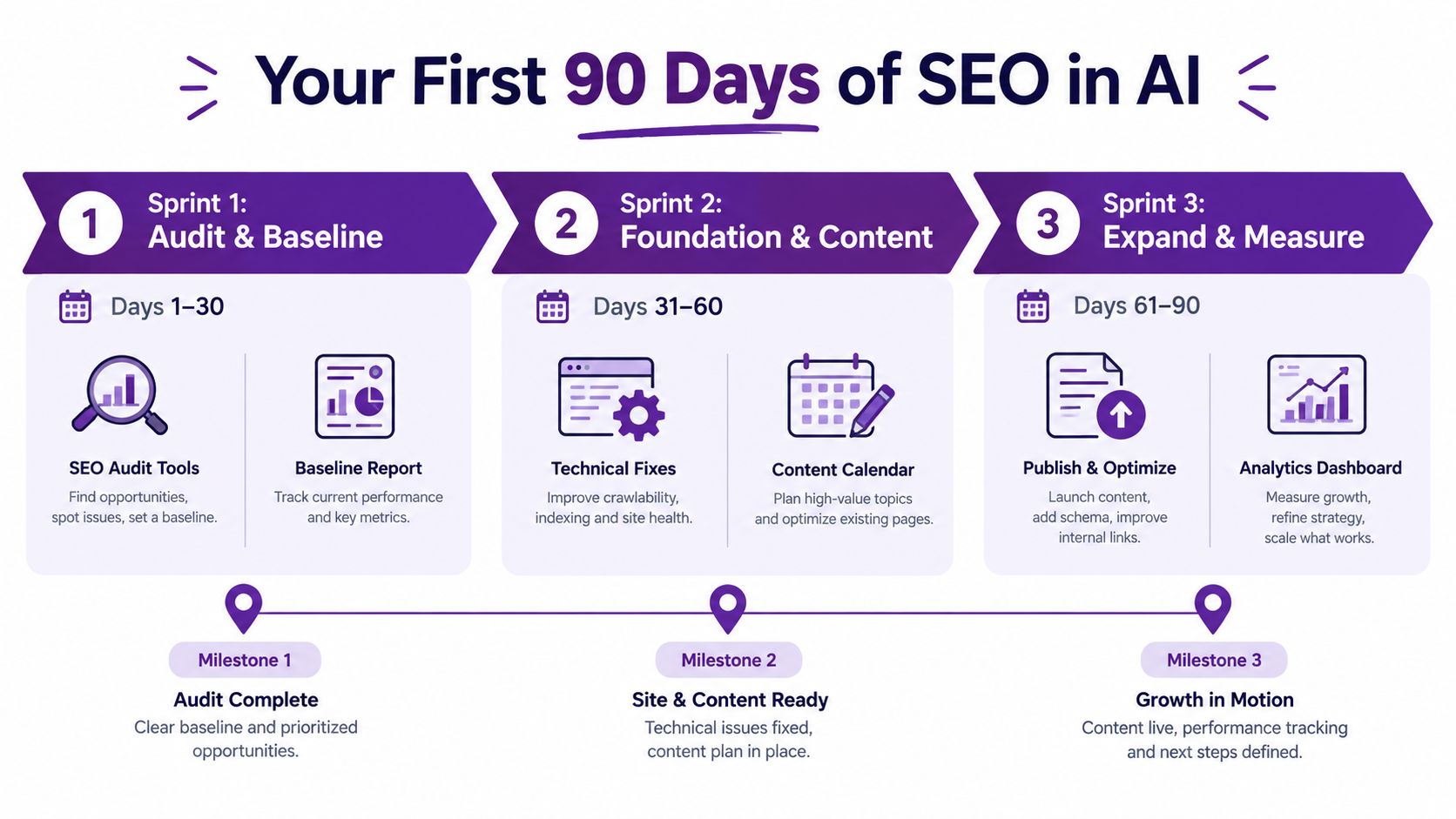
A small Irish team can begin without rebuilding its website. The first cycle should establish visibility and tracking, improve the pages closest to revenue and create a repeatable review habit.
Sprint one, audit and baseline
The founder or marketing lead should:
Audit priority queries for organic results, AI Overviews and assistant mentions.
Identify high-value pages with strong impressions or weak conversion.
Check crawlability, internal links, canonicals, mobile performance and structured data.
Create referral segments for ChatGPT, Perplexity and Copilot.
Record a baseline for qualified organic enquiries, AI referral sessions and assisted conversions.
Progress metric: a trusted baseline dashboard with agreed definitions for AI-influenced sessions and opportunities.
Sprint two, foundation and content
The marketer and developer should:
Rewrite priority pages around explicit customer questions.
Add concise, self-contained answers, comparison tables and clear subheadings.
Implement relevant Organisation, Product, Article, FAQPage or HowTo markup.
Improve author, location, product and service consistency.
Link each revised page to a clear commercial next step.
Progress metric: the number of priority pages that pass content, technical and structured-data review.
Sprint three, expand and measure
The content owner should run prompt tests across realistic buyer questions, brief subject-matter experts and compare whether the brand is named, accurately described and linked. The developer or analytics owner should connect assistant referrals with landing pages and CRM outcomes, while the founder reviews lead quality rather than chasing mentions alone.
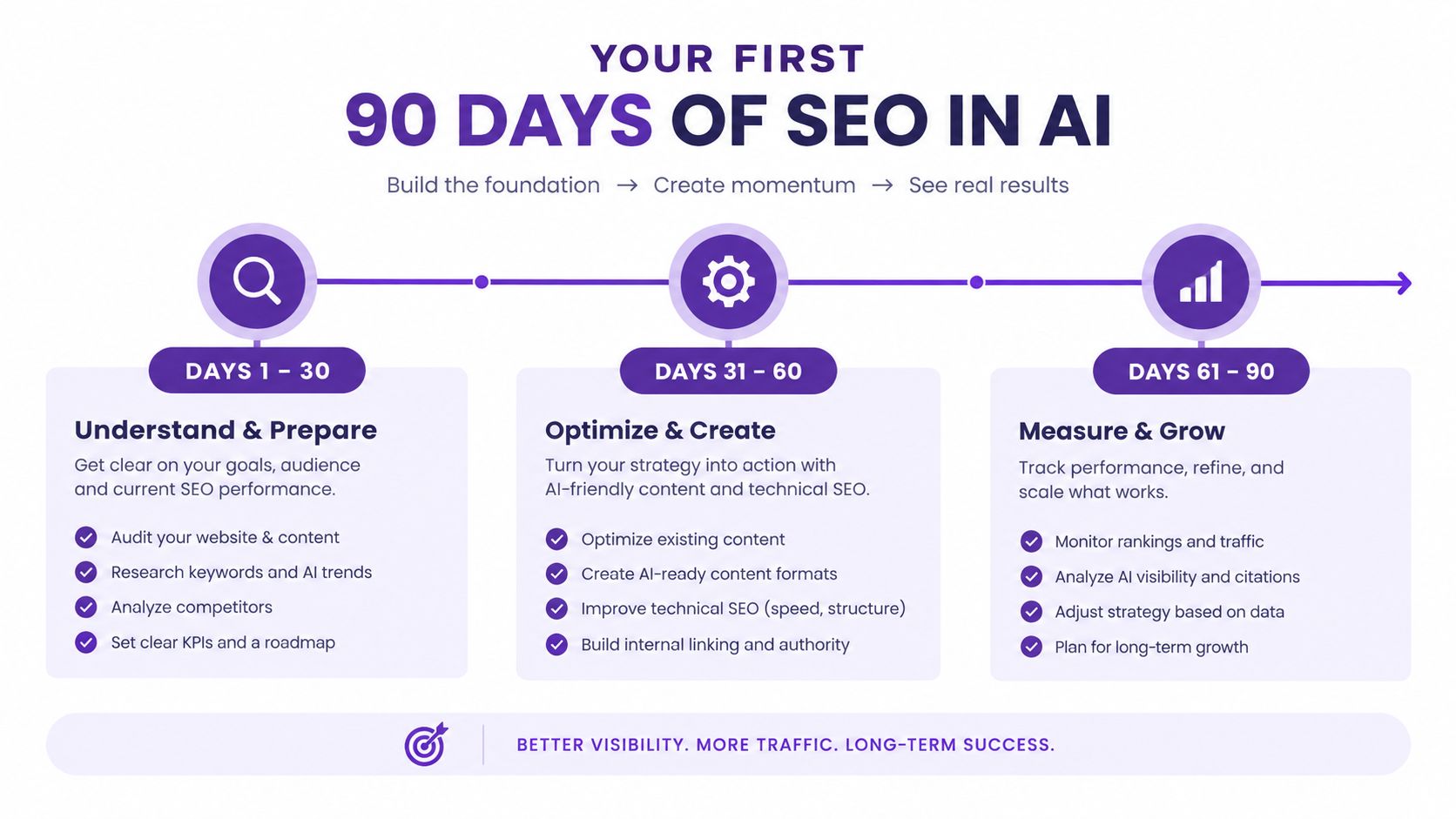
At the end of the cycle, keep the pages that produced useful engagement, revise those that attracted irrelevant demand and add the next set of question-led topics. The strongest programme treats AI visibility as a quarterly SEO operating rhythm, not a one-off technical launch.
Scéaled helps Irish businesses connect SEO, AEO, content, measurement and conversion work so visibility can support qualified demand across search engines and AI answer platforms. Visit Scéaled to discuss an evidence-led plan for improving how your business is found, understood and considered.
Comments