AI Search Help That Grows Visibility and Conversions

A buyer in Dublin asks, “Which software firm can help us automate customer support without creating compliance headaches?” Instead of opening ten search results, they type the question into an AI search experience and receive a short recommendation, supporting explanations and a handful of cited businesses. Your company might be relevant, but if the answer engine can't understand your services, location, expertise or evidence, you may never enter the conversation.
That shift creates a practical challenge for Irish SMEs and mid-market firms. AI search help isn't a standalone button you switch on. It connects content, technical SEO, paid media, conversion optimisation, analytics, customer data and governance into one growth system.
The central idea: AI search can create visibility, but connected marketing turns that visibility into qualified enquiries, sales conversations and revenue.
Ireland's rapid adoption makes this urgent. Research from Trinity Business School and Microsoft found that AI adoption in the Republic of Ireland rose from 49% in 2024 to 91% in 2025, while 92% of surveyed organisations either had AI in active use or had a defined deployment plan. The same research found that 38.8% said AI tools were already implemented and actively used in day-to-day operations, as reported in the Trinity Business School and Microsoft AI Economy Report.
This guide moves from basic principles to implementation. You'll learn how AI search interprets intent, where answer-engine optimisation fits, how to prepare data and content, which signals to measure, and why governance matters. You'll also see how an Irish public-sector example translates into practical choices for ecommerce, B2B, SaaS and professional services teams.
Table of Contents
What AI Search Is and How It Understands Intent - From matching words to understanding meaning - RAG in plain English
Why AI Search Matters for Discovery Conversion and AEO Readiness - Three commercial outcomes to prioritise
How to Implement AI Search From Data to Governance - Start with data preparation - Structure content for retrieval - Choose retrieval and model components carefully - Design the experience before scaling it - Add analytics and governance
Measuring and Optimising AI Search Performance - Build an optimisation loop
Common Pitfalls and How Scéaled Helps You Integrate AI Search - A practical decision checklist
Introduction to AI Search Help for Growing Businesses
A traditional search journey starts with a phrase such as “accountancy firm Galway” or “CRM for Irish construction companies”. The search engine returns pages, adverts, maps and other features. The buyer compares options, visits websites and decides which companies deserve attention.
An AI-assisted journey sounds different. The buyer may ask, “What CRM works well for a growing construction business in Ireland, and which suppliers offer implementation support?” The system tries to interpret the need, assemble an answer and point the user towards useful sources. The buyer might still visit your website, but they may first encounter your brand inside an answer, comparison or recommendation.
That changes the marketing question. It isn't only, “Can we rank for this keyword?” It becomes, “Can search systems recognise what we do, who we serve, where we operate and why our information is trustworthy?”
For a local professional services firm, that means making services, locations, team expertise and customer questions clear. For a B2B technology company, it may mean organising product documentation, use cases, integrations and commercial pages so that both people and machines can connect the pieces. For an ecommerce business, it means giving search systems reliable information about products, availability, suitability and delivery.
The work still depends on familiar foundations. Search engines and AI systems need crawlable pages, meaningful headings, useful internal links, accurate metadata and content that answers real questions. They also need a clear path from discovery to action, otherwise a business can earn attention without generating a useful commercial outcome.
This is why AI search help should sit inside a wider growth roadmap rather than operate as an isolated experiment. Scéaled's connected approach brings together SEO, AEO, paid media, content, conversion optimisation, analytics and automation, so teams can decide what to improve first and how each activity supports the next.
By the end, you'll have a practical way to assess your current position. You can use it to brief an agency, align an in-house team, or decide whether a technical project, content programme, measurement upgrade or conversion test should come first.
What AI Search Is and How It Understands Intent
A business owner may search for “cover if a customer is injured on my premises” without typing “public liability insurance”. Traditional keyword matching can struggle because the exact phrase is missing. AI search works to connect the question with the underlying need, then identify pages that explain the relevant service.
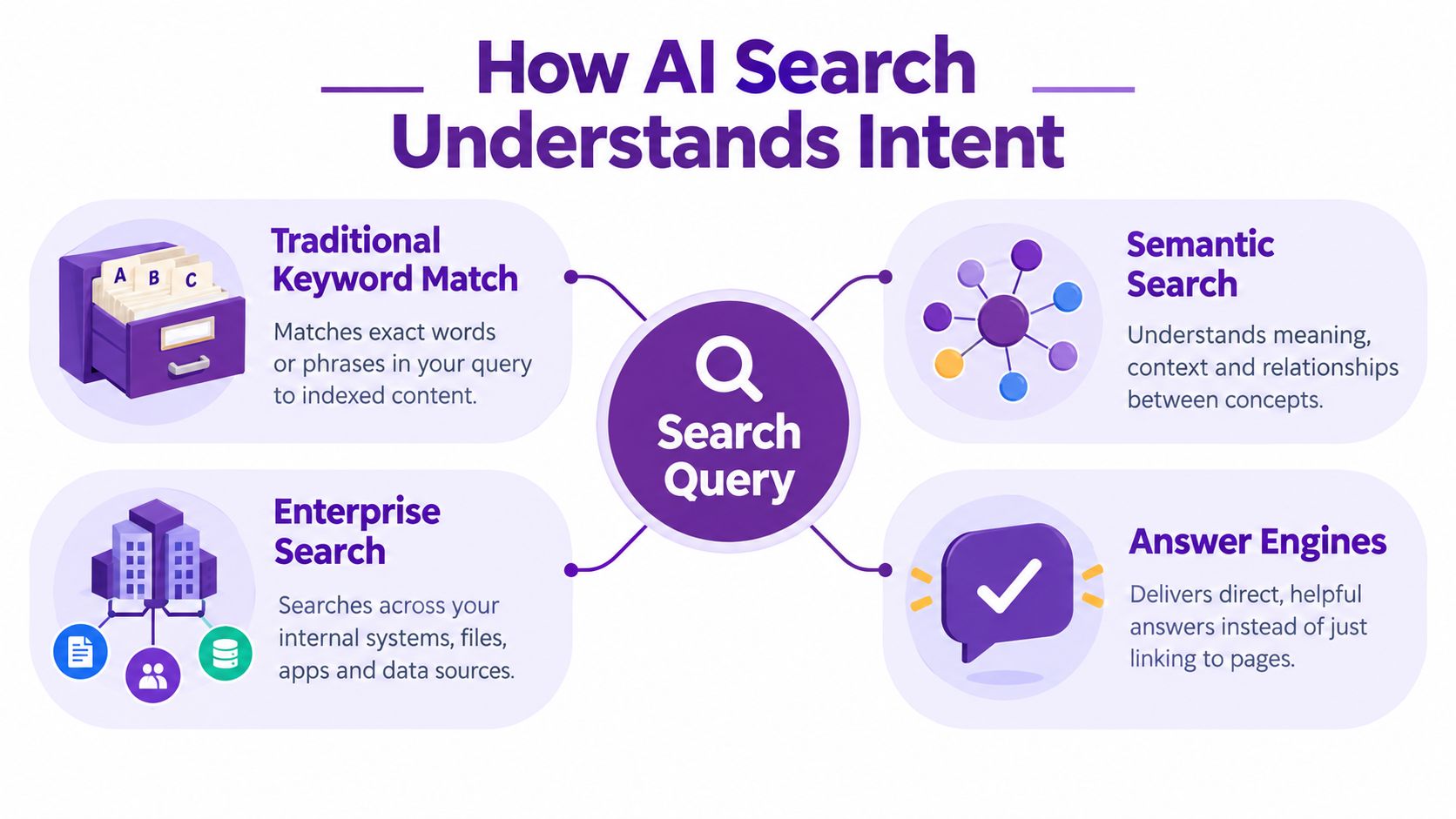
Traditional search still provides the foundation. It works like a library index, linking words on a page with the words in a query. Semantic systems add context by recognising related concepts, entities and the action the searcher wants to take.
From matching words to understanding meaning
Semantic search examines meaning rather than relying only on exact wording. “How do I reduce support workload?” may connect with knowledge bases, self-service content, ticket deflection, automation and customer-service software. The system is trying to understand the job behind the question.
Enterprise search applies the same principle within an organisation. It can examine internal documents, product records, policies, contracts and support material, bringing scattered knowledge into one search experience. That only works reliably when information is organised and access controls are respected.
Answer engines work across available sources. They retrieve information, interpret the request and produce a direct response instead of returning only a list of pages. Conventional search indexes may still provide the raw material, while the answer engine assembles it around inferred intent.
Ireland's gov.ie search offers a public example. Its AI search uses a hybrid retrieval-augmented generation, or RAG, design that combines keyword search with AI-assisted ranking. Results are prioritised by inferred intent rather than exact-word matching. The service remains in beta and is limited to the main gov.ie search, according to the gov.ie explanation of AI search.
RAG in plain English
Retrieval-augmented generation means the system first finds relevant information, then uses an AI model to formulate an answer from that material. The process works like a concierge checking a catalogue, locating suitable books and explaining the answer from what was found.
The model needs current, relevant and authorised content, rather than relying only on general training. Inconsistent product information makes it harder to choose the correct version. Facts hidden in an image, inaccessible PDF or unlinked document are also harder to retrieve.
A practical model is:
Keywords identify language.
Semantic search connects meaning.
Enterprise search finds relevant internal knowledge.
Answer engines combine retrieved information into a response.
For Irish SMEs, this is a connected implementation problem. Content, structured data, technical access and governance must help the same information move from discovery into a useful answer and then toward an appropriate commercial next step. A clear explanation of the relationship appears in how AI search works in Google.
Why AI Search Matters for Discovery Conversion and AEO Readiness
A buyer searches for help with a problem your business solves. An AI-generated answer names the relevant service, explains the next step and introduces your company before that buyer creates a shortlist. That is the commercial shift: discovery, conversion and answer visibility now depend on connected information, not on a standalone search tool.
The first mention can affect which providers the buyer considers, what they expect from your website and whether your offer appears suitable. Clear expertise gives the buyer useful context and gives the search system reliable material to retrieve and present.
Ireland's adoption figures show why this affects growing businesses. Trinity Business School and Microsoft research reported that AI adoption rose from 49% in 2024 to 91% in 2025, with 92% of organisations either already using AI or having a defined deployment plan, and 38.8% reporting active day-to-day use, according to the AI Economy Report for Ireland. As organisations and customers become more comfortable with AI interfaces, marketing teams need to prepare for discovery that may begin with an answer rather than a conventional results page.
Three commercial outcomes to prioritise
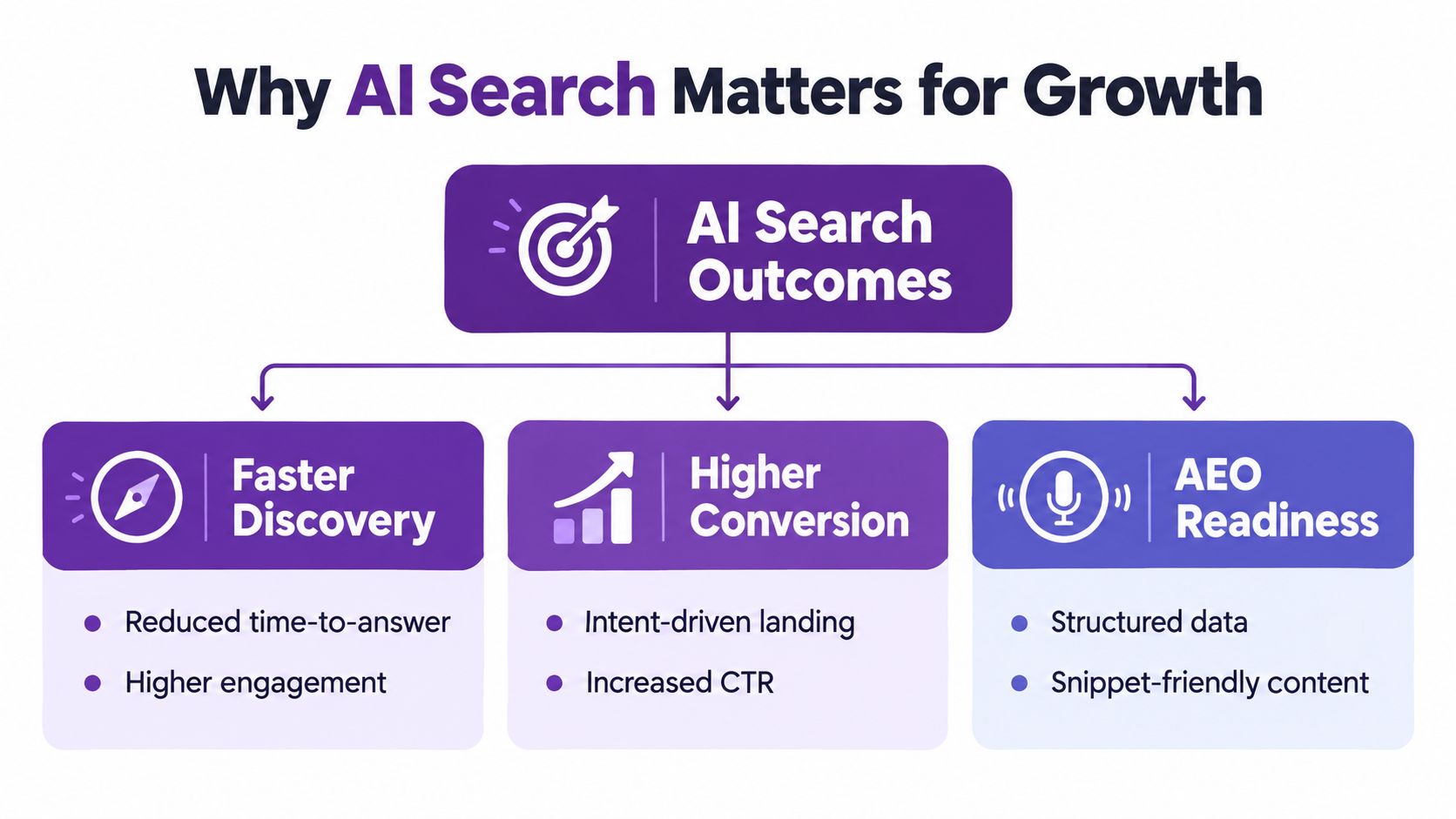
Faster discovery means matching a question with the right page, product, service or explanation. Clear information architecture reduces the work required to understand what your company offers. Local relevance matters too, particularly for Irish SMEs serving defined regions or communities.
Higher conversion depends on what happens after discovery. An AI answer about implementation support should lead to a page that explains the service, addresses objections and offers a clear next action. A generic homepage forces the visitor to search again, adding friction at the point of intent.
AEO readiness prepares content and technical foundations for answer-oriented search. Useful work includes concise answers, descriptive headings and metadata, connected internal links, clear entity relationships and suitable structured data where relevant. These elements help the same information move from discovery into an answer and then towards a commercial action.
Prioritise the integration work according to the problem your team can observe:
If buyers struggle to find you: Review service language, local relevance, technical SEO and topic coverage.
If visitors arrive but do not enquire: Improve landing-page alignment, proof, calls to action and form or booking journeys.
If content exists but is not surfaced: Audit headings, internal links, metadata, structured data and answer clarity.
If staff answer the same questions repeatedly: Organise internal knowledge and assess enterprise search or support automation.
If reporting only shows rankings: Add visibility, citation, engagement and commercial outcome signals.
AI search help belongs alongside paid search, paid social and CRO. Paid campaigns reveal demand, SEO supports discoverability, content addresses objections, and conversion optimisation turns attention into action. The growth stack works when these activities share accurate information and a connected implementation roadmap, rather than operating as separate projects.
How to Implement AI Search From Data to Governance
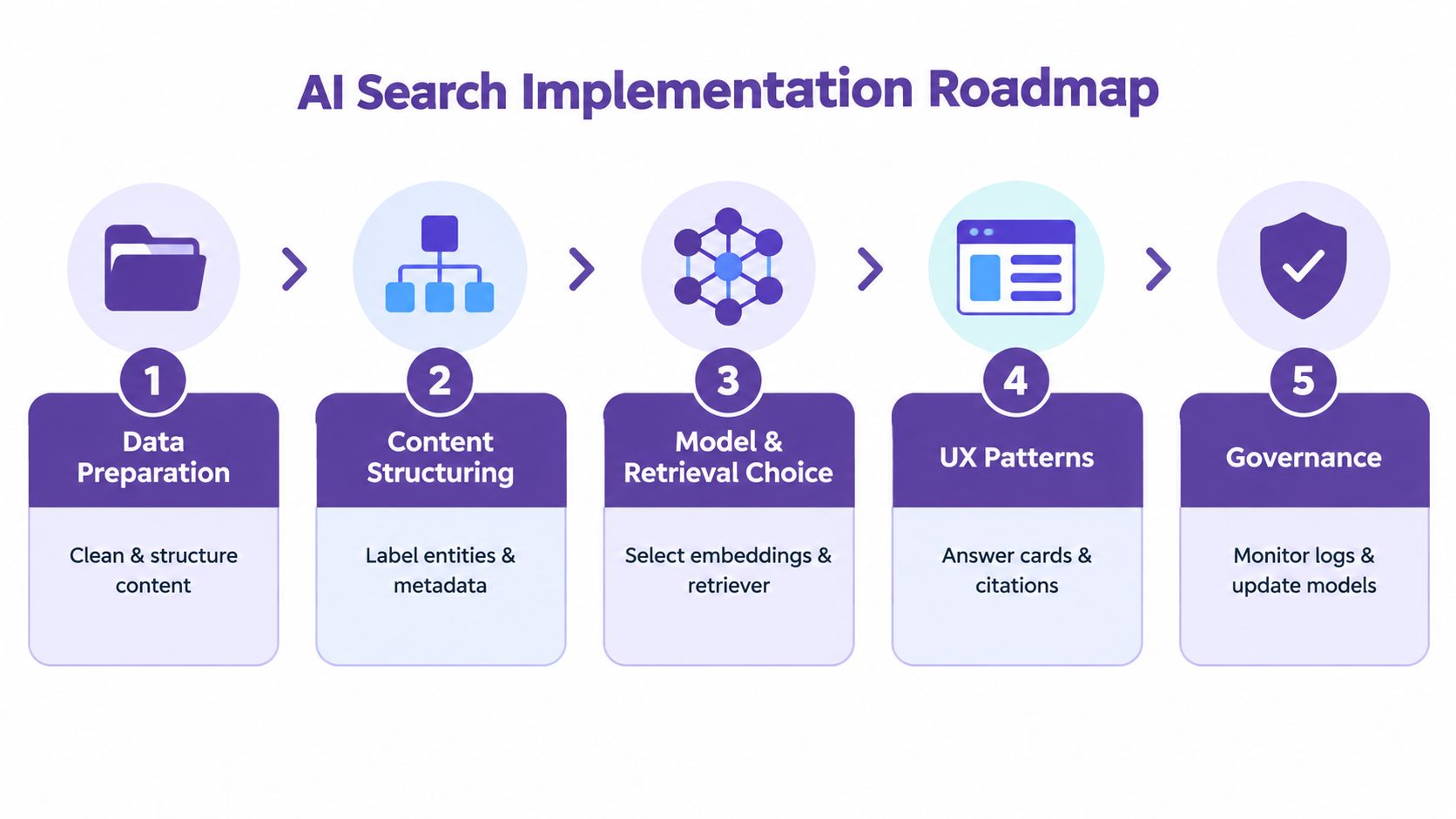
A reliable implementation starts with information, not an AI model. If the source content is outdated, contradictory, or poorly labelled, a more advanced retrieval system will find and present the wrong material more efficiently.
Start with data preparation
Create an inventory of the content that search users, customers and staff need. Include service pages, product data, pricing explanations, technical documentation, support articles, case material, policies and location information.
Then check each item for:
Accuracy: Does the page reflect the current offer and process?
Ownership: Is someone responsible for reviewing it?
Consistency: Do names, product descriptions and service terms match elsewhere?
Accessibility: Can users and crawlers reach the information without unnecessary barriers?
Context: Does each page explain who the information is for and what action follows?
A clean source of truth supports SEO, paid landing pages, sales enablement and customer service at the same time.
Structure content for retrieval
Organise pages around clear entities and relationships. A software product page should connect the product to its features, industries, integrations, support model and implementation process. A professional services site should connect each service to the problems it solves, the people who deliver it, the locations served and the questions prospects ask.
Use descriptive headings rather than vague labels. Put important answers in HTML text, not only inside images or hard-to-interpret documents. Tables, numbered processes, FAQs and concise answer blocks can make complex information easier to reuse.
Internal linking also matters. A guide about payroll compliance should connect naturally to the relevant service page, contact route and supporting resources. That structure helps users continue their journey and helps search systems understand how the information fits together.
Choose retrieval and model components carefully
The right setup depends on the use case. A website search experience may need a different retrieval approach from an internal knowledge assistant. A support tool may require strict permissions and citations, while a marketing content system may focus on crawlability, entity clarity and answer eligibility.
Don't begin with a model choice and force the business problem to fit it. Define the questions users ask, the information they need, the acceptable sources and the action that should follow. Then select the retrieval and generation components that support those requirements.
Design the experience before scaling it
An answer isn't automatically useful because it sounds fluent. Users need to know where the information came from, whether it applies to them and what they can do next.
Useful patterns include answer cards, source links, related questions, product comparisons, filters and clear escalation routes. For a customer-service assistant, escalation to a person should be easy when the question involves risk, uncertainty or account-specific information.
Add analytics and governance
Instrument the journey before launch. Capture the questions users ask, searches that return no useful result, content selected for answers, clicks on sources, follow-up actions and handoffs to staff.
Governance should cover content review, access permissions, privacy, brand tone, incorrect-answer handling and change management. Assign owners for source data and define what happens when a product, regulation, policy or service changes.
Practical rule: Build a smaller, well-governed information set first. Scale only after users can find accurate answers and staff can see where the system needs improvement.
Measuring and Optimising AI Search Performance
Traditional SEO reporting often centres on rankings, impressions and organic clicks. Those measures still help, but they don't explain every way an AI-assisted search journey can create value.
An Irish analysis of 175 million searches reported aggregate organic click-through rate falling from 3.62% to 2.67%, while average ranking position improved slightly from 6.38 to 6.18. The same analysis reported AI Overviews on 12.00% of tracked Irish queries, using Ahrefs data, as detailed in the analysis of zero-click search in Ireland.
The lesson is straightforward. A better average position doesn't guarantee more visits when the search interface answers the question directly. Your reporting needs to distinguish between being visible, being cited, receiving a click and generating a commercial action.
Traditional Metric | AI Search Metric | What It Tells You |
|---|---|---|
Average ranking position | Answer placement or citation visibility | Whether your information appears in the response |
Organic click-through rate | Source click and assisted engagement | Whether users want to investigate further |
Impressions | Prompt or query coverage | Whether priority questions trigger relevant visibility |
Sessions | Task completion | Whether the user found a useful answer |
Form submissions | Qualified conversion rate | Whether visibility contributes to demand |
Bounce rate | Follow-up actions and escalation | Whether the answer supports the next step |
Build an optimisation loop
Start with query analysis. Review the language customers use in site search, sales calls, support tickets, paid-search reports and website analytics. Group questions by intent, such as learning, comparing, buying, troubleshooting or finding a local provider.
Next, inspect the answer or landing experience. Does it address the actual question? Is the answer self-contained? Does it identify the company, service, location or product clearly? Can a user verify the claim and take the next step?
Then refine the content and retrieval rules. Improve terminology, add missing context, strengthen links between related pages and remove contradictions. Test different answer formats where the experience allows it, such as a short summary, comparison table, product filter or guided enquiry route.
Finally, connect visibility to business outcomes. Track qualified enquiries, booked calls, product actions, assisted conversions and sales feedback. AI search optimisation should be judged by its contribution to the whole journey, not by a single ranking screenshot.
Real World Examples of AI Search in Action
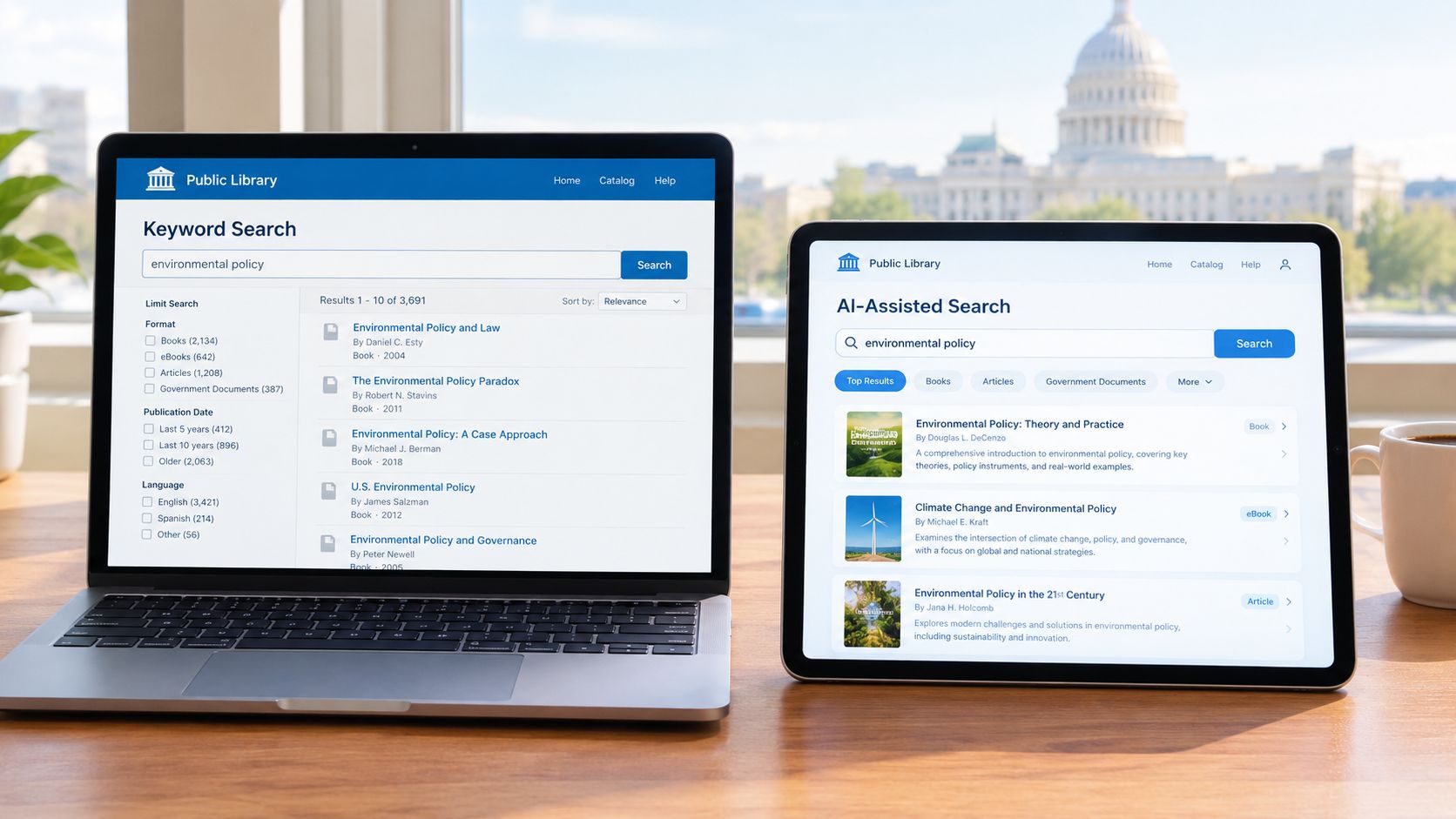
A public-sector search service shows how intent-based retrieval can address a common problem. Government websites bring together policies, services, guidance and forms written by different teams. Citizens may understand the task they need to complete without knowing the official wording used on the relevant page.
Ireland's gov.ie AI search uses hybrid RAG, combining traditional keyword search with AI-assisted ranking. Results can therefore reflect inferred intent instead of relying only on exact-word matches. The service is in beta and limited to the main gov.ie search, but it illustrates a useful approach for smaller organisations: connect natural customer questions to reliable source information and suitable next steps.
An outdoor equipment retailer may receive a question about choosing a jacket for wet, windy commuting. The customer may not search for a product name. An effective search experience connects weather protection, fit, use case, materials, stock and delivery details, then directs the customer to suitable products. That result depends on consistent product data and terminology across product pages, buying guides and campaign landing pages.
A B2B software company has a different information problem. Prospects may ask about data migration, user permissions or integration with existing systems. If those answers are spread across sales decks, help articles and technical pages, the company can connect them into a shared knowledge structure. The same structure supports marketing discovery and gives sales teams clearer material for follow-up conversations.
For a professional services firm, AI search can qualify demand before a consultation. Pages that explain the client type, service scope, location and next steps help prospects decide whether to enquire. They also give the team more context when a lead arrives.
Across these examples, the implementation roadmap follows the same growth stack. Discovery starts with questions, conversion depends on relevant destinations, and AEO readiness depends on accurate, connected information. The transferable lesson is to link customer questions with clean data, useful pages and a measurable action, rather than copy a particular interface.
Here is a visual explanation of how answer-oriented experiences can support discovery and decision-making:
Common Pitfalls and How Scéaled Helps You Integrate AI Search
The first mistake is treating AI search as a content generator. More pages won't solve unclear positioning, weak information architecture or conflicting product details. Teams should fix the source material before adding automation.
The second is relying on rankings alone. A company can appear prominently and still lose attention when the search interface supplies a direct answer. Measure citations, source engagement, task completion and qualified actions alongside conventional SEO signals.
A third problem is separating AEO from conversion work. If an answer introduces your service but the landing page doesn't support the promise, visibility won't become demand. Content, paid media, SEO and CRO need shared definitions of audience, intent, offer and success.
A practical decision checklist
Information quality: Are your key services, products and policies current, accessible and consistent?
Intent coverage: Have you mapped the questions buyers ask before they contact you?
Technical readiness: Can search systems crawl, interpret and connect your important pages?
Commercial alignment: Does each high-value answer lead to a relevant next action?
Governance: Who reviews accuracy, permissions, privacy and changes?
Measurement: Can you connect search visibility with qualified pipeline?
Ireland's AI use is already substantial. Microsoft reported that 48.4% of Ireland's working-age population were using AI in 2026, up 3.8 percentage points from the previous quarter, with Ireland ranked fourth globally for AI adoption. The Irish government also cited Ireland as fifth in the EU for generative AI adoption at 45%, compared with an EU average of 33%, as reported by Microsoft's Ireland AI adoption update.
Businesses that need to diagnose specific blockers can review common AI search problems. Scéaled can then support a connected programme across SEO and AEO, content, paid media, conversion optimisation, analytics, lead generation and process automation. The right starting point depends on whether your main constraint is discoverability, information quality, conversion friction, measurement or operational follow-through.
Scéaled helps Irish businesses connect AI search visibility with SEO, AEO, paid media, content and conversion optimisation, so discovery has a clear route to qualified demand. Visit Scéaled to discuss your current search journey, identify the highest-priority gaps and build an implementation plan around measurable commercial outcomes.
Comments