AI Search Optimisation for Irish SMEs

An Irish buyer searches for a specialist in their county, but they don't start with ten blue links. They ask ChatGPT, Perplexity, Gemini, or Google's AI search experience for a recommendation, a shortlist, or the answer to a practical question. Your competitor appears in the response because their services, location, credentials, and supporting evidence are easier for machines to verify. Your business may still rank in traditional search, yet remain absent from the answer that shapes the buyer's next step.
That gap is the operational challenge behind AI search optimisation. It isn't solved by adding a few phrases such as “AI search” to existing pages. Irish SMEs need accurate business data, accessible websites, answer-first content, independent proof, and a measurement system that connects citations with enquiries and revenue.
Table of Contents
Why AI Search Optimisation Matters for Irish SMEs - The adoption gap creates an opening
How AI Answer Engines Choose What to Cite - Evidence beats polished generalities
Building a Crawlable Business-Facts Ledger - Audit the technical access first - Reconcile the ledger across the web
Writing Answer-First Content That AI Systems Trust - Make every section independently useful - Use schema as reinforcement, not camouflage
Winning Visibility Across Fragmented AI Platforms - Local intent requires local proof - Test the same prompts repeatedly
Measuring AI Presence Rate and Business Impact - Build a useful measurement record
Why AI Search Optimisation Matters for Irish SMEs
A buyer looking for an accountant in Cork, a software implementation partner in Galway, or a commercial solicitor serving Meath may ask an AI assistant to narrow the market. The assistant has to decide which businesses are relevant, which claims it can support, and which providers appear credible for that specific location. If your website has inconsistent contact details, vague service descriptions, or little evidence beyond self-written marketing copy, the system has fewer reliable facts to use.
This is why AI search optimisation is becoming a commercial priority rather than an SEO experiment. AI adoption among Irish enterprises more than doubled from 8.1% in 2023 to 20.2% in 2025, according to the Central Statistics Office data summarised by the US International Trade Administration. Large enterprises reached 57.7% adoption, compared with 28.6% for medium-sized firms and 17.2% for small firms in the same release.
Those figures matter beyond technology procurement. Organisations using AI in daily operations are more likely to invest in content workflows, automation, data systems, and analytics. They're also more likely to compete for visibility across conventional search and AI-assisted answers. An SME that treats discovery as a list of rankings alone may miss how buyers now evaluate providers.
Commercial reality: a mention in an AI answer can influence consideration before a prospect visits a website, submits a form, or speaks with sales.
The adoption gap creates an opening
A separate ESRI working paper on Ireland's AI economy found that 13.8% of Irish SMEs reported using AI, up from 8% in 2023. It also reported that large-firm adoption in Ireland reached 51%, above the EU average of 41% in 2024, with Ireland ranked 7th among EU countries for large-company AI use.
The split is strategically useful. Larger organisations are building capability and may create stronger competition for broad commercial queries. Smaller firms remain earlier in adoption, which leaves room for businesses that organise their facts, improve their technical foundations, and publish useful local content before the market becomes more crowded.
Traditional SEO still matters. AI search optimisation adds another layer, making your company easier to identify, verify, summarise, and cite. A practical introduction to the wider discipline is available in Scéaled's explanation of AI search, but the immediate priority is operational: make sure an assistant can understand exactly who you serve, what you do, where you operate, and why a buyer should trust you.
How AI Answer Engines Choose What to Cite
A Dublin consultancy can rank well for “SEO agency” yet disappear when a buyer asks ChatGPT which firms serve regulated businesses in Leinster. The problem is often not visibility alone. The site may leave the answer engine with incomplete, conflicting, or weakly supported facts.
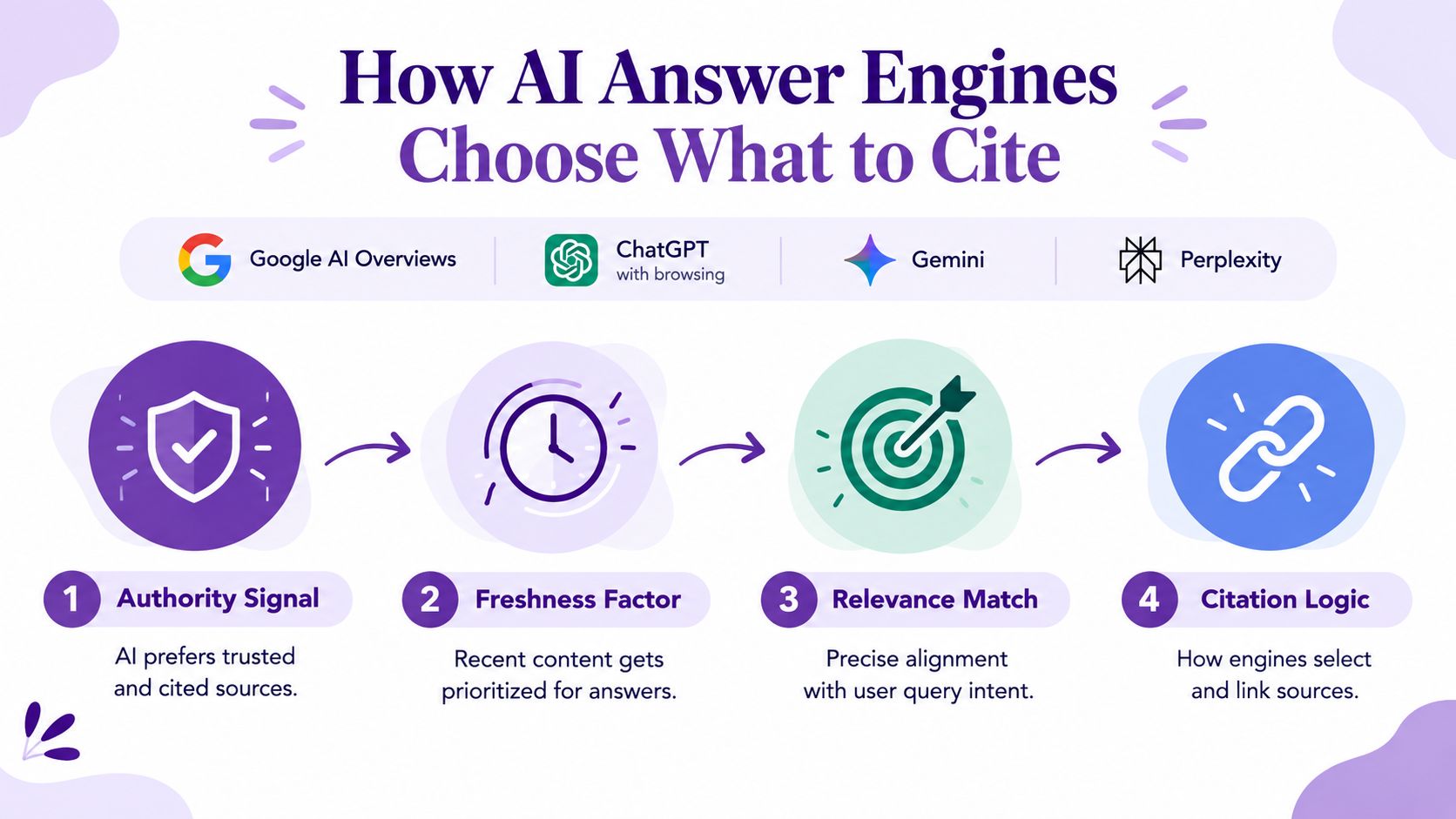
AI answer engines do not reproduce a traditional results page. Google AI Overviews, ChatGPT with browsing, Gemini, and Perplexity can retrieve pages, extract passages, compare sources, and assemble an answer around the user's intent. A technically accessible page can still supply poor citation material if its claims are broad, inconsistent, or difficult to isolate.
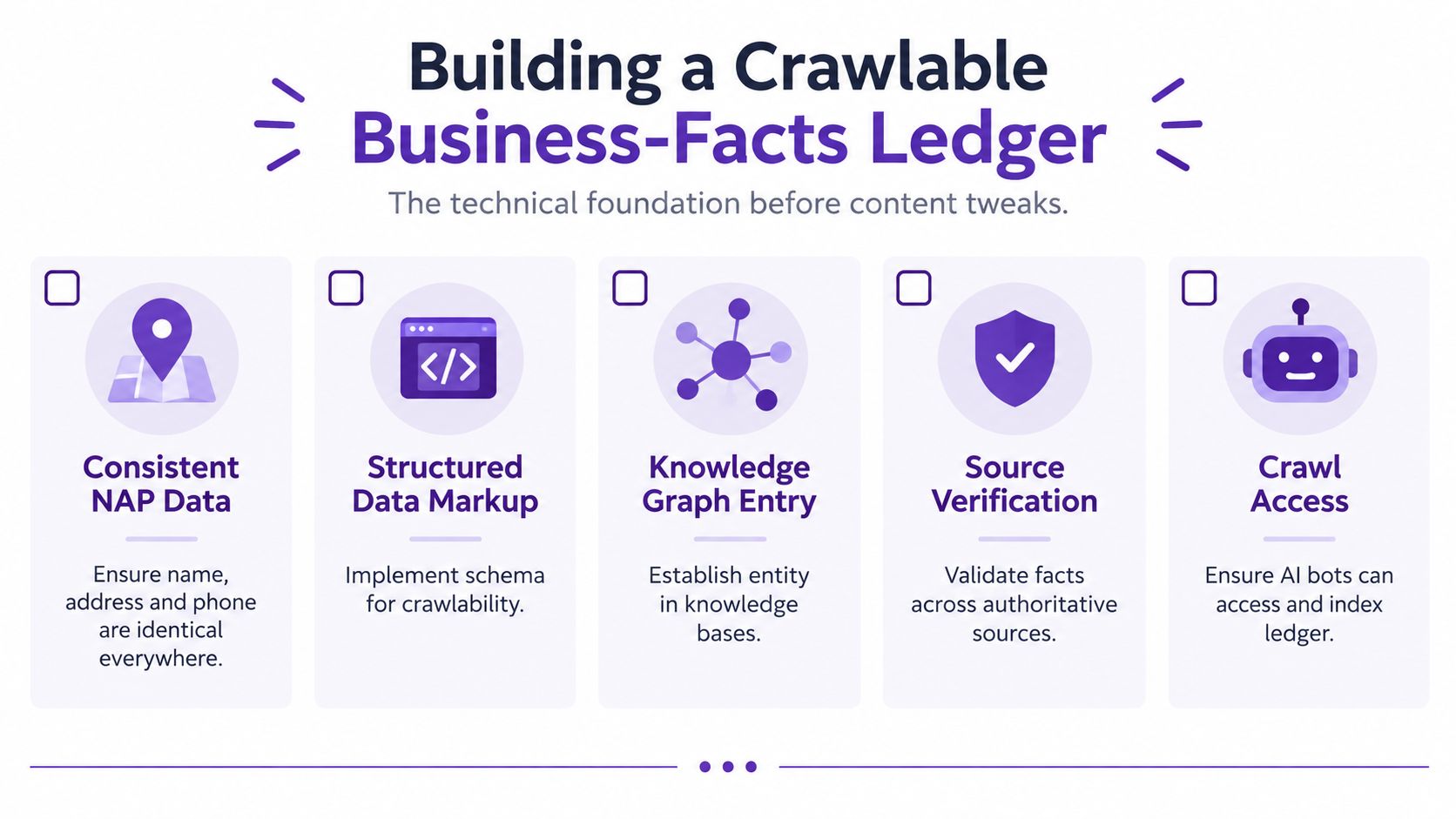
The practical model is a business-facts ledger: a controlled record of the facts machines should be able to verify across the website and supporting profiles. It should make five questions easy to answer:
Who are you? Keep the legal or trading name consistent across important properties.
What do you provide? Use specific service names and describe the customer outcome.
Where do you operate? State offices, counties, towns, and service areas accurately.
How can buyers contact you? Keep phone and address details aligned.
Why should anyone trust you? Provide credentials, case evidence, partnerships, reviews, and independent references.
Links, page relevance, internal linking, and crawlability still influence selection. AI systems also need evidence density, clear relationships between entities, and support for material claims. Aligning the Google Business Profile, Search Console settings, robots directives, canonicals, and indexable HTML helps present one coherent business identity. The Ireland-focused local SEO and AI search guidance from Made by Hatch also highlights consistency as a condition for source consideration.
Evidence beats polished generalities
“We deliver solutions” gives an answer engine little usable material. A stronger page identifies the service, customer type, geographic coverage, process, limitations, and supporting sources. Each detail helps a system decide whether the page answers the query and whether its claims can be checked.
An Ireland-specific guide reports observed GEO lifts from source-linked statistics at +41% AI visibility, inline authoritative citations of up to +115% for lower-ranked pages, and direct quotations from recognised authorities at +28%. These are observations, not guaranteed outcomes. The figures appear in the SystemSetter guide to generative engine optimisation in Ireland. The operational lesson is narrower and useful: traceable evidence gives an answer engine stronger material than promotional wording.
Audit each important page like a cautious editor. Can a reviewer verify the main claims? Does an extracted paragraph still make sense without nearby context? Are the organisation, service, and location names unambiguous? If not, adding keywords will not fix the underlying identity or evidence problem.
Building a Crawlable Business-Facts Ledger
Start with a source-of-truth ledger before adding schema markup. Record the facts your business wants search engines, AI assistants, directories, sales teams, and customers to understand: organisation and trading names, address, phone number, opening hours, service areas, core services, industries served, leadership, credentials, affiliations, and preferred contact routes.
Label every entry as confirmed, outdated, disputed, or missing. Then compare the ledger with the places where buyers encounter your brand. The aim is not to make every profile look active. It is to remove contradictions that make the business difficult to identify and cite.
Audit the technical access first
A page cannot be selected if crawlers cannot access or interpret it. Run a proper crawl and review Google Search Console for:
Robots directives: Check that important sections are not blocked accidentally. Review rules affecting search crawlers and AI-related access in line with your publishing policy.
Indexation: Confirm that priority service and location pages can be indexed. Check for directives, access restrictions, and rendering failures.
Canonical tags: Ensure each important page points to the version you want indexed. Conflicting canonicals can weaken the identity of a service page.
Indexable HTML: Place core facts in visible HTML. Do not rely on images, downloadable documents, or client-side interfaces for information that needs to be extracted.
Internal links: Connect service pages, location pages, proof assets, and contact routes with descriptive links that clarify their relationships.
As noted earlier, Irish AI search guidance stresses agreement between Google Business Profile, Search Console, robots directives, canonicals, and indexable HTML. Resolve those inconsistencies before polishing prompts or producing more content.
Reconcile the ledger across the web
Your visible copy and structured data should describe the same organisation. Use suitable or related schema, but only mark up facts that users can see on the page. Validate the implementation with structured data testing tools, then inspect the rendered page manually.
For local businesses, compare the website with Google Business Profile, relevant Irish directories, professional associations, supplier pages, and credible industry references. A county service area needs evidence of actual coverage. A list of towns created only to capture searches adds noise and can weaken trust.
Audit standard: if two important sources describe your business differently, correct the facts before adding more content. Then track whether the corrected entity appears in answers across the AI platforms your customers use, and whether those appearances lead to enquiries or qualified pipeline.
Writing Answer-First Content That AI Systems Trust
Once the facts are stable and crawlable, restructure the pages closest to revenue. Prioritise high-value service pages, category pages, location pages, and comparison content. A large editorial calendar can wait if a buyer-facing page still fails to explain the service clearly.
Put the main answer near the top. A page for an outsourced finance service might state who the service suits, which work it covers, where the team operates, and what a typical engagement includes. Supporting sections can then explain the process, suitability, exclusions, evidence, pricing context where appropriate, and the next step.
Make every section independently useful
Use headings that describe a customer question or decision, rather than labels such as “Our approach”. Place a concise, self-contained answer directly beneath each heading. Expand it with examples, qualifications, and evidence that an AI system can extract without losing the meaning.
Build trust signals into the page instead of leaving them in the footer:
Source-linked statistics: Cite reliable public data beside the relevant claim.
Authority references: Link to recognised bodies, regulators, professional associations, or primary sources.
First-hand expertise: Describe the team's relevant experience without inflating credentials.
Specific proof: Include documented outcomes only when they can be substantiated.
Local corroboration: Support service-area claims with genuine projects, partnerships, or customer contexts.
Ireland-focused guidance has highlighted source-linked data, inline citations, and recognised quotations as useful visibility levers. Use those elements to clarify claims, not to manufacture authority. A weak source attached to a confident statement can reduce trust rather than strengthen it.
Use schema as reinforcement, not camouflage
schema can clarify the relationship between a business, its location, contact details, and service offering. , , and other suitable types can help systems interpret page purpose. Markup must match visible, accurate information and be updated when the business changes.
For practical guidance on structuring content for conversational discovery, see Scéaled's guide to SEO for ChatGPT. The principle applies across answer engines: address the buyer's question, make the answer self-contained, and provide enough context for responsible citation. Test each page against real customer prompts, then record whether the resulting mention produces a visit, enquiry, or qualified pipeline rather than treating every citation as a win.
Winning Visibility Across Fragmented AI Platforms
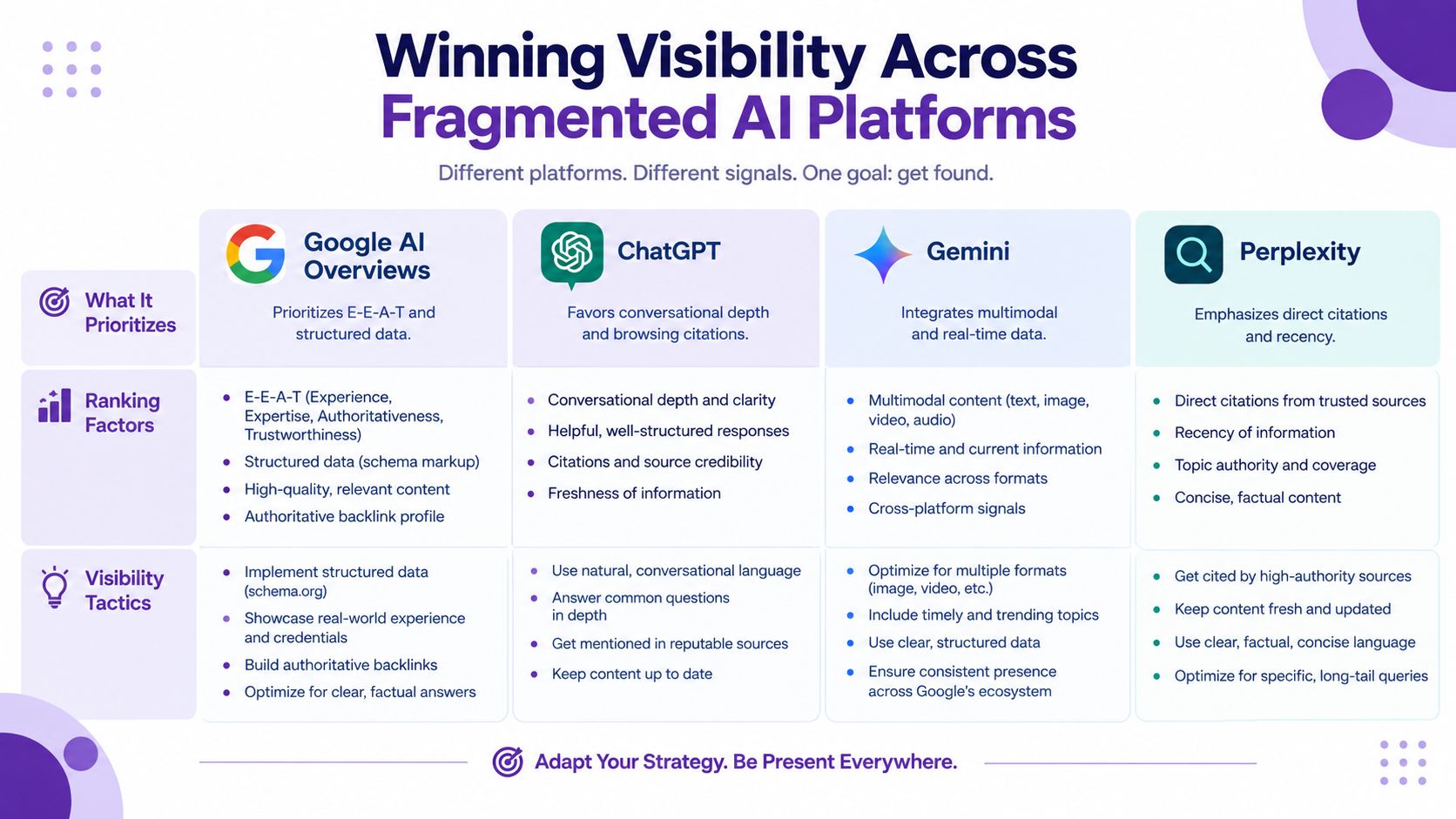
There isn't one AI search engine to optimise for. Google AI Overviews sits inside the Google search ecosystem, while ChatGPT, Gemini, and Perplexity have different retrieval, interface, and citation behaviours. A page that appears in one assistant may not appear in another because each system can draw on different indexes, retrieval choices, freshness signals, and answer formats.
A 2026 traffic snapshot reported ChatGPT at 54.8% of generative-AI website traffic, Gemini at 26.8%, Claude at 9.7%, and Perplexity at 1.0%, as shown in the Tech Insider Ireland comparison. Treat that snapshot as directional context rather than a reason to ignore smaller platforms. Your prospects may use the assistant that fits their workflow, device, search habit, or industry.
Local intent requires local proof
For a query such as “best commercial architect in Limerick” or “IT support for SMEs in Kildare”, generic expertise may not be enough. Assistants need signals connecting the provider to the location and the service. Consistent NAP data helps, but it should sit alongside location-specific pages, genuine customer examples, local partnerships, relevant directories, and clear service-area language.
Avoid creating near-identical county pages with only the place name changed. That approach produces thin material and can create more contradictions. A useful location page explains the work delivered there, the customer context, access arrangements, team coverage, and relevant local considerations.
Test the same prompts repeatedly
Create a fixed prompt set that reflects real buying journeys. Include broad category questions, problem-led questions, provider comparisons, county searches, town searches, and branded prompts. Run the same questions across Google, ChatGPT, and Perplexity, then add Gemini where it matters to your audience.
Record whether your business appears, which page is cited, how the assistant describes you, which competitors appear, and whether the answer includes a location mismatch. Re-test monthly after meaningful technical, content, or authority changes. This turns platform fragmentation into a comparable operating process instead of anecdotal checking.
Measuring AI Presence Rate and Business Impact
Visibility needs a defined denominator. An AI Presence Rate can be calculated as the share of tracked prompts where your brand is mentioned or cited, provided you keep the prompt set and testing conditions consistent. Don't treat the rate as a universal industry score. Use it as an internal trend and competitor-comparison measure.
The Irish working document on AI search measurement identifies the need to connect AI visibility with business outcomes rather than relying on vanity mentions. That means logging more than whether your name appeared.
Build a useful measurement record
For each test, capture:
Prompt context: The exact question, location, industry, and buying stage.
Platform result: Whether the brand appeared, where it appeared, and whether a page was cited.
Message accuracy: Whether the assistant described services, locations, and differentiators correctly.
Competitor context: Which alternatives appeared and what evidence supported them.
Commercial action: Referral visits, branded searches, calls, form submissions, bookings, or sales influenced after exposure.
Use analytics annotations, campaign parameters where referral links permit them, call tracking, CRM source fields, and lead-quality notes. Ask new enquiries how they found the business, but don't treat self-reported attribution as perfect. Compare patterns rather than claiming causation from a single mention.
Measurement principle: a citation is an exposure signal. A qualified enquiry is a commercial signal. Keep both, but don't confuse them.
Review results by prompt category. A business might have strong visibility for educational questions but weak coverage for county-level provider searches. That distinction tells the team whether to improve technical facts, commercial pages, local proof, or authority coverage.
Implementation Roadmap and Common Pitfalls
Treat AI search optimisation as an operating discipline with three connected phases.
Phase one, technical foundation: create the business-facts ledger, reconcile NAP details, inspect robots directives, validate canonicals, confirm indexation, and align visible content with structured data.
Phase two, content upgrades: rewrite priority commercial pages around real questions, lead with direct answers, add verifiable evidence, strengthen service-area proof, and connect relevant pages through internal links.
Phase three, ongoing optimisation: run the fixed prompt set, log citations, review competitor coverage, update facts, and connect visibility records with CRM outcomes.
The common mistakes are predictable:
Chasing AI keywords: Adding phrases about ChatGPT won't repair unclear services or inconsistent entity data.
Adding schema too early: Markup can't compensate for blocked crawling or contradictory page content.
Publishing generic county pages: Location names without local substance create weak evidence.
Testing only one assistant: A single platform gives an incomplete view of buyer discovery.
Tracking mentions alone: A brand mention matters less than whether it reaches a relevant prospect and contributes to pipeline.
For a broader view of the operational issues that can undermine AI visibility, review Scéaled's guide to AI search problems. Start with the pages and prompts closest to revenue, then expand once the measurement process is reliable.
Scéaled helps Irish SMEs and mid-market teams improve AI search visibility through technical SEO, answer-first content, entity consistency, and measurement tied to qualified demand. Visit Scéaled to discuss an AI search optimisation programme connected to SEO, conversion optimisation, and pipeline growth.
Comments