AI Search Problems Explained and How to Fix Them

You've checked the page, the structured data looks clean, and the business still isn't appearing when potential customers ask an AI tool for a recommendation. In another search, the tool mentions a competitor but describes its service incorrectly. A third answer sounds authoritative, yet cites an outdated page.
These are AI search problems, but they aren't all traffic problems. Some come from retrieval, some from ranking, some from generation, and others from weak evidence about who your business is and what it offers. Treating every decline as a traditional SEO issue leads to the wrong fix.
That distinction matters in Ireland. Google accounted for 94.01% of search engine market share in Ireland in August 2026, while Bing held 3.51%, DuckDuckGo 0.93%, Yahoo 0.86%, and Ecosia 0.34%, according to Statcounter's Ireland search market data. At the same time, AI adoption has accelerated sharply. An AI Economy in Ireland report cited by the U.S. International Trade Administration recorded adoption at 91% in 2025, compared with 49% in 2024.
For Irish SMEs, SaaS firms, professional services providers, and e-commerce teams, search visibility now depends on more than ranking a page. Your content must be retrievable, understandable, current, attributable, and trustworthy enough for an answer system to use.
Table of Contents
How AI Search Actually Works Behind the Scenes - Query understanding - Retrieval - Reading and ranking - Summarisation and answer generation
The Most Common AI Search Problems and What Causes Them - Relevance mismatches - Hallucinations - Retrieval failures - Ranking drift - Bias - Privacy leakage - Latency - Freshness gaps - Evaluation challenges
How AI Search Problems Affect Visibility Clicks and Trust in Ireland
Real Examples and How to Diagnose AI Search Failures - The hallucinated product fact - The retrieval miss caused by weak entity linking - The outdated answer after a price change
Fixing AI Search Problems with Architecture Tuning and Monitoring - Start with retrieval quality - Stabilise ranking decisions - Add generation guardrails - Monitor outcomes and failure modes - Keep improving the loop
Introduction Why AI Search Feels Broken Right Now
The uncomfortable part of AI search is that it can fail while looking successful. A conventional search result gives you a visible URL, a position, and usually enough context to inspect why the page appeared. An AI answer compresses that process into a short response, so a missing citation or an inaccurate summary can be difficult to trace.
Consider a software company with a well-written product page. A prospective buyer asks an AI search platform which Irish tools support a particular workflow. The company's page contains the answer, but the system retrieves a directory listing instead. The generated response then omits the company, or includes it with a feature that belongs to another product. The business experiences this as lost visibility, but the underlying failure could be weak entity matching, incomplete source coverage, or poor passage selection.
That's why a ranking report alone can't diagnose modern search performance. AI systems often return a single recommendation or a short shortlist rather than a page of competing organic results. Irish guidance on AI SEO describes this as a citation bottleneck, because businesses compete to be selected as the answer rather than to occupy a page-one position.
The problem has become more urgent as Irish users adopt AI tools for questions, comparisons, updates, and recommendations. Microsoft Source EMEA reported that 48.4% of Ireland's working-age population used AI in Q1 2026, an increase of 3.8 percentage points from the previous quarter, as reported in the Irish AI market summary.
This guide gives marketers and engineers a practical mental model. You'll learn how AI search retrieves and summarises information, how to distinguish a retrieval miss from a hallucination, why query type changes click risk, and how to build a monitoring and content system that improves both visibility and trust.
How AI Search Actually Works Behind the Scenes
A useful analogy is a librarian working under time pressure. You ask a complicated question, the librarian searches a large collection, chooses the most relevant sources, reads selected passages, and gives you a concise answer with references. AI search follows a similar sequence, although its components use indexes, embeddings, ranking models, language models, and citation systems rather than shelves and catalogue cards.
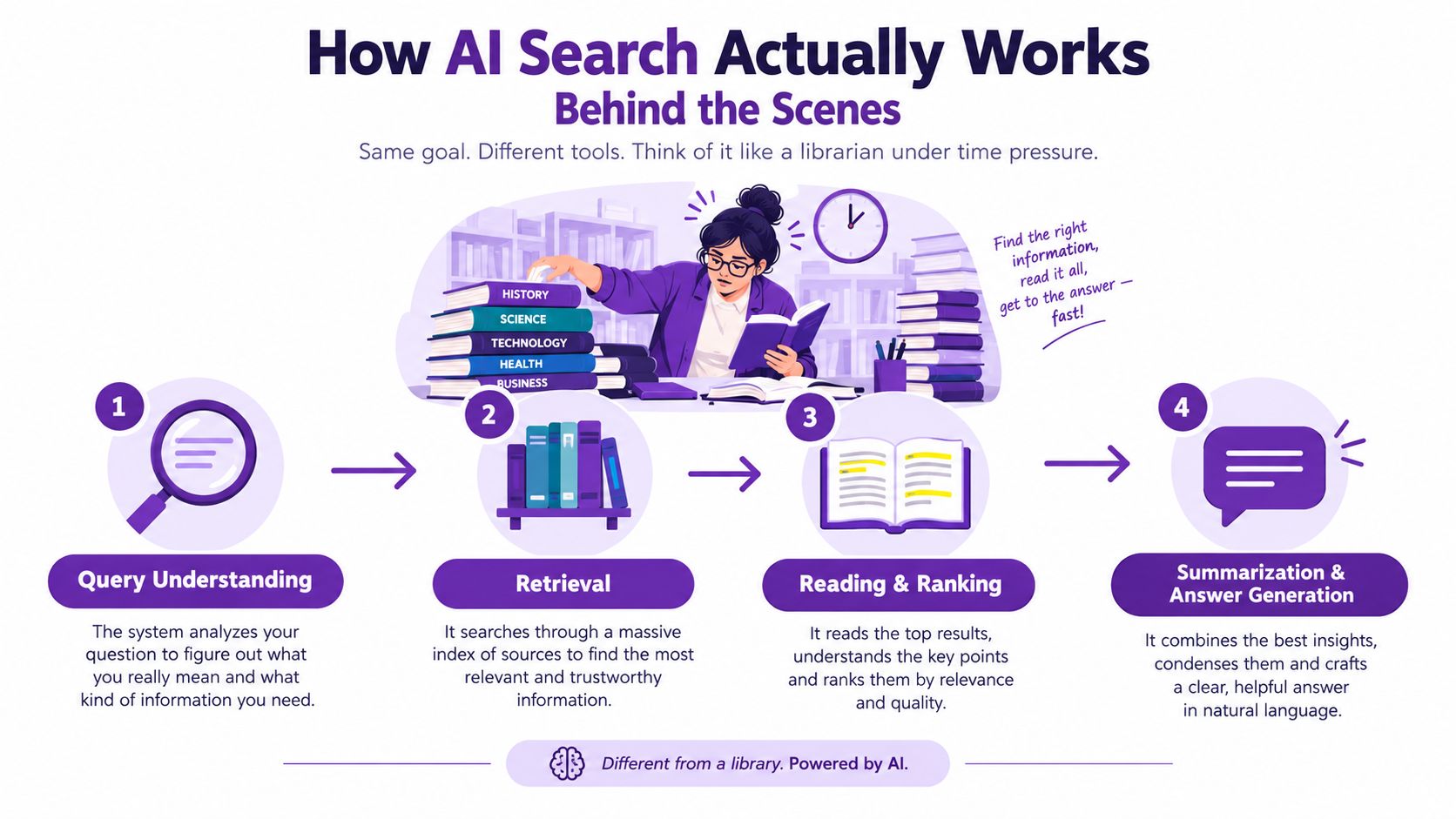
Query understanding
First, the system interprets the question. It may identify the topic, location, commercial intent, product category, and implied comparison. “Best payroll software for a growing Irish company” contains more information than the phrase “payroll software”. The system may infer that the user wants a shortlist, local relevance, and a business-oriented recommendation.
This stage can fail when the wording is ambiguous, the organisation has several names, or the page uses different terminology from the question. A company that calls its service “revenue operations consultancy” may be overlooked for a query using “sales pipeline consulting” unless its content establishes those relationships clearly.
Retrieval
The system then finds potentially useful material. Traditional lexical matching may look for shared words, while semantic retrieval tries to match concepts with similar meaning. Structured data, internal links, consistent business details, and clear page sections all help systems understand what a document is about.
Retrieval doesn't necessarily select the entire page. It may return a passage, product attribute, review, knowledge graph connection, or third-party mention. If the relevant detail is buried in a vague paragraph, the system may retrieve a less precise source.
For a broader explanation of the distinction between conventional search and AI answer systems, see what AI search means for modern discovery.
Reading and ranking
The system evaluates the retrieved material. It may consider topical relevance, source authority, freshness, consistency with other sources, and how directly a passage answers the question. This is different from ranking ten pages for a keyword.
A page can rank well organically and still lose an AI selection because another source expresses the answer more directly. Conversely, a smaller site may be cited when it provides a precise, current explanation that fits the question better.
Summarisation and answer generation
Finally, the language model turns selected evidence into a response. It decides what to include, how to combine sources, and whether to show citations. Unsupported claims, overconfident wording, and source mismatch can appear.
Practical rule: Treat every AI answer as the final output of several systems, not as a direct reading of your webpage.
The same answer can therefore hide different problems. If the correct page was never retrieved, improve discoverability and entity signals. If the page was retrieved but misrepresented, investigate passage quality, source conflicts, and generation safeguards.
The Most Common AI Search Problems and What Causes Them
AI search problems become easier to fix when you name the failure precisely. A relevance mismatch, for example, doesn't need the same intervention as a hallucination.
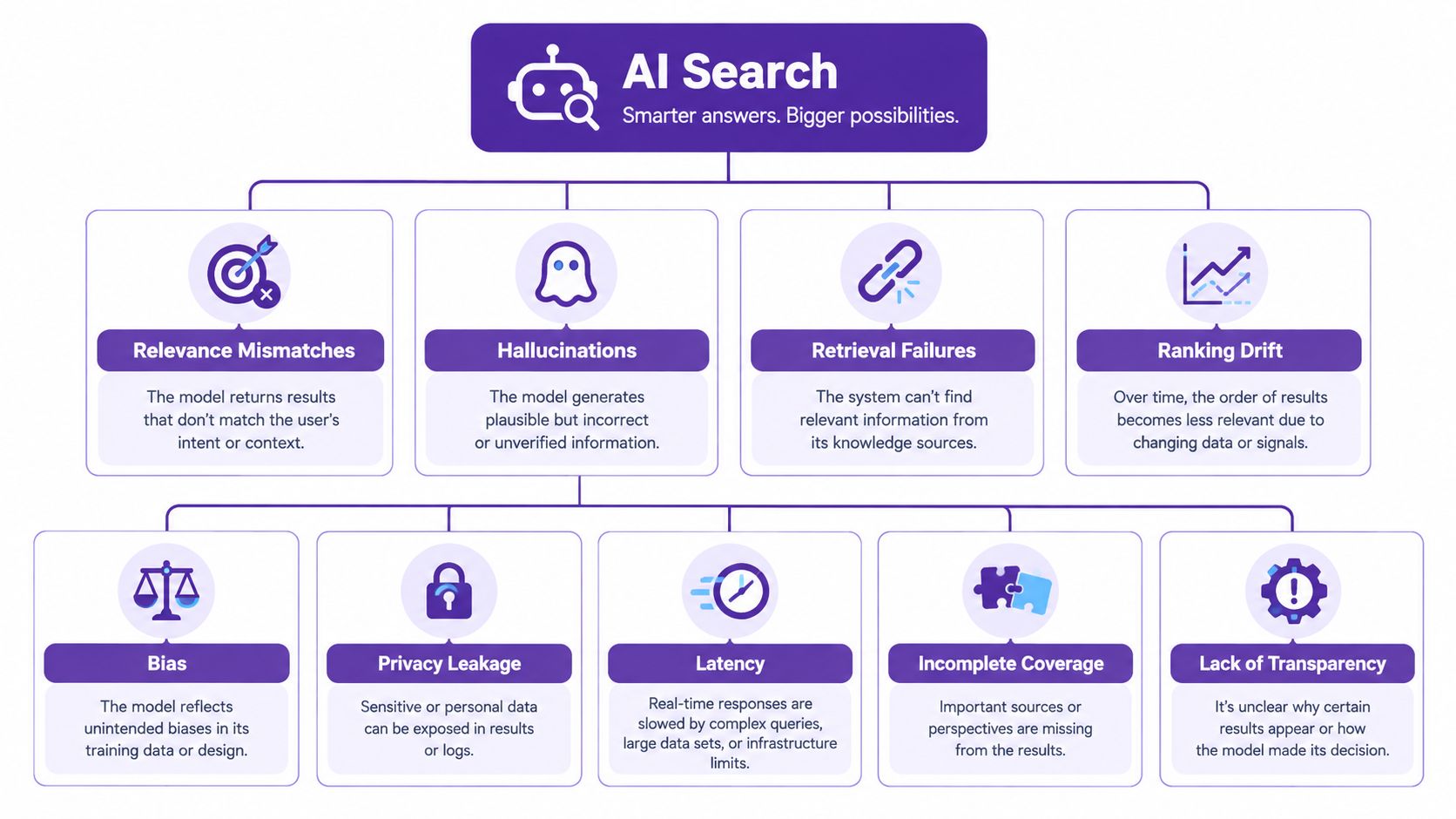
Relevance mismatches
The system retrieves content related to the general topic but not to the user's actual need. An Irish user asking about VAT considerations for a specific business type may receive a generic tax explanation. The symptom is an answer that sounds plausible but misses the location, audience, product, or intent.
The business consequence is wasted attention. Your brand may be present in the source set, yet the answer fails to address the question that could have created demand.
Hallucinations
A hallucination occurs when the generated response states a fact that the retrieved evidence doesn't support. The model may combine details from similar products, infer a feature from a vague description, or fill a gap with plausible language.
The key distinction: Retrieval finds the evidence. Generation decides what to say. A correct retrieval can still produce an incorrect answer.
Retrieval failures
A retrieval failure happens earlier. The relevant page, passage, or entity isn't selected at all. Weak headings, inconsistent names, limited internal linking, inaccessible content, and thin supporting context can all reduce inclusion odds.
This is particularly damaging for niche services. If an AI system can't connect your brand with the problem you solve, it may recommend a better-known but less suitable alternative.
Ranking drift
AI search results can change as indexes, models, source weighting, and query interpretations change. A page may be selected one day and omitted later without a visible technical change on your site.
The risk is operational rather than purely editorial. Teams need to monitor representative questions and investigate changes instead of assuming that one successful test proves stable visibility.
Bias
Bias can enter through training data, source availability, ranking choices, or the language used to describe organisations. Well-known brands and heavily cited sites may receive more attention because the system has more evidence about them.
For Irish businesses, that can create a visibility disadvantage when local expertise is documented mainly on smaller websites, trade associations, or pages with limited machine-readable context.
Privacy leakage
Search systems can expose sensitive information when they combine public and private material incorrectly, or when users include confidential details in a prompt. Marketing teams should avoid placing customer data, unpublished commercial information, or personal details into unapproved tools.
Latency
A system that retrieves more sources or performs additional verification may produce a better answer, but it can take longer. A faster pipeline may rely on a smaller source set or less thorough checking.
That trade-off affects user experience and architecture decisions. Teams need to decide where verification is essential and where a quicker response is acceptable.
Freshness gaps
An answer can remain accurate in general while being wrong for the current commercial context. Prices, availability, opening hours, product versions, regulations, and service terms can change before an answer engine updates its representation.
Evaluation challenges
Traditional SEO offers familiar measurements such as rankings, impressions, and clicks. AI search often exposes fewer intermediate signals. You may know that a user saw an answer, but not which passages were considered, why another source won, or how the model weighted conflicting evidence.
The video on AI search challenges provides a visual introduction to these failure patterns. Use it as a starting point, then test your own queries against known facts and source pages.
How AI Search Problems Affect Visibility Clicks and Trust in Ireland
An Irish business can lose visits while appearing more often in search answers. That apparent contradiction comes from treating every query as if it had the same commercial value. Evidence from Ireland points to a shift in which searches convert, not a simple end to SEO.
A recent analysis of 175 million Irish searches found that click-through rate fell 26% year on year. Informational and question-format searches were affected most strongly, while transactional and commercial-investigation queries held up better, according to Friday's Irish search analysis.
A guide answering “What is cloud accounting?” may lose a visit when an AI overview provides a sufficient summary. A page targeting “compare cloud accounting platforms for Irish SMEs” has a stronger reason to attract a click because the user still needs evaluation, evidence, pricing context, or a next step.
Query Type | CTR Trend | Visibility Risk | Priority Action |
|---|---|---|---|
Informational | More exposed to click reduction | The answer may satisfy the user without a visit | Make the source authoritative, concise, and citation-ready |
Question format | More exposed to click reduction | AI can answer directly in the results experience | Add clear evidence, definitions, examples, and a reason to continue |
Commercial investigation | Better protected than purely informational queries | The system may show a short shortlist | Build comparison pages, proof, reviews, and distinctive expertise |
Transactional | More resilient than informational searches | Competitors may be selected as the recommendation | Strengthen product clarity, availability, trust signals, and conversion paths |
The practical response is segmentation. Protect pages that capture active demand, then improve informational pages so they supply reliable evidence for citations and create brand recall. Review recent SEO changes affecting AI-driven visibility alongside query intent, rather than applying one optimisation rule across the site.
Trust determines whether visibility becomes consideration. An AI system may summarise a company without sending the user to its website, so important claims must remain accurate when separated from their original context. Consistent service descriptions, named expertise, current policies, and supporting evidence give both the system and the user something dependable to recognise.
Irish consumer research found that 69% of AI users in Ireland use AI platforms weekly or more often for updates, as reported by Irish research into AI use and trust. That behaviour makes citation quality part of brand trust. Businesses should monitor whether AI answers represent their services correctly, identify which query groups still produce visits, and give citation-first attention to topics where an unsupported summary could influence a buying decision.
Real Examples and How to Diagnose AI Search Failures
A useful diagnosis starts with the answer, the citation, and the source page. Don't begin by rewriting everything.
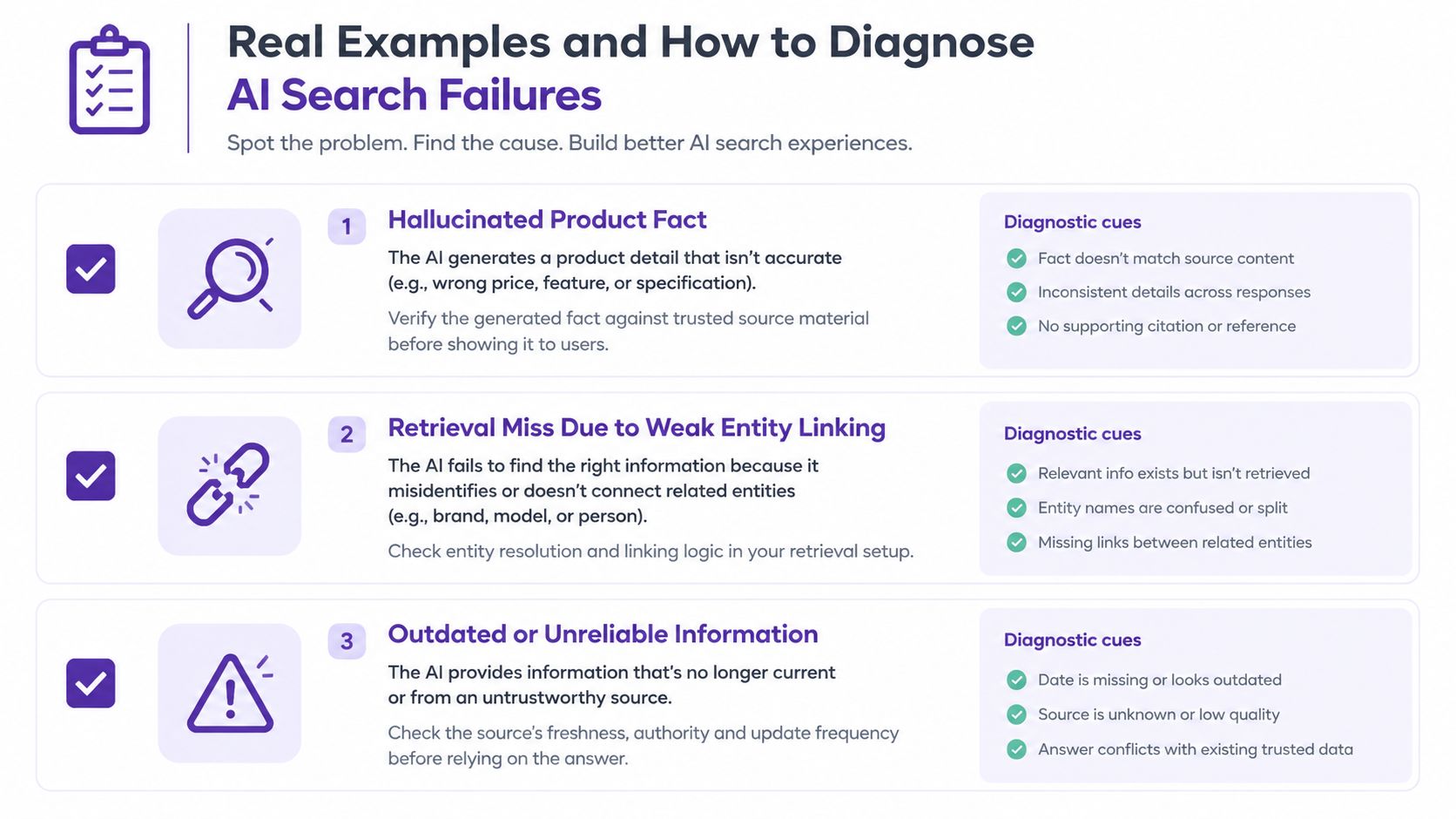
The hallucinated product fact
An AI answer says that a software product includes an integration it doesn't offer. The quick test is to inspect the cited page and search the page for the feature. If the page doesn't support the claim, compare the wording with nearby competitor pages and review whether your own product information uses clear, unambiguous feature statements.
The likely root cause is generation or source conflation. Your remediation should include precise product documentation, an authoritative feature page, and a process for checking high-value answers against current source material.
The retrieval miss caused by weak entity linking
A consultancy appears in searches for its brand name but not for the service category it serves. Its website uses a distinctive internal phrase, while partner pages and business profiles use different descriptions.
Test this by checking whether the brand, service, location, and audience appear together across important pages. Review organisation and service schema, internal links, author details, and third-party references. If the system can't connect the entity to the problem, it may never retrieve the right source.
The outdated answer after a price change
A customer asks for current pricing and receives an old figure from a page that remains indexed. Check the answer's citation date, the page's visible update information, and whether the new price appears consistently across product pages, feeds, comparison pages, and partner listings.
A freshness gap needs more than changing one sentence. Remove contradictory information, make current details easy to extract, and establish an ownership process for commercial facts.
Use this compact triage sequence:
Verify the claim: Does the cited source support the answer?
Check retrieval: Was your best page available, crawlable, and clearly about the query?
Compare entities: Are your brand, service, location, and category described consistently?
Review freshness: Do current prices, features, dates, and policies agree across sources?
Record the query: Save the exact wording, answer, citations, date, and market context.
This record turns an anecdotal complaint into a repeatable test. It also helps engineers identify whether the intervention belongs in content, indexing, ranking, data governance, or answer validation.
Fixing AI Search Problems with Architecture Tuning and Monitoring
Reliable AI visibility needs a connected system. A single schema update won't solve a retrieval problem caused by unclear content, and a prompt change won't repair contradictory business information across the web.
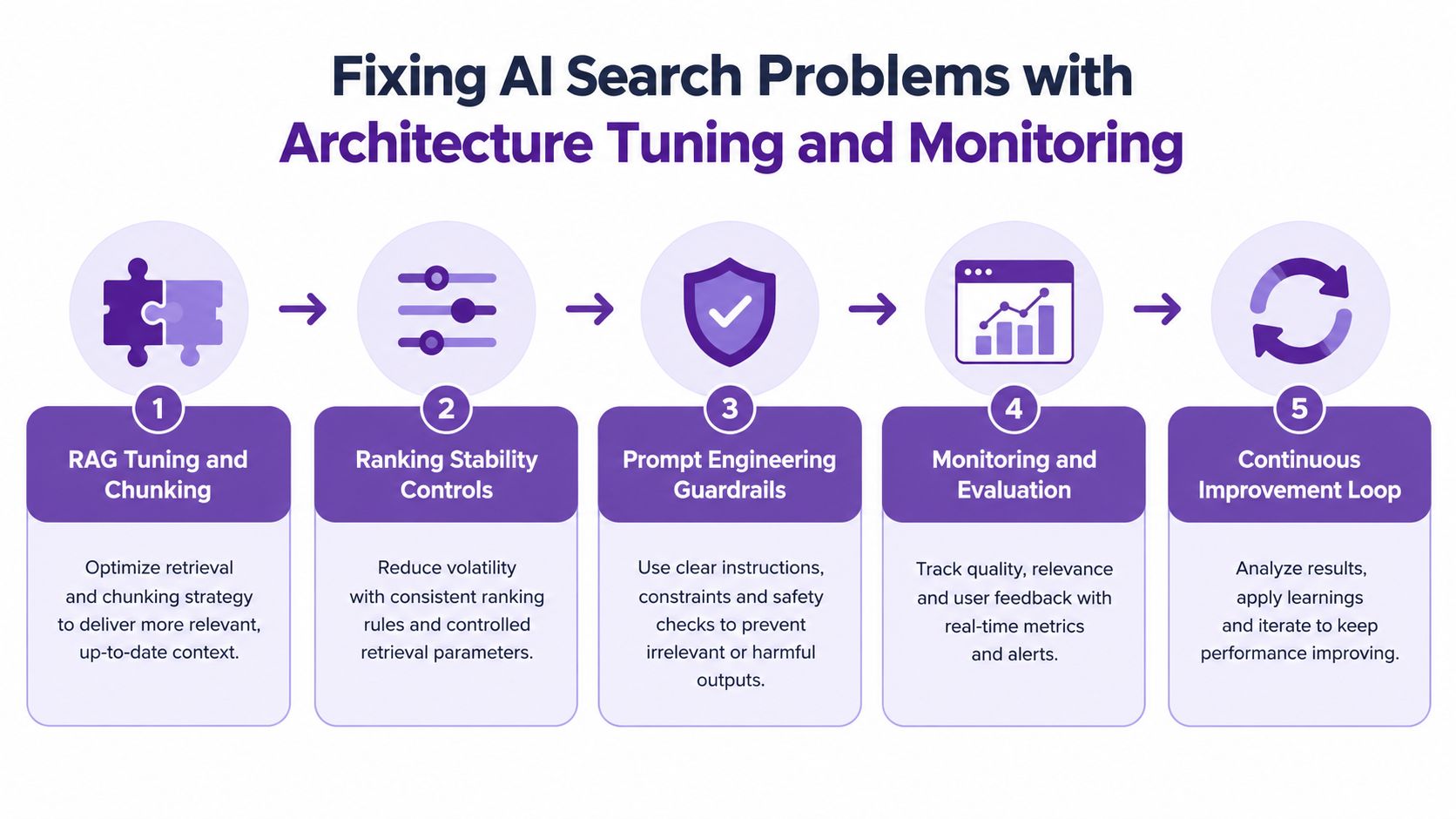
Start with retrieval quality
For internal or proprietary AI search systems, improve the retrieval layer first. Test chunk size, overlap, metadata filters, hybrid lexical and semantic search, and reranking. A chunk that contains a complete answer is more useful than one that splits the condition from the conclusion.
For public-facing discovery, create citation-ready content. Use descriptive headings, direct answers, named authors or experts where relevant, transparent dates, internal links, and consistent organisation and service details. Structured data can reinforce meaning, but it can't compensate for vague prose.
Stabilise ranking decisions
Ranking systems need controls against sudden changes. Keep a test set of representative queries covering brand, category, comparison, local, informational, and transactional intent. Compare which sources appear, which passages are selected, and whether the answer remains supported.
Avoid optimising for one impressive result. A page that wins a single test but disappears for related wording has weak coverage.
Add generation guardrails
Prompt instructions should require the system to distinguish evidence from inference, cite the passage supporting each material claim, and state uncertainty when sources conflict. For high-risk topics, add deterministic checks before publishing or displaying an answer.
A guardrail is useful only when the system can enforce it. “Be accurate” is an aspiration. Source validation, claim matching, and refusal rules are controls.
Monitor outcomes and failure modes
Track more than clicks. Build a query set and record inclusion, citation accuracy, brand representation, factual freshness, competitor presence, and the user's next action. Segment results by query intent, because the Irish evidence shows that informational and commercial searches don't carry the same click risk.
Teams can use specialist SEO and AEO support, internal dashboards, or an agency such as Scéaled's AI search SEO service to connect technical foundations, content, authority signals, and commercial measurement.
Keep improving the loop
Feed failures back into the right owner. Marketing may need to clarify positioning, engineering may need to adjust retrieval, product may need to update source data, and legal or compliance teams may need to review sensitive answers. Privacy controls should limit what data enters prompts, logs, indexes, and evaluation sets.
The central trade-offs remain practical. More verification can increase latency. Broader retrieval can improve coverage while lowering precision. More frequent updates can improve freshness while increasing operational cost. Choose deliberately, based on the risk of being wrong for each query type.
Next Steps to Build Reliable AI Search Visibility
Start with the queries closest to revenue. Identify the commercial, transactional, local, and comparison questions that influence enquiries or sales, then test whether AI systems mention your business accurately and cite useful pages.
Next, audit the evidence behind those answers. Check entity consistency, service descriptions, product facts, dates, prices, authorship, structured data, internal links, and third-party references. Fix contradictions before producing more content.
Then create a lightweight monitoring routine. Save representative prompts, record the answer and citations, classify the failure, and review changes over time. Traditional rankings still matter, but they won't tell you whether an answer engine selected the right passage or described your offer correctly.
For informational content, prioritise authority and citation value rather than chasing visits alone. For commercial and transactional content, protect the pages that still help users compare, trust, and act. That's the segmentation shift: AI search problems require different responses for different demand states.
Over the next planning cycle, assign owners across SEO, content, engineering, analytics, and compliance. Seek specialist help when your team lacks the time or technical access to connect AEO, search strategy, content quality, conversion tracking, and AI monitoring into one operating process.
Scéaled helps Irish businesses improve SEO and AEO visibility across Google AI Overviews, Google AI Mode, ChatGPT, and Microsoft Copilot by strengthening content, technical foundations, authority signals, and measurement. Visit Scéaled to discuss an AI search diagnostic and a practical growth plan built around qualified demand.
Comments