AI Search Algorithms Explained for Marketers and SEO

You've published a carefully researched page, watched its rankings, and found no obvious drop. Yet the traffic report feels different. A customer searches a detailed question, receives an AI-generated answer, and never sees the familiar list of results that once directed them to your site. Your page may still be indexed and relevant, but the route from query to visit has changed.
That change is driven by AI search algorithms. They don't just look for pages containing the words a user typed. They interpret intent, retrieve passages with related meaning, combine different relevance signals, re-rank candidates, and may generate an answer with source citations. For Irish marketers, the shift is especially visible because search activity is concentrated in one dominant engine while AI answer traffic is concentrated in a small number of platforms.

This guide starts with the basic difference between keyword matching and meaning-based retrieval, then moves through sparse, dense, hybrid and neural ranking systems. It explains the pipeline behind an AI answer, the ways engineers evaluate quality, and the practical decisions that affect SEO and answer engine optimisation, or AEO. For a helpful primer on the wider topic, see what AI search means for modern visibility.
Table of Contents
How AI Search Algorithms Understand Intent - From matching words to mapping meaning - Why context changes the result
Key Families of AI Search Algorithms Compared - Sparse retrieval - Dense vector retrieval - Hybrid retrieval and neural re-ranking
Core Components That Power AI Search Systems - Embeddings and vectorisation - ANN indexes for speed - Query rewriting and first-stage retrieval - Re-ranking and grounded generation
How AI Search Quality Is Measured and Evaluated - Retrieval metrics - Answer-level evaluation
Implementation Trade Offs Tooling and What It Means for SEO and AEO - Prioritise Ireland's dominant surface - Turn algorithm behaviour into page decisions
Introduction Why AI Search Feels Different Now
Ireland provides a concentrated view of the shift. Statcounter recorded Google at 94.01% of Ireland's search market in August 2026, followed by Bing at 3.51%, DuckDuckGo at 0.93%, Yahoo at 0.86%, and Ecosia at 0.34% (Statcounter-based Irish search analysis). One dominant retrieval system therefore shapes visibility for publishers and SMEs at unusual scale. A change to how it interprets queries, ranks pages, or presents answers can affect a large share of search demand.
The search page is becoming more conversational too. Google's AI search experience in Ireland supports complex queries and follow-up questions, using a custom version of Gemini for Search (reporting on Google's AI Mode in Ireland). A request for “best accounting software” may expand into questions about company size, integrations, budget, compliance, and implementation. The system must connect those requirements, rather than match one phrase across separate pages.
For marketers, that creates two related jobs. SEO still helps pages enter and perform in traditional retrieval. Answer engine optimisation, or AEO, helps the same information become a clear, citable candidate when an AI system builds an answer. The underlying content may overlap, but the selection signals and visible outcome can differ.
Practical rule: A page can remain relevant to a topic while becoming less visible for a particular answer. Track query intent and the answer surface, not only the blue-link position.
Ireland's AI answer activity adds another layer. Ahrefs found AI Overviews on 12.00% of tracked Irish queries in November 2025, based on an analysis of 108 million AI Overview queries across 50 countries, placing Ireland 44th out of 50 countries (Irish Government overview of AI search). That figure does not describe every Irish search, but it shows that generated answers already form part of the market.
The guide explains the systems behind this change, alongside what AI search means for modern visibility, and connects retrieval choices to practical SEO and AEO work.
How AI Search Algorithms Understand Intent
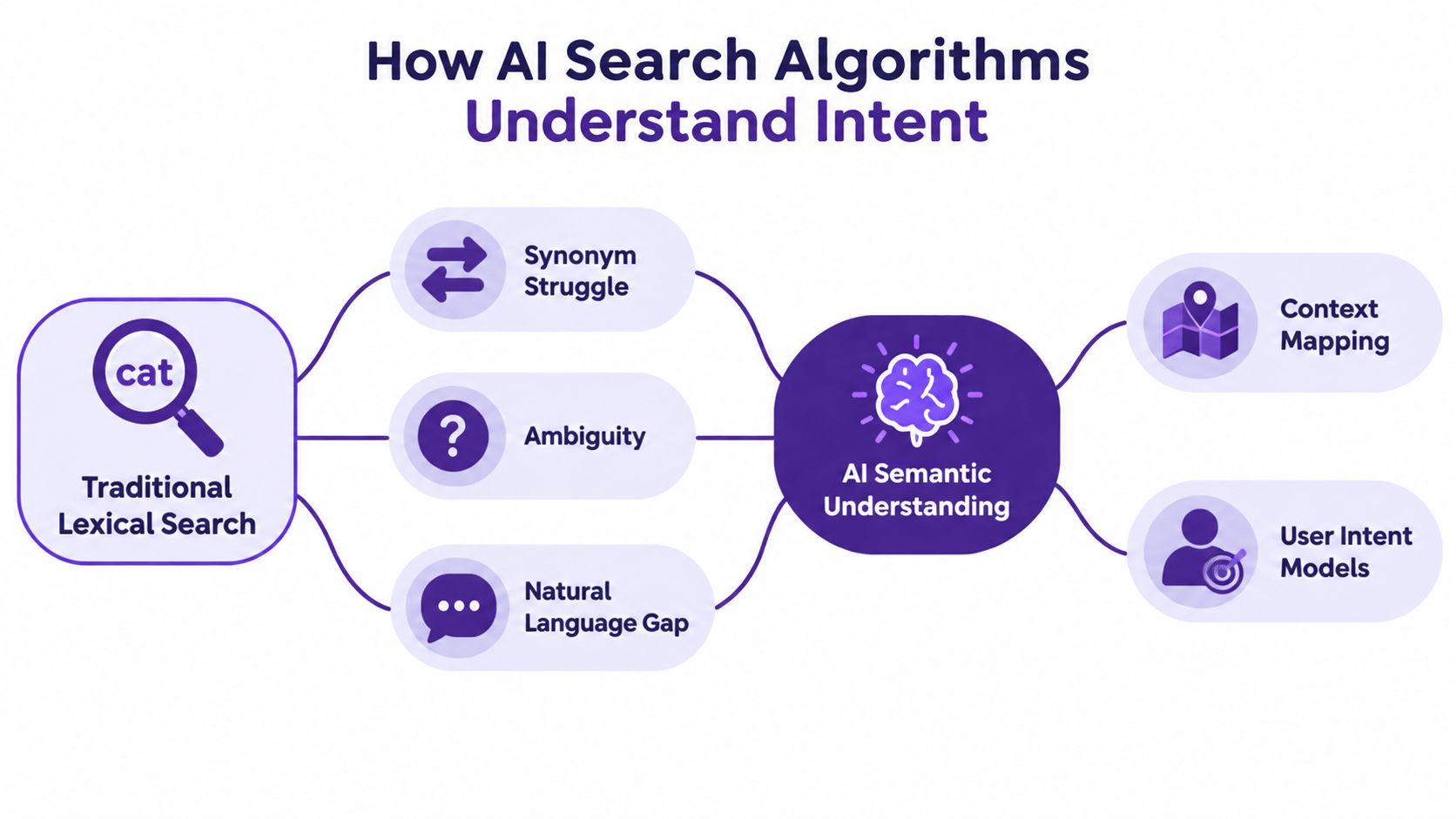
Traditional lexical search treats a query primarily as a set of terms. An inverted index maps words to documents, allowing a system to find pages containing important tokens and score them according to factors such as term frequency and document frequency. This approach is fast and useful, especially when the exact wording matters, but it can struggle when the user's language differs from the page's language.
Consider a search for “ways to reduce SaaS churn”. A page titled “customer retention strategies for subscription software” may address the need perfectly without using the word “churn” often. Lexical matching can miss some of that connection. It can also misread ambiguous terms, synonyms and conversational phrasing because the words alone don't fully reveal the task.
From matching words to mapping meaning
Semantic search adds a meaning layer. An embedding model converts text into a numerical representation, often called a vector. You can think of that vector as a position on a very large meaning map. Texts discussing similar ideas tend to occupy nearby regions, even when they use different vocabulary.
The library analogy helps. A keyword-based librarian searches the catalogue for the exact phrase on a book's label. A semantic librarian understands that “lower subscription cancellations”, “improve customer retention” and “reduce SaaS churn” may belong to the same shelf. The librarian still needs good titles and catalogue records, but they can respond to the purpose behind the request.
When a user submits a query, the system can embed the query and compare it with embedded documents or passages. Vector retrieval then searches for nearby meaning neighbours. Similarity is a signal, not a guarantee of usefulness. A passage can be semantically close but outdated, vague, commercially irrelevant or unsupported, so later ranking stages still matter.
Why context changes the result
AI systems can interpret a query as a connected task. “Compare CRM platforms for an Irish professional services firm that needs Microsoft integration” contains a market, an audience, a product category and a functional requirement. A useful retrieval process identifies each element, rewrites the request into focused searches, and looks for evidence that answers the combination.
That affects content production. A page should state its audience, use case, category and constraints clearly instead of relying on the reader or model to infer them. Question-led headings, direct definitions, comparison tables and self-contained answer blocks give retrieval systems clearer units to assess.
The best answerable content doesn't sound like a database entry. It makes the intended question, audience and conclusion easy to identify.
Semantic understanding doesn't replace keywords. Product names, regulations, locations and technical terms still need precise wording. The marketer's job is to combine lexical clarity with semantic completeness, so a page can match exact entities while also explaining the relationships between them.
Key Families of AI Search Algorithms Compared
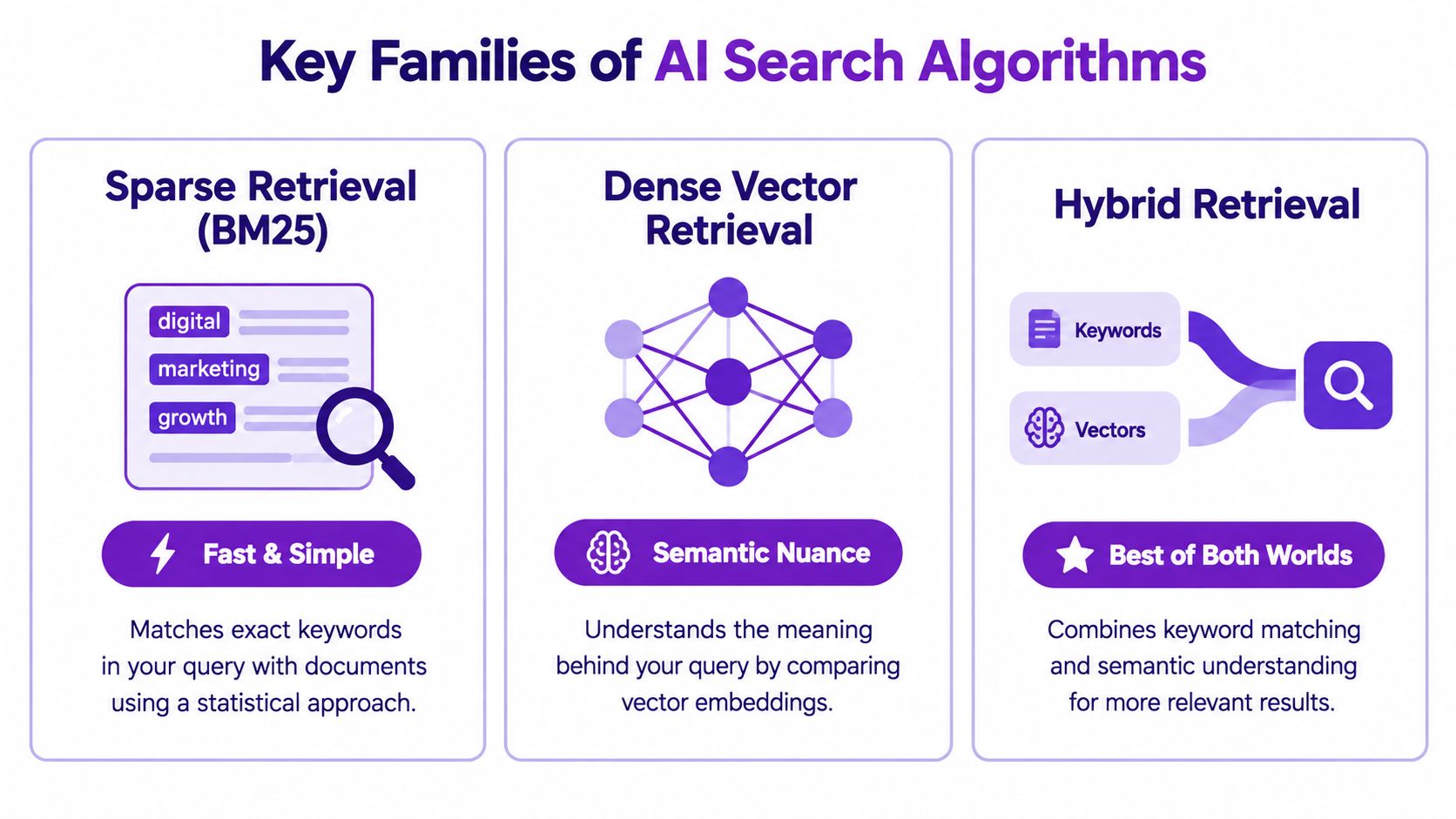
Different retrieval families solve different problems. Sparse retrieval is strongest when exact terms and rare entities carry meaning. Dense retrieval is useful when a concept can be expressed in many ways. Hybrid retrieval combines both, while neural re-ranking applies a more expensive relevance judgement to a smaller candidate set.
Sparse retrieval
Sparse methods represent text through a high-dimensional term space where most document entries are empty. BM25 is a well-known example. It considers term frequency, document frequency and document length, making it effective for exact product names, legal phrases, model numbers and uncommon terminology.
Its weakness is vocabulary mismatch. A page may be highly relevant but fail to score strongly if it uses “lead nurturing” while the query uses “prospect follow-up automation”. Sparse retrieval also has limited ability to understand a compound request as a complete situation.
Dense vector retrieval
Dense methods encode queries and documents into compact vectors. They can retrieve passages with related meaning, which helps with paraphrases and natural language questions. Their weakness is precision around exact details. A dense model may see two concepts as related even when a specific distinction, such as an Irish regulatory term or product version, changes the answer.
Hybrid retrieval and neural re-ranking
Hybrid retrieval fuses sparse and dense results. It can protect exact matches while recovering semantically relevant passages. Many practical systems use this combination because marketers need both entity precision and intent coverage.
Neural re-ranking then examines the query and candidate passage together. A cross-encoder, for example, can assess the relationship between the full query and full document more carefully than a simple vector-distance calculation. Learning-to-rank systems may combine relevance, freshness, authority, user context and other signals.
Algorithm family | How it matches | Strengths | Best for |
|---|---|---|---|
Sparse retrieval | Matches weighted terms in an inverted index | Fast, transparent, precise for exact language | Product names, regulations and technical phrases |
Dense vector retrieval | Compares meaning-based embeddings | Handles synonyms, paraphrases and natural questions | Topic discovery and broader intent coverage |
Hybrid retrieval | Combines lexical and vector signals | Balances precision with semantic recall | General-purpose search and content discovery |
Neural re-ranking | Scores query and candidate together | Refines relevance using richer context | Final ordering of a smaller candidate set |
The distinction matters for SEO and AEO. Exact naming still helps systems recognise entities, while complete explanations help dense retrieval understand the page's purpose. Clear headings and focused passages give re-rankers evidence they can evaluate rather than forcing them to interpret an undifferentiated block of copy.
For a platform-specific perspective, compare this model with Microsoft AI search. The underlying lesson is consistent: optimise for discoverable meaning, but don't remove the precise language that retrieval systems use to verify a match.
Core Components That Power AI Search Systems
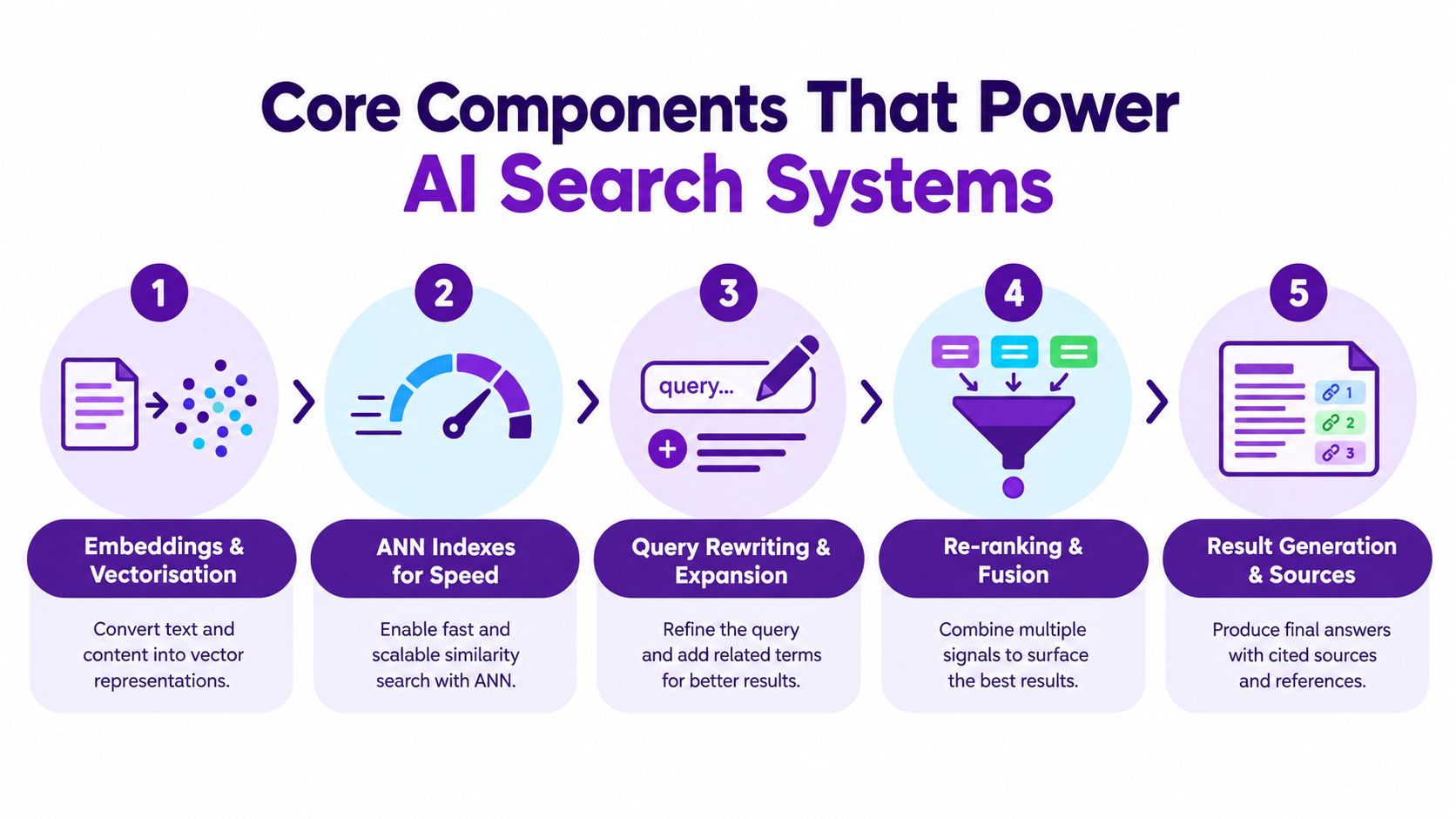
An AI search system works like an assembly line. Each stage has a different job, and a failure early in the process can't always be repaired by the generation model at the end.
Embeddings and vectorisation
The process begins by converting documents, pages or passages into representations that a retrieval model can compare. Chunking matters here. If a chunk is too broad, it may contain several unrelated ideas. If it's too narrow, it may lose the context needed to interpret a claim.
For marketers, headings and paragraph boundaries are not merely visual choices. They help create coherent retrieval units. A passage that defines a service, states its audience and explains its limitations is easier to retrieve and cite than a fragment made of unexplained pronouns and promotional language.
ANN indexes for speed
A system rarely compares a query with every vector directly. Approximate nearest neighbour, or ANN, indexes narrow the search to likely candidates. They trade a small amount of theoretical completeness for practical speed, using structures such as graphs, clusters or compressed representations.
That trade-off creates a useful publishing insight. Important information should be expressed in more than one clear context across a site, through a well-organised pillar page and relevant supporting pages. This doesn't mean repeating paragraphs. It means building an accessible network of related explanations so retrieval has multiple coherent entry points.
Query rewriting and first-stage retrieval
The system may rewrite the user's question, expand it with related terms, identify entities, or split a compound request into sub-queries. It then retrieves an initial candidate set from sparse, dense or hybrid indexes.
Vague copy creates friction. A page that never names the problem it solves, the market it serves or the conditions under which its advice applies gives the system fewer reliable signals. Use descriptive titles, informative introductions, meaningful internal links and structured data that agrees with the visible page.
Re-ranking and grounded generation
A re-ranker orders the candidate passages using richer relevance signals. In a retrieval-augmented generation system, selected passages are then supplied to a language model, which produces an answer grounded in that retrieved context. Source selection and citation quality depend on whether the retrieved text is clear, authoritative and directly supports the statement being made.
Generation can make an answer sound confident even when retrieval was weak. That's why marketers should separate being mentioned from being accurately cited. A brand name in an answer has limited value if the supporting page doesn't clearly substantiate the associated claim.
How AI Search Quality Is Measured and Evaluated
Search engineers need to know whether the system retrieves useful material before they judge the final answer. Marketers face the same diagnostic split. A visibility problem may come from poor retrieval, weak ordering, or a generated answer that misrepresents otherwise suitable sources.
Retrieval metrics
Precision asks how many retrieved results are relevant. If a system returns a small set of highly suitable pages for “Irish payroll software integrations”, precision is strong. Recall asks how much of the relevant material the system managed to retrieve. High recall matters when missing one important document could change the answer.
Mean reciprocal rank, or MRR, focuses on where the first relevant result appears. It reflects the user's experience when one strong answer should surface quickly. NDCG, or normalised discounted cumulative gain, evaluates the ordering of results while allowing different degrees of relevance. It's useful when several candidates are valuable but not equally useful.
Metric | Diagnostic question | Marketer interpretation |
|---|---|---|
Precision | Are the retrieved pages relevant? | Does the system avoid unrelated content? |
Recall | Did it find the important material? | Are valuable pages being missed? |
MRR | How soon does the first useful result appear? | Does the best answer surface early? |
NDCG | Are results ordered by usefulness? | Are strong pages placed ahead of merely related ones? |
Answer-level evaluation
A generated answer needs different checks. Faithfulness asks whether the answer stays supported by the retrieved material. Citation accuracy asks whether each citation supports the statement beside it. Hallucination checks look for details that the source doesn't contain.
Human review still matters because usefulness includes judgement, clarity and task completion. A response can be factually supported yet fail to address the user's actual commercial question. For content teams, that means reviewing AI outputs against the original query, the cited passages and the intended audience.
Measurement principle: Don't treat an AI answer as a single ranking position. Inspect retrieval, ordering, source use and answer accuracy separately.
Business metrics remain important. Organic qualified enquiries, assisted conversions, branded demand and referral visits show whether visibility contributes to commercial outcomes. AI-specific monitoring can add prompt coverage, citation presence, source accuracy and recurring brand mentions, but these indicators need consistent query sets and human validation.
Implementation Trade Offs Tooling and What It Means for SEO and AEO
Every AI search architecture makes trade-offs. Dense retrieval improves semantic coverage, but embeddings and vector indexes require storage and computation. Re-ranking can improve relevance, yet applying an expensive model to every document increases latency. Systems therefore retrieve a smaller candidate set first. Fresh indexes reflect current information, while frequent updates create operational work.
These choices have direct content implications. A page that includes every possible query variation may broaden recall while weakening its focus. A tightly optimised page can answer one query clearly but miss related needs. A connected content system handles both pressures: focused pages support distinct intents, descriptive internal links show their relationship, and consistent entity language helps retrieval systems interpret the subject.
Prioritise Ireland's dominant surface
As noted earlier, Ireland's search market is concentrated around Google. That makes crawlability, internal linking, page relevance and trustworthy content practical priorities before expanding AEO monitoring. Fixing blocked resources, weak navigation and unclear page purpose can improve the primary search surface more reliably than producing another broad content variation.
AI answer platforms require a separate view. Ireland's AI search activity is divided among several services, with ChatGPT representing the largest share in the cited market information, followed by Gemini, Claude, Microsoft Copilot and Perplexity. The implication is operational: test the same commercially important questions across relevant answer interfaces, because standard Google visibility does not show whether a brand is selected or accurately represented in conversational answers.
Turn algorithm behaviour into page decisions
Put a concise answer near each relevant heading, then provide reasoning and evidence below it. Use structured data only when it accurately describes visible content. Keep important information in crawlable HTML, connect related pages with descriptive internal links, and review titles, introductions, definitions, comparisons and source references for clarity.
A team can use an AI search assistant to inspect pages, identify unanswered questions and organise content improvements. Scéaled presents its tool as part of its wider approach to AI-enabled search work. Existing analytics, crawling and content tools can support the same workflow, provided teams validate recommendations against the live page, retrieval intent and business goal.
Putting AI Search Algorithms to Work Next Steps
Start with a visibility audit rather than a wholesale content rewrite. Select the questions that matter commercially, inspect the traditional Google results, and test the same questions in relevant AI answer interfaces. Record whether your organisation appears, which pages are cited, whether the answer is accurate, and what competitors or third-party sources receive attention.
Then work through the highest-impact gaps:
Clarify the page's job. State the audience, problem, location and decision the page supports.
Improve retrieval units. Use descriptive headings, concise answer passages, definitions, tables and meaningful context.
Strengthen evidence. Add author information, review dates, primary sources and clear support for important claims.
Connect the site. Link pillar content to focused supporting pages using descriptive anchor text.
Measure both surfaces. Keep organic visibility and qualified conversions alongside AI citations, mentions and referral activity.
Review manually. Check whether AI systems represent your position accurately, not merely whether they mention your brand.
Avoid chasing every new tool or stuffing pages with question variants. Answerability comes from clear subject coverage, credible evidence and accessible structure, while commercial value comes from matching those assets to the right customer journeys.
If your audit shows a technical retrieval problem, inconsistent content signals or weak coverage across Irish search and answer platforms, specialist support can turn the findings into an organised SEO and AEO work plan.
Scéaled helps Irish businesses connect technical SEO, content strategy and AEO so their pages can be retrieved, understood and cited across traditional search and AI answer platforms. Visit Scéaled to discuss an evidence-led visibility plan for your organisation.
Comments