SEO ChatGPT Playbook for Smarter Content and Visibility

Irish businesses don't need to abandon SEO because people are using ChatGPT. They need to make SEO work across more than one discovery layer. The Central Statistics Office reported in 2025 that 42% of Irish internet users had used generative AI in the previous three months, while 72% had used tools such as ChatGPT, Copilot, or similar systems. Among 16- to 29-year-olds, usage reached 65%, compared with 15% among people aged 60 to 74, and students were the most active group at 66%. (Friday's analysis of the CSO release)
That adoption matters commercially, but it doesn't make ChatGPT a magic ranking channel. For Irish SMEs, SEO ChatGPT is best understood as a controlled workflow for protecting existing search demand, improving content quality, and testing whether a brand appears in AI answers. The evidence should come from prompt batteries, citation tracking, Google Search Console, and qualified leads, not from occasional searches that happen to show your company.
Table of Contents
Why SEO ChatGPT Matters for Irish Businesses Right Now - Where ChatGPT helps - Where human judgement stays in control
Practical Prompt Templates for Keyword Research and Content Briefs - Start with intent, not volume - Expand a seed into a topic map - Turn a cluster into a brief
Creating Meta Tags and Optimised Content With ChatGPT Without Losing Quality - Draft on-page elements from the page's real promise - Improve clarity without manufacturing authority - Strengthen thin pages with evidence and purpose
Tuning Content for Answer Engines and Local Irish Visibility - Make important answers easy to extract - Treat local visibility as an entity problem - Prioritise pages by commercial value
Automation Governance and Testing That Keeps Quality Under Control - Build a simple operating model - Add source and publication gates - Automate handoffs, not judgement
Measuring What Works and Deciding Your Next Moves - Use the next 30 days well
Why SEO ChatGPT Matters for Irish Businesses Right Now
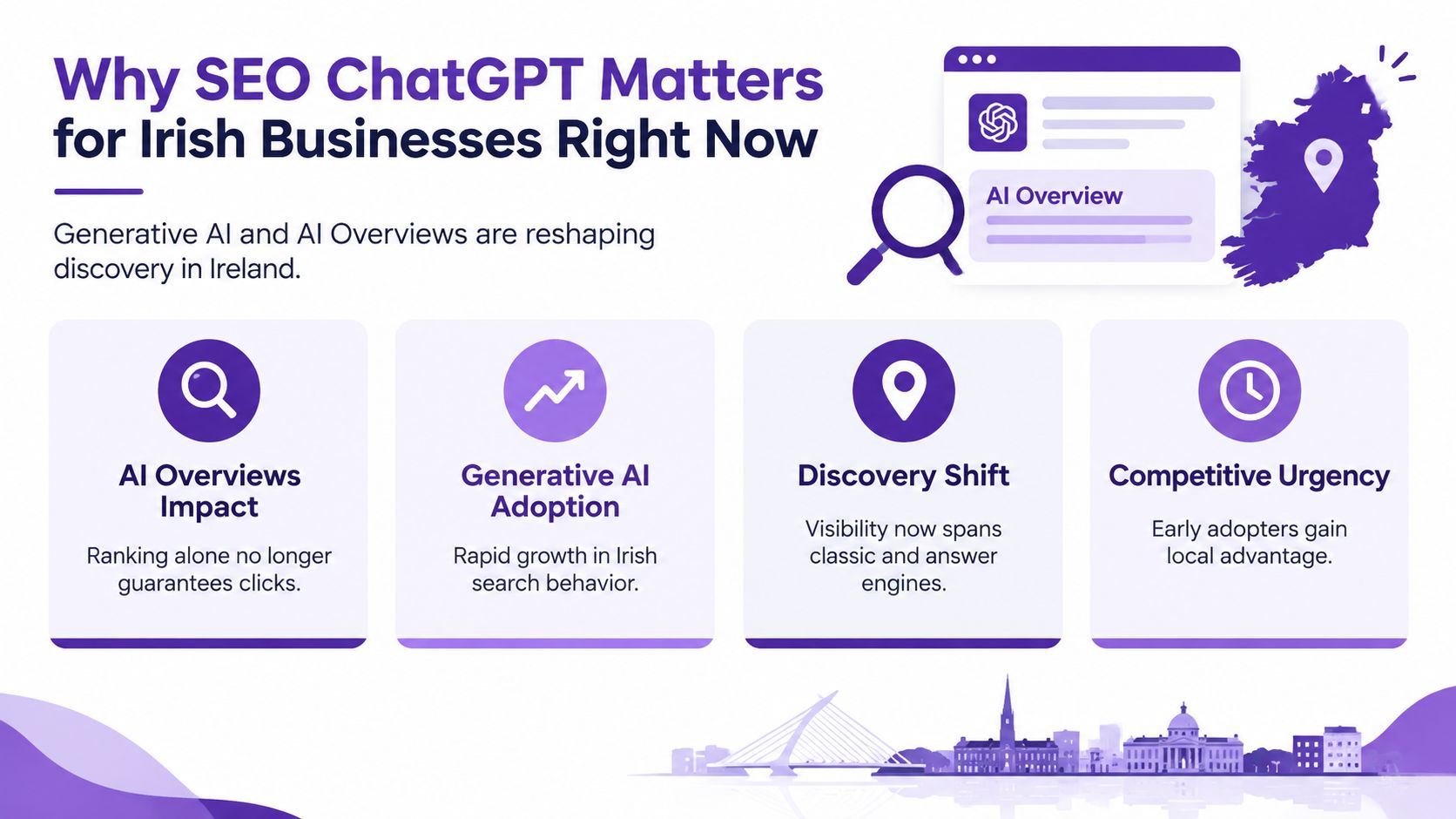
Google visibility still matters, but a traditional ranking no longer guarantees a visit. An analysis of 175 million Irish searches, published in 2026, found that Google AI Overviews reduced click-through rate from 3.62% to 2.67%, a 26% reduction, with informational and question-style queries between positions four and ten most affected. (The Irish search analysis)
That finding changes the brief for content teams. A page can rank, appear below an AI-generated answer, and receive less traffic than its position might suggest. The response isn't to write for a chatbot while neglecting Google. It's to create pages that satisfy the original searcher, provide extractable answers, and give answer engines clear, verifiable material to interpret.
Where ChatGPT helps
ChatGPT can accelerate repetitive and analytical work:
Query expansion: Turn real customer questions into themes, subtopics, and intent groups.
Brief development: Convert a keyword set into a structured outline with questions, evidence requirements, and internal-link opportunities.
Content refinement: Improve clarity, identify missing explanations, and suggest alternative headings.
Answer testing: Produce realistic prompts for local, service, comparison, and problem-based searches.
Quality checks: Flag unsupported claims, vague language, duplicated sections, and inconsistent terminology.
Those uses save time because the model handles pattern recognition and first drafts quickly. They don't remove the need for a strategist who understands margins, sales objections, regulatory constraints, Irish terminology, and the difference between a page that attracts attention and one that creates demand.
Where human judgement stays in control
ChatGPT can produce fluent nonsense. It may merge different services, invent a feature, confuse a county with a service area, or turn an unverified assumption into a confident sentence. That risk rises when the prompt asks for “expert content” without supplying first-party facts and source requirements.
For an SME, brand risk often matters more than writing speed. A professional services firm cannot publish an inaccurate qualification. A SaaS company cannot allow an AI-generated comparison to misstate integration support. An e-commerce business shouldn't let a model create product claims that nobody has approved.
A useful decision filter is simple:
Augment first: Use ChatGPT for research organisation, clustering, outlines, editing, and test prompts.
Control tightly: Require source inputs for claims, products, prices, qualifications, policies, and performance statements.
Keep ownership human: Let a subject-matter expert approve anything that affects trust, compliance, positioning, or conversion.
Measure the outcome: Track rankings, impressions, clicks, citations, enquiries, and lead quality together.
For a broader explanation of how answer-led discovery changes the customer journey, see what AI search means for marketers. The practical point is not that ChatGPT replaces SEO. It makes disciplined SEO more valuable because weak, generic pages are easier for both search engines and users to ignore.
Practical Prompt Templates for Keyword Research and Content Briefs
ChatGPT produces better SEO research when you define the market, the customer, the output format, and the validation rules before asking for ideas. A prompt such as “give me keywords for accountants” creates a long list with little commercial value. A useful prompt asks the model to separate research intent from buying intent and to explain what a human should verify.
Start with intent, not volume
Use a prompt like this:
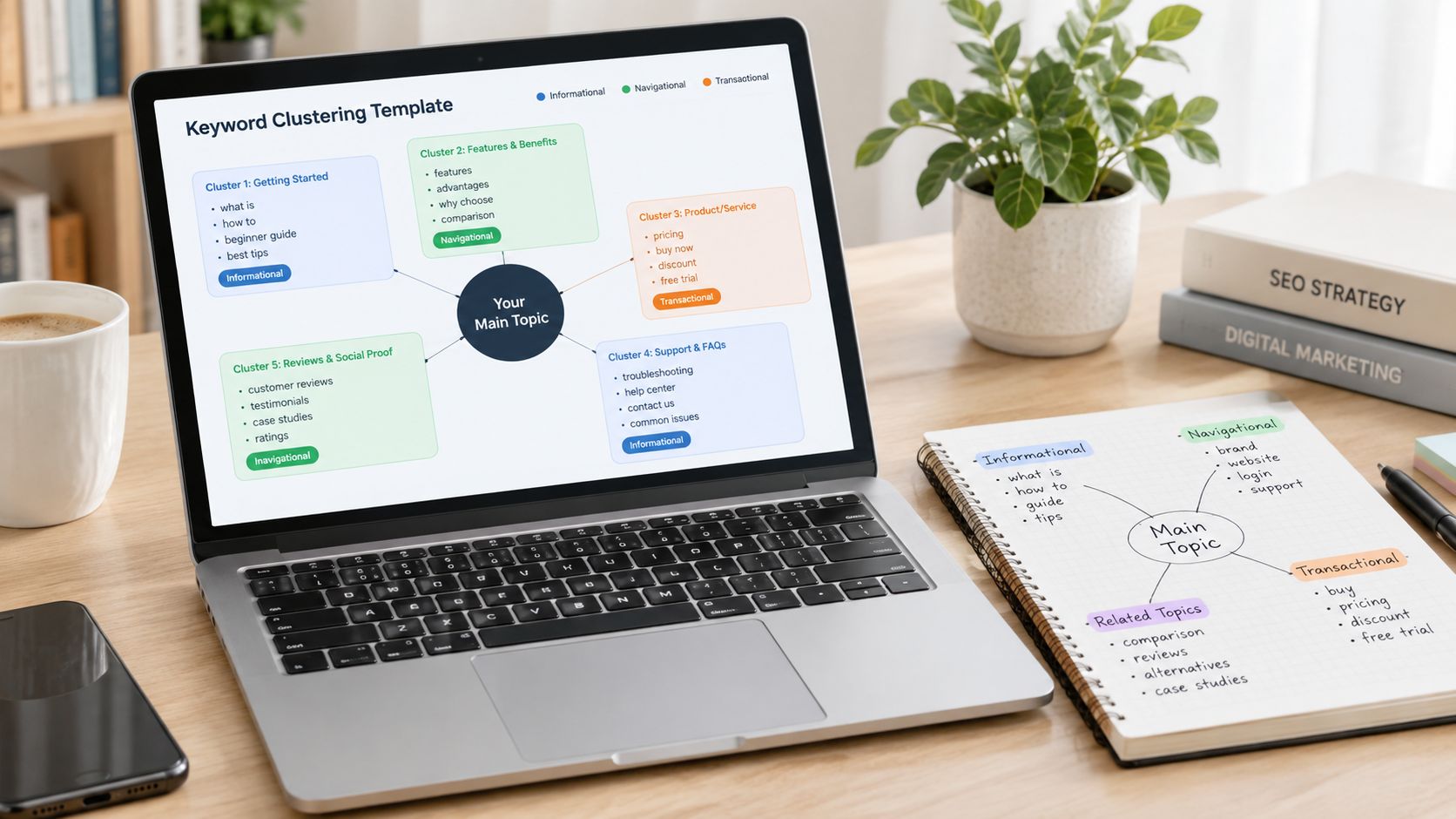
You're an SEO strategist supporting an Irish [business type]. Cluster the following queries by intent: informational, commercial investigation, transactional, navigational, and local service. For each cluster, identify the likely customer problem, the appropriate page type, the funnel stage, and the evidence a human researcher must verify. Do not invent search volumes or market data. Queries: [paste list].
The output should become a working map, not a final decision. Check each cluster against Google Search Console, existing landing pages, sales conversations, and the actual services you deliver. If several queries belong to one intent, avoid creating several near-identical pages only because ChatGPT has grouped them neatly.
For a more structured process, use this SEO keyword research resource alongside the model. ChatGPT can organise inputs, but it can't tell you whether a query attracts a profitable customer unless you provide commercial context.
Expand a seed into a topic map
Build a topic map for [primary service] in Ireland. Use these seed topics: [list]. Group related questions into one proposed pillar page and supporting pages. Include the audience, search intent, recommended format, customer objection addressed, internal-link destination, and a fact or source requirement. Exclude topics that don't connect to the service or a realistic customer need. Do not create statistics, quotes, or case studies.
This prompt limits the model's tendency to treat every related question as a standalone article. The validation step is to compare the proposed map with your site architecture and sales process. A question may be relevant but still belong in a service page, FAQ, buying guide, or support document rather than a new blog post.
Turn a cluster into a brief
Create a content brief for the query cluster [cluster]. Audience: [audience]. Location: [Irish city, county, or national market]. Business goal: [enquiries, bookings, demo requests, sales]. Include the primary question, supporting questions, recommended H2s, direct-answer opportunities, internal links, first-party information required, external sources to verify, conversion action, and likely objections. Mark every statement that needs human fact-checking.
Then ask for a critique:
Review this brief for keyword cannibalisation, unsupported claims, missing commercial intent, weak local relevance, and opportunities to answer the query more directly. Return issues only, grouped by priority.
That second pass is often more useful than asking for another list of headings. It forces the model to challenge its own structure, while the strategist decides what deserves publication.
Creating Meta Tags and Optimised Content With ChatGPT Without Losing Quality
ChatGPT is useful in production when it works from an approved brief and a controlled fact set. It should not be given a blank page and asked to “write an SEO article” with no audience, sources, offer, or review process. That approach produces smooth copy, but often produces the same smooth copy as every competitor.
Draft on-page elements from the page's real promise
For a title:
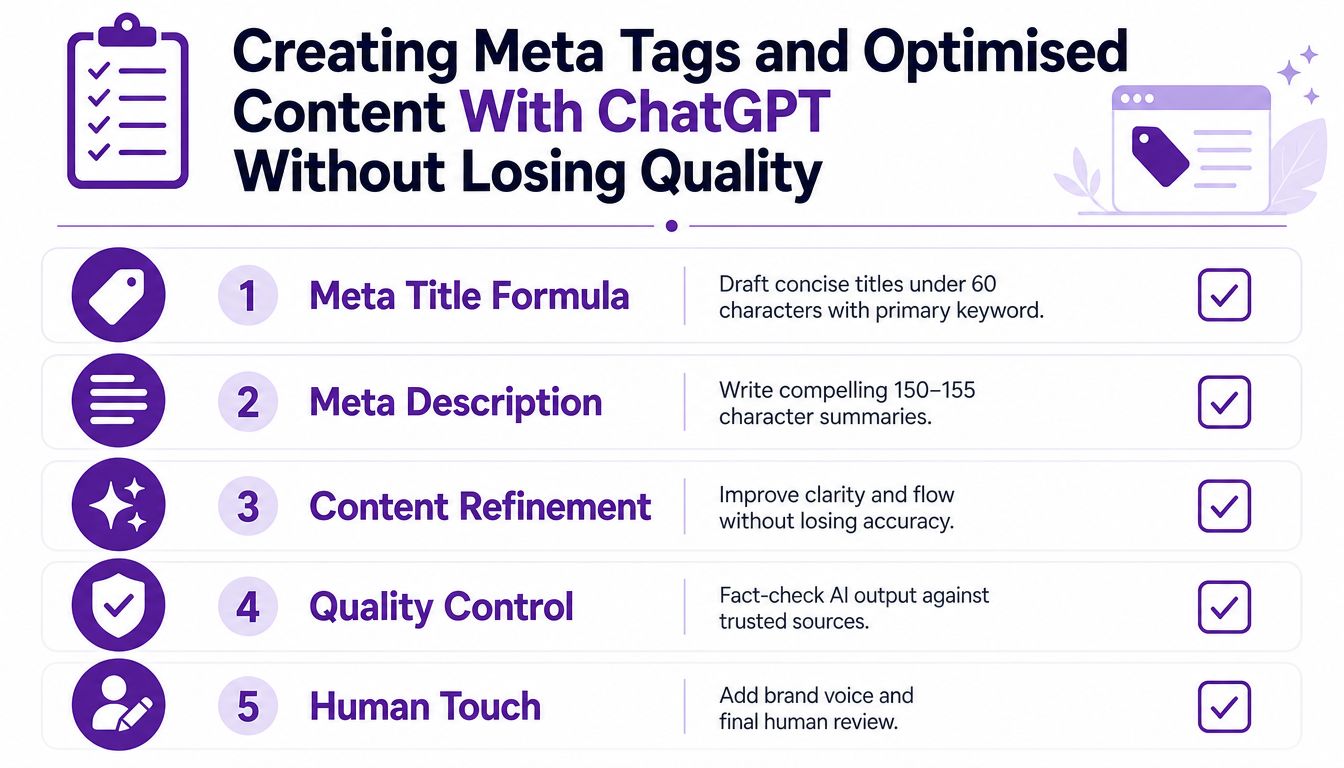
Write five meta title options for this page. Primary topic: [topic]. Audience: [audience]. Business: [business]. Each option must accurately reflect the page, use natural wording, avoid exaggerated claims, and distinguish the page from these existing titles: [paste titles]. Do not invent features, results, qualifications, or locations.
For a description:
Write five meta description options for this page using the approved facts below. Explain the practical value, reflect the page content accurately, include the relevant service or location where appropriate, and avoid promises the business can't prove. Approved facts: [paste facts].
The human check is straightforward. Open the page and ask whether the title and description describe what a visitor will find. A high-click promise that the page doesn't fulfil creates poor user experience and weakens trust.
Improve clarity without manufacturing authority
Use ChatGPT to revise a supplied section:
Rewrite the text below for clarity and flow. Keep every factual meaning unchanged. Do not add statistics, customer results, certifications, prices, product features, or attributed claims. Preserve the brand voice, Irish spelling, and technical terms. Identify any sentence that is ambiguous or unsupported after the rewrite.
This is safer than asking the model to “make it more authoritative”. That phrase often encourages invented specificity. If the page needs stronger evidence, supply the evidence or commission the research. Don't ask the model to fill the gap.
Practical rule: Give ChatGPT approved facts to arrange, not permission to create facts that sound plausible.
Strengthen thin pages with evidence and purpose
For an underdeveloped service page, ask for a gap analysis before requesting more copy:
Compare this page with the customer questions and objections below. Identify missing explanations, unclear terms, weak proof, poor internal-link opportunities, and conversion barriers. Do not recommend adding sections unless they answer a real customer need. Customer questions: [list]. Page: [paste or attach].
Then produce only the missing section, with a human reviewer checking every claim against the company's documentation. FAQs can help answer natural-language questions, but they shouldn't become a dumping ground for repeated keywords or questions nobody asks.
The same discipline applies to editing existing copy. Remove generic introductions, put the direct answer near the top, define specialist terms, and explain what the reader should do next. Keep the human contribution visible through genuine expertise, local context, clear judgement, and accurate examples from the business.
Tuning Content for Answer Engines and Local Irish Visibility
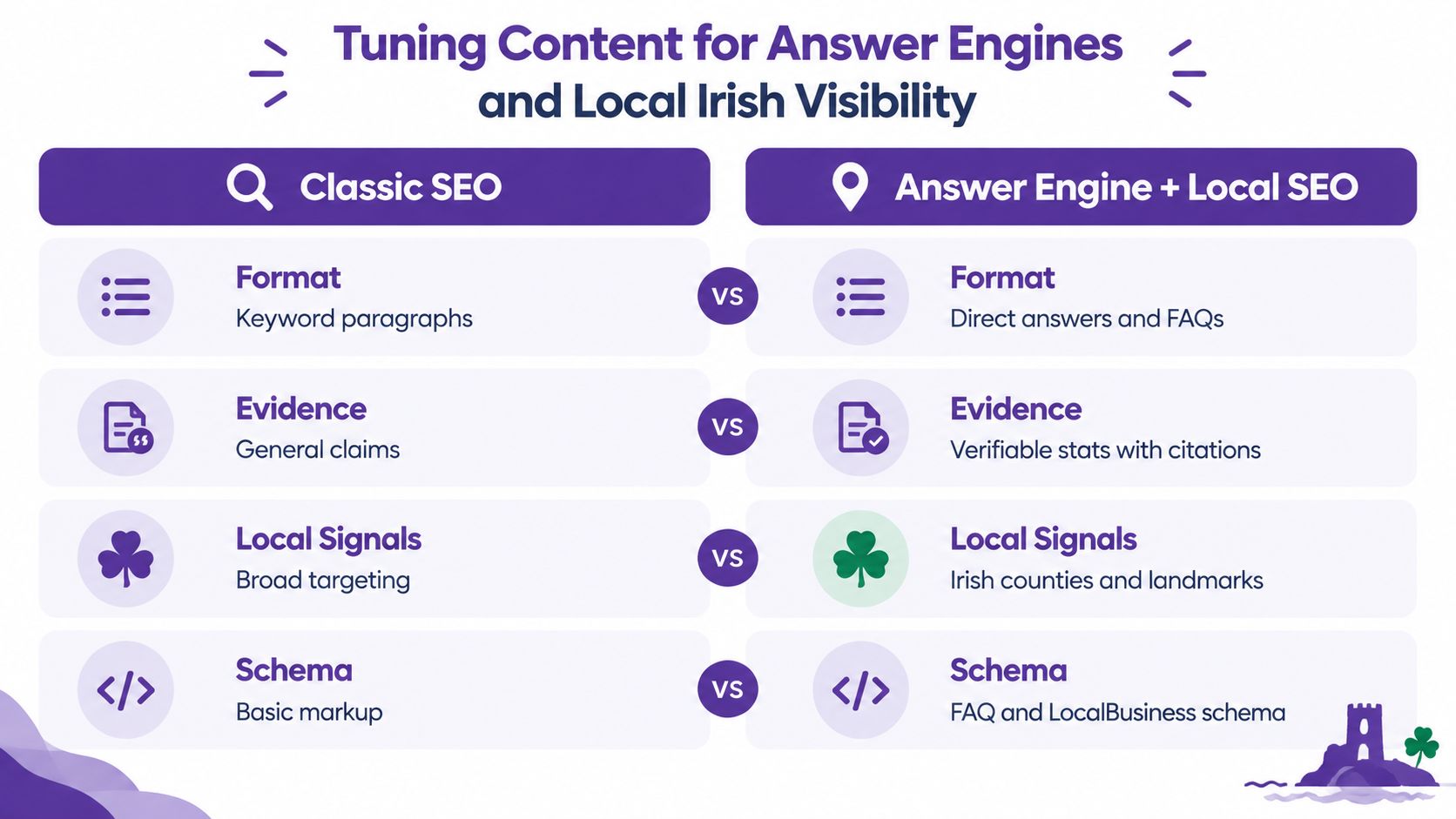
Classic SEO asks whether a page is relevant and technically accessible. Answer-engine optimisation adds another question: can an AI system identify a precise, trustworthy answer and connect it to the right business entity? The work overlaps with SEO, but the emphasis shifts towards direct answers, evidence, consistent business information, and clear relationships between services, locations, people, and organisations.
Make important answers easy to extract
A useful page usually answers the main question near the relevant heading, then adds qualification and detail. For example, a Dublin commercial cleaning page might state the service area, premises covered, scheduling options, and enquiry route directly instead of burying each point inside promotional paragraphs.
The evidence layer matters too. An Irish GEO guide referencing a 10,000-query KDD study reports that adding verifiable statistics with source links increased AI visibility by 41%, inline citations to authoritative sources raised visibility by up to 115% for lower-ranked pages, and direct quotations from recognised authorities increased visibility by 28%. (The Irish GEO guidance and study reference) Treat those findings as a reason to improve evidence quality, not as a guaranteed result for every page.
Use structured data where it accurately describes the page. LocalBusiness, Organisation, Service, FAQPage, and relevant product markup can clarify meaning, but schema won't rescue contradictory addresses, unsupported claims, or poor page content.
Treat local visibility as an entity problem
For Irish SMEs, local relevance requires more than adding “Dublin” to a heading. Keep the business name, address, phone number, service description, opening information, and service areas consistent across the website, Google Business Profile, Bing Places, and credible Irish directories. Make the connection between the business and each location explicit, particularly when the company serves several counties from one base.
Test prompts that reflect how people ask for help:
“Which [service] providers serve [Dublin area]?”
“Who offers [specialist service] near [town or county]?”
“Compare [service type] companies in Ireland for [customer need].”
“What should I check before hiring a [provider] in [location]?”
Record whether the business appears, whether the answer describes it accurately, which sources are cited, and which competitors are named. Don't treat one result as proof of a stable position. ChatGPT answers can vary by wording, account, location, recency, and available browsing context.
Prioritise pages by commercial value
Query Type | Tuning Priority | ChatGPT Prompt Test Idea |
|---|---|---|
Local service query | High, if the page generates enquiries | “Which providers serve [location] for [service], and what evidence supports the recommendation?” |
Core service query | High, when the page is commercially important | “What does [business] offer for [problem], and how does it compare with alternatives?” |
Informational question | Medium, unless it feeds a clear buying journey | “What should an Irish customer know about [topic] before choosing a provider?” |
Brand or navigational query | High for accuracy and reputation | “What does [business] do, where is it based, and who is it suitable for?” |
Low-intent broad topic | Test before investing heavily | “Which sources explain [topic] clearly for an Irish audience?” |
For local implementation support, Scéaled's local SEO service is one option to consider alongside in-house work, directory management, and technical improvements. The right starting point is the page with both a credible customer need and a measurable commercial path, not the page that happens to be easiest to rewrite.
Automation Governance and Testing That Keeps Quality Under Control
A useful SEO ChatGPT workflow has roles, inputs, review gates, and a record of what changed. Without those controls, automation scales inconsistency. The team publishes faster, but nobody can explain where a claim came from or why a page was altered.
Build a simple operating model
Assign responsibility before creating prompts:
SEO owner: Defines the search opportunity, page purpose, intent, and measurement plan.
Subject expert: Supplies accurate service, product, regulatory, and customer information.
AI operator: Runs approved prompts and preserves the inputs and outputs.
Editor: Removes generic language, checks structure, and protects the brand voice.
Approver: Signs off claims, compliance-sensitive content, and publication.
One person can hold several roles in a small business, but the review steps should still exist. A model shouldn't approve its own output, and a draft shouldn't move directly from a prompt into the CMS.
Add source and publication gates
Before drafting, store a source pack containing approved first-party facts, service pages, product documentation, customer language, brand rules, and external references. Tell ChatGPT what it may use and what it must not infer. Require it to mark gaps instead of guessing.
Before publication, check:
Accuracy: Does every factual statement match an approved source?
Search alignment: Does the page answer the intended query rather than a broader imagined topic?
Original value: Does it add expertise, process detail, local context, or useful judgement?
Technical readiness: Are indexation, robots, canonicals, status codes, internal links, and structured data correct?
Commercial fit: Is the next step clear and appropriate for the visitor?
The Irish GEO workflow referenced by SEO Wizard's guide for Irish businesses recommends testing a monthly set of 5 to 10 real customer queries, recording brand appearance, source citation, replacement sources, date, query, platform, and result in a spreadsheet. Repeating that process over 3 to 6 months creates a trend line instead of relying on anecdotal checks. Those figures describe a practical workflow, not a universal measurement standard.
Automate handoffs, not judgement
A spreadsheet can connect query, page, owner, status, source pack, draft link, review result, publication date, and Search Console landing page. A form can send approved brief fields into a document template. A checklist can flag missing sources, unreviewed headings, and absent conversion actions.
Avoid automatic publishing. The safer pattern is automated preparation followed by human approval. ChatGPT can classify queries, draft alternatives, identify gaps, and prepare a revision list. A person still decides whether the page is accurate, useful, commercially relevant, and safe to publish.
Measuring What Works and Deciding Your Next Moves
The right question isn't “Did ChatGPT write more content?” It's “Did the business protect valuable demand, earn credible visibility, and produce better enquiries?” Google Search Console remains essential for impressions, clicks, queries, landing pages, and changes in click-through rate. AI visibility tracking adds prompt-level evidence, while CRM data shows whether the resulting enquiries fit the business.
Irish evidence is mixed, which is precisely why teams should measure rather than assume. A Dublin-based analysis of 55 Irish websites found a small 0.77% year-over-year increase in average Google Organic clicks, challenging the idea that AI Overviews automatically reduce traffic for every local business. (The Dublin analysis of Irish websites) That result doesn't cancel the Irish AI Overview findings cited earlier. It shows that impact varies by query mix, ranking position, industry, page quality, and how much demand the business captures through other channels.
Use the next 30 days well
Establish a baseline: Export current Search Console queries, clicks, impressions, positions, and landing-page performance.
Choose priority pages: Start with commercially important service, location, comparison, and high-impression informational pages.
Create a prompt battery: Use real customer wording across ChatGPT, Google AI Overviews, and other relevant answer platforms.
Improve evidence: Add approved facts, authoritative citations, clear service definitions, and consistent business details.
Track outcomes: Record mentions and citations, then connect organic sessions and enquiries to CRM quality.
Review before scaling: Expand only where accuracy, visibility, engagement, and lead quality support the investment.
Pause AI-assisted production when drafts need heavy factual correction, pages become repetitive, or traffic rises without useful enquiries. Double down when the workflow reduces research time, improves page clarity, strengthens important answers, and gives the team reliable evidence about where the business appears.
For an Irish SME, SEO ChatGPT is not a replacement for search strategy. It's a testing and production layer inside a wider system that includes technical SEO, content, local visibility, conversion optimisation, and measurement. The businesses that gain from it will be the ones that treat AI as an assistant, keep humans accountable for judgement, and connect visibility to revenue rather than publishing volume.
Scéaled helps Irish businesses connect SEO, AEO, content, paid media, and conversion optimisation into practical growth programmes. Visit Scéaled to discuss prompt testing, search visibility, content workflows, and qualified lead generation for your business.
Comments