AI Search Assistant Strategy for Irish SMEs

Ireland is already a serious market for AI-assisted discovery. The Central Statistics Office's 2025 household survey found that 42% of internet users in Ireland had used generative AI in the preceding three months, while Google began rolling out AI Overviews in Ireland on 26 March 2025 through its European rollout announcement. For Irish SMEs, the question isn't whether an AI search assistant will affect demand generation. It's whether your business will be understood, cited, and recommended when buyers stop scrolling through traditional results.
Table of Contents
How Retrieval and Grounding Actually Work - The retrieval sequence
Business Use Cases Across the Buyer Journey - Early-stage discovery - Comparison and selection - Support and post-purchase questions
Navigating the SEO and Paid Media Implications - Audit intent before cutting investment - Organic and paid roles are changing
Practical Implementation Steps for AEO Readiness - Start with the technical foundation - Restructure answer content - Build stronger entity signals
Measurement and KPIs for AI-Driven Discovery - Build a prompt and citation panel - Connect visibility to pipeline
Privacy Considerations and Strategic Next Steps - Prioritise the next decisions
The New Reality of AI Search Assistants in Ireland
An AI search assistant is a conversational discovery engine that interprets a user's question, retrieves relevant information, and synthesises an answer. It may appear inside a search results page, as with Google AI Overviews, or within a dedicated interface such as ChatGPT, Microsoft Copilot, or Perplexity. Instead of presenting only a ranked list of pages, it can summarise options, explain a problem, compare providers, and point users towards selected sources.
That changes the commercial role of search. Traditional SEO aimed to earn a click from a results page. AI search adds another contest before the click: which businesses and sources become part of the answer itself. A company can be visible without receiving a visit, while another may receive fewer but more informed and commercially valuable visitors.
Irish adoption makes this a live market issue rather than a speculative technology discussion. Deloitte Ireland reported in early 2025 that 48% of adults in Ireland had used generative AI, and that 46% used it more regularly than monthly, compared with 27% in 2023 for that regular-use measure. Deloitte's Digital Consumer Trends research places Ireland among Europe's higher-adoption environments, creating a substantial audience for tools that answer questions directly.
Commercial implication: Your prospects may form a shortlist, clarify a requirement, or reject an approach before they reach your website.
For Irish B2B firms, professional services providers, SaaS companies, and e-commerce brands, that creates two risks. First, informational content can lose visits when an assistant satisfies the question on the results page. Second, a business with weak entity signals may be absent from comparisons even when its website ranks for related terms.
The practical response is Answer Engine Optimisation, or AEO. It doesn't replace technical SEO, useful content, or authority. It adds a requirement for pages to be clear enough for an assistant to retrieve, interpret, and reuse confidently. Scéaled's explanation of what AI search means for modern discovery provides useful context, but the strategic point is straightforward: Irish SMEs need to optimise for the answer layer as well as the results page.
How Retrieval and Grounding Actually Work
An AI search assistant doesn't just recall everything it has learned and produce an answer from memory. For current or specific questions, it typically retrieves information from available sources, evaluates how well those sources address the query, and uses the retrieved material to ground the response.
A useful analogy is a capable researcher working with a well-organised filing cabinet. The researcher has broad background knowledge, but checks the latest documents before making a precise recommendation. Your website, profiles, reviews, publications, and structured data form part of that filing system. If the information is inconsistent, buried, vague, or difficult to parse, the researcher has less reason to use it.
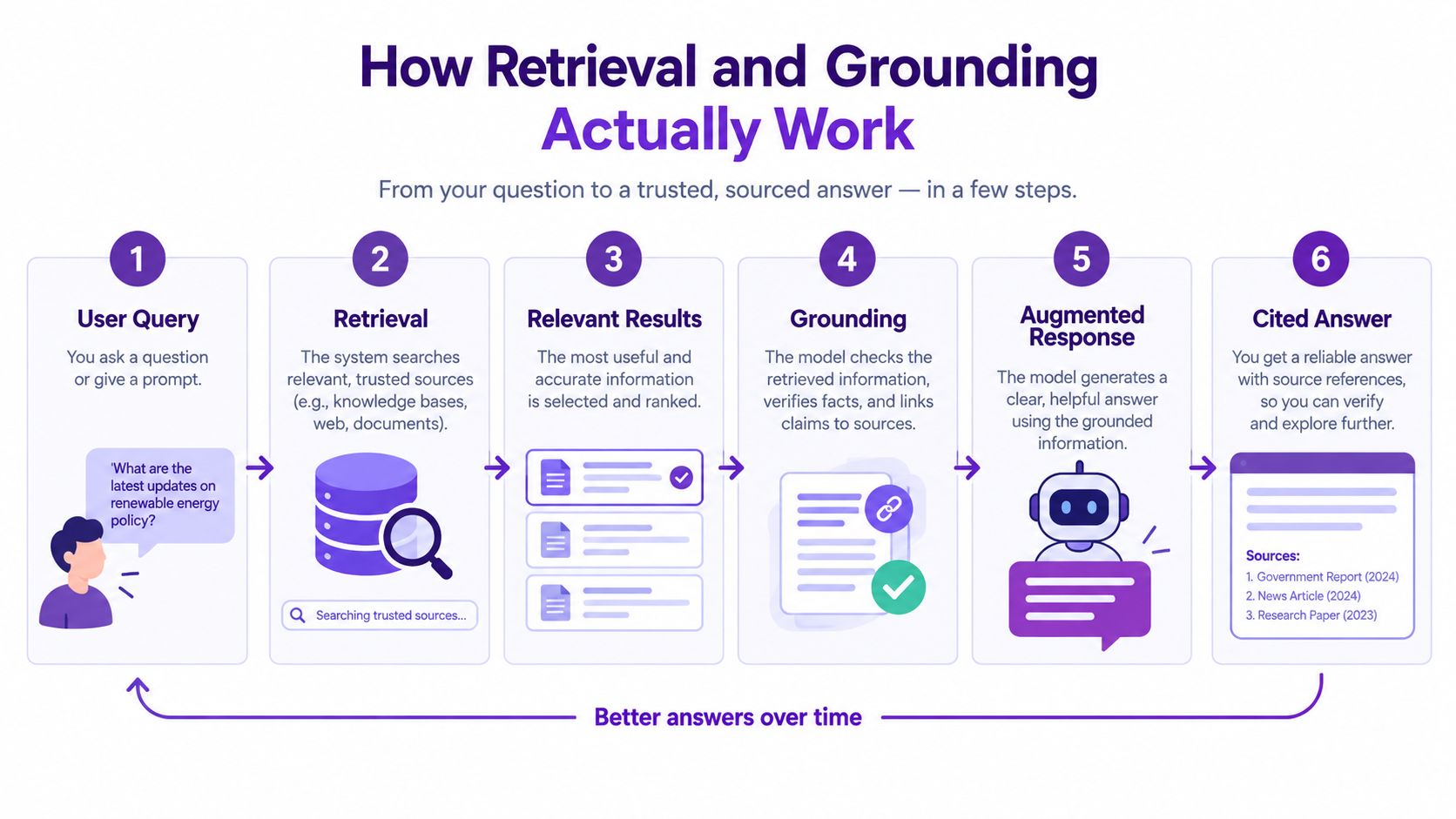
The retrieval sequence
A practical grounding process usually involves several connected tasks:
Interpret the request. The assistant identifies the subject, intent, location, constraints, and implied comparison.
Retrieve relevant material. It searches indexed content and other available information sources.
Assess relevance. It looks for passages that answer the specific question rather than merely mentioning a keyword.
Resolve entities. It connects your organisation, services, locations, people, products, and categories into a coherent identity.
S synthesise the response. It combines usable evidence into a concise answer.
Expose citations or recommendations. Where the interface supports it, the assistant links to sources or names businesses that fit the request.
The typo in the previous list must be avoided in production content, but the underlying lesson matters: machine-readable structure supports reliable interpretation. Clear headings, direct answers, consistent terminology, internal links, and relevant schema help systems separate one idea from another.
Traditional crawlability remains foundational. A page that search engines can't access won't become a dependable source for an assistant. But accessibility alone isn't enough. A page may be indexable and still fail to communicate what the business does, whom it serves, where it operates, or how its offer differs from alternatives.
Teams investigating common AI search problems should inspect the content as a retrieval system would. Can a model identify a self-contained answer? Can it associate the claim with a named organisation? Can it distinguish a service page from a general opinion article? Those questions lead to better AEO work than adding more keywords.
Business Use Cases Across the Buyer Journey
Consider an Irish operations director looking for help with a fragmented lead-generation process. Under the traditional model, they might search several phrases, open agency websites, compare service pages, and build their own shortlist. With an AI search assistant, they can describe the business problem in ordinary language and ask for suitable approaches, providers, questions to ask, or warning signs.
That assistant now acts as a research filter. It may summarise the difference between paid search, SEO, conversion optimisation, and marketing automation before the buyer visits a provider. A firm that publishes precise explanations can influence the framing of the problem. A firm with only broad claims such as “full-service growth partner” gives the assistant little concrete material to use.
Early-stage discovery
At the awareness stage, buyers ask questions about symptoms:
Problem definition: Why are qualified leads falling even though website traffic is steady?
Process choice: Should an SME invest in SEO, paid media, or conversion optimisation?
Risk assessment: What should an Irish company check before adopting an AI tool?
Planning: How should a B2B team measure demand beyond last-click conversions?
The opportunity isn't to force a sales pitch into every answer. It's to publish authoritative, specific guidance that explains causes, trade-offs, and next actions. This builds relevance before the buyer has chosen a category or provider.
Comparison and selection
Later, a buyer may ask an assistant to compare vendors, platforms, or approaches. They might request providers serving Irish companies, ask which solution fits a particular team, or seek a comparison of pricing models and implementation requirements. Your own website can't control every recommendation, but it can make the facts around your business easier to verify.
Entity consistency matters here. The company name, service descriptions, locations, leadership information, industry experience, and contact details should align across the website and credible third-party profiles. Contradictions create uncertainty, especially when an assistant is trying to distinguish similarly named organisations.
Support and post-purchase questions
AI discovery also affects existing customers. Buyers may ask how to use a product, interpret a contract, troubleshoot a service, or find the correct support route. A well-structured knowledge base can reduce friction, but it needs HTML pages, descriptive headings, and direct answers rather than relying entirely on inaccessible documents or marketing copy.
The commercial lesson is broader than traffic acquisition. An AI search assistant can shape problem recognition, vendor consideration, and customer confidence. Treating it only as a replacement for Google rankings misses the influence it has across the journey.
Navigating the SEO and Paid Media Implications
The most common overreaction is to assume that AI search means every organic visit will disappear. Irish evidence doesn't support such a simple conclusion. A report based on an Ireland-focused analysis of 55 websites found a 0.77% year-on-year increase in average organic clicks, as noted in coverage of Google's Irish AI Overviews rollout by The Irish Times. That doesn't prove that AI search is harmless. It shows that impact varies by query, market, page type, and user intent.
An assistant is more likely to satisfy a straightforward informational request without a click. The user may need only a definition, a basic process, or a short explanation. Commercial investigation behaves differently. A buyer comparing agencies, requesting a quote, checking compatibility, or evaluating risk usually needs evidence, detail, and a route to contact the provider.
Audit intent before cutting investment
Group your search demand into practical categories:
Informational: Questions that can be answered fully in a short summary.
Problem-aware: Queries where the user is diagnosing an issue and evaluating possible solutions.
Commercial: Searches involving providers, platforms, categories, comparisons, or service requirements.
Transactional: Queries showing readiness to enquire, book, buy, or request a demonstration.
Branded: Searches where the user already knows your organisation or product.
The first category may be vulnerable to zero-click behaviour. That doesn't make it worthless. Informational content can still establish the language and concepts that influence later consideration. But commercial and transactional pages deserve especially close protection because their value depends on qualified action, not raw sessions.
The right question isn't “How many clicks did AI remove?” It's “Which valuable decisions now happen before the click, and does our brand appear in them?”
Organic and paid roles are changing
AEO strengthens the organic layer by making your content easier to retrieve and cite. Paid media remains useful for controlling exposure around high-intent searches, testing commercial messages, and capturing demand that already exists. The two channels should share an intent model rather than operate as separate keyword lists.
Review paid search terms for language that signals comparison, urgency, location, and procurement. Then ensure the landing page answers the practical questions an assistant or buyer is likely to raise. Sending a high-intent visitor to a vague service page wastes the advantage of the click.
Use AI visibility to refine messaging, not to chase vanity exposure. If assistants repeatedly describe a category using a particular concern, reflect that concern in ad copy and landing-page structure. If they misrepresent your offer, strengthen first-party explanations and entity signals before increasing spend.
Practical Implementation Steps for AEO Readiness
AEO readiness starts with making the business unambiguous. An assistant should be able to determine what you sell, who you serve, where you operate, and why a buyer might select you without stitching together scattered hints.
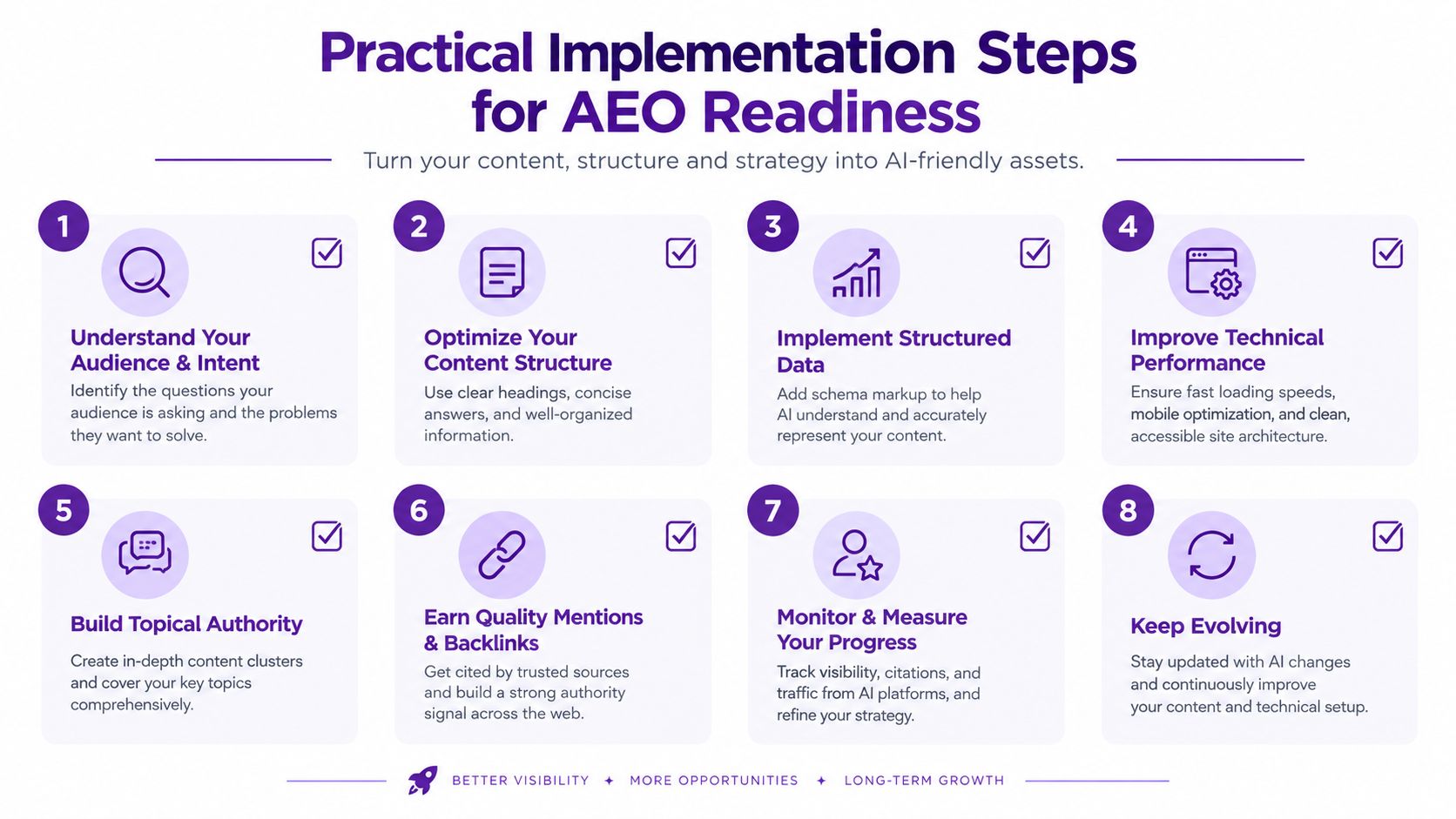
Start with the technical foundation
Check crawling, indexation, canonical pages, internal linking, page titles, descriptions, and heading hierarchy. These are not outdated SEO tasks. They help retrieval systems discover and interpret the content you want to be considered.
Add relevant Schema.org structured data through JSON-LD where it accurately represents the page. Depending on the business, useful types may include Organisation, LocalBusiness, Product, Service, Article, FAQPage, or Event. Schema doesn't guarantee inclusion in an AI answer, and inaccurate markup can create confusion, so treat it as a precise description rather than a visibility trick.
Restructure answer content
Create question-and-answer blocks in visible HTML. Put the question in a descriptive heading and answer it directly in the following paragraph. Then add nuance, conditions, examples, or evidence. Don't hide the only answer inside a tab, image, or downloadable PDF.
Comparison tables work well when the criteria are meaningful. For example, an Irish SaaS firm might compare implementation model, integrations, support ownership, security responsibilities, and ideal customer profile. A professional services firm could define the difference between a strategy engagement, an execution retainer, and a project-based intervention.
Build stronger entity signals
Publish a clear organisation page, named author profiles, service pages with defined boundaries, and location information that reflects how the business operates. Connect related pages with descriptive internal links. Keep names, services, sectors, and contact details consistent across your website and external profiles.
Use a language audit to remove vague claims. “Flexible support” is difficult to retrieve as evidence. “Monthly paid search management for Irish B2B firms with lead-quality reporting” gives an assistant a clearer proposition to classify.
A practical sequence looks like this:
Inventory priority queries. Begin with questions connected to revenue, not a giant list of generic terms.
Map sources. Identify which pages, profiles, and documents currently answer those questions.
Rewrite weak passages. Turn indirect marketing copy into concise, self-contained explanations.
Add supporting proof. Include named processes, relevant qualifications, service boundaries, and accurate examples.
Validate markup. Check that structured data matches visible page content.
Improve conversion paths. Make it easy for a qualified visitor to call, enquire, book, or request a demonstration.
Monitor assistant outputs. Test realistic prompts and record whether your business is mentioned accurately.
Review quarterly. Update pages when services, team details, markets, or customer questions change.
The Scéaled AI search optimisation service is one option for businesses that need support across technical SEO, answer-first content, entity consistency, and measurement.
Measurement and KPIs for AI-Driven Discovery
AI visibility creates a measurement problem because an assistant can influence a decision without sending a conventional referral. Standard analytics may show a direct visit, branded search, or assisted conversion without revealing that an AI answer introduced the company.
That doesn't mean measurement is impossible. It means the reporting model needs to connect visibility, consideration, and commercial action rather than treating sessions as the complete outcome.
Build a prompt and citation panel
Create a repeatable set of prompts based on real buyer language. Include problem questions, category questions, local searches, comparisons, objections, and branded prompts. Test them consistently across relevant assistants, recording whether your organisation appears, how it is described, which competitors are named, and which sources are cited.
Don't treat one answer as a ranking position. AI responses can vary by account context, location, timing, and wording. Look for patterns across a controlled set of prompts and review the quality of the recommendation, not only the mention.
Connect visibility to pipeline
Track changes in branded search, direct visits, assisted conversions, enquiry quality, call outcomes, and opportunities influenced by organic content. Ask new leads how they first heard about the business, but don't rely on that answer alone. A buyer may say Google even when an AI assistant shaped the research that led them there.
Use a dashboard that separates leading indicators from revenue indicators:
Measurement Area | Legacy SEO Metric | New AEO KPI |
|---|---|---|
Visibility | Rankings for target keywords | Presence and accuracy in tested assistant answers |
Content selection | Organic impressions | Citations and source inclusion for priority prompts |
Engagement | Organic sessions | Qualified visits from AI referrals and branded discovery |
Brand demand | Branded search volume | Branded searches following tracked AI exposure |
Conversion | Last-click leads | Assisted enquiries and opportunities influenced by AEO content |
Quality | Bounce rate and time on page | Sales-qualified rate, booking quality, and pipeline value |
Authority | Backlinks and domain metrics | Consistent entity descriptions across trusted sources |
A useful reporting note should explain uncertainty. AI referral attribution is often incomplete, so don't claim that every branded search came from an assistant. Instead, compare prompt visibility with changes in branded demand and pipeline over time, then validate the relationship through sales and customer research.
For Ireland, referral concentration can guide testing priorities. StatCounter data cited in Ireland AI assistant market coverage showed ChatGPT at 87.82% in March 2025 and 83.9% in June 2025, while Copilot reached 7.75% and Perplexity 5.28% in June. Those figures support prioritising the dominant surface first, while still checking other assistants that matter to your audience.
Privacy Considerations and Strategic Next Steps
Irish firms should treat AI search as both a visibility channel and a data-governance issue. Public assistants may receive sensitive prompts, internal documents, customer details, or commercially confidential material if employees use them without clear controls. Before feeding proprietary information into any external model, establish what data may be entered, which approved tools are permitted, who can access outputs, and how the organisation handles retention and reuse.
The same discipline applies to an on-site AI assistant. A support bot connected to internal documentation can improve navigation and customer service, but it must respect access permissions and avoid exposing confidential account information. Keep public marketing content separate from restricted operational data, and involve the appropriate privacy and security owners before deployment.
Irish consumer behaviour also makes inaction risky. An Irish survey reported that 53% of adults used AI tools such as ChatGPT, Gemini, or Copilot, while the Citizens Information Board reported a 19% traffic drop coinciding with search engines introducing AI summaries, according to Irish research on consumer use of AI. The figures don't establish a universal traffic outcome for every business, but they do show why SMEs should test their own demand patterns instead of relying on general predictions.
Prioritise the next decisions
Start with the commercial questions that matter most:
Protect revenue pages first. Audit service, product, comparison, and location pages tied to enquiries or sales.
Create an entity baseline. Check whether your organisation and offers are described consistently across first-party and relevant external sources.
Test real prompts. Use the questions your sales team hears, not only the keywords in your SEO platform.
Fix conversion friction. A citation is useful only if the resulting visitor can quickly understand the offer and take the next step.
Set governance rules. Define approved AI tools, permitted data, review requirements, and accountability.
Choose build versus partner carefully. Build an internal assistant when your information is controlled, your use case is clear, and your team can maintain it. Use specialist support when technical SEO, content, measurement, and paid media need to work as one system.
The strategic advantage won't come from publishing more generic AI content. It will come from being the clearest, most consistent, and most commercially useful source for the questions Irish buyers ask. Traditional SEO remains the discovery foundation, but AEO determines whether your expertise can be selected and reused inside the answer.
Scéaled helps Irish SMEs and mid-market teams improve visibility across search engines and AI-powered answer platforms, while connecting SEO, paid media, content, and conversion work to qualified demand. Visit Scéaled to discuss an AI search visibility audit and a practical plan for protecting your inbound pipeline.
Comments