Meta Ads for Instagram: The Complete 2026 Guide

You've launched an Instagram campaign for an Irish business, the creative looks polished, and the first results still don't make sense. CPMs rise, leads arrive with the wrong intent, and the Ads Manager dashboard suggests that everything is working because clicks are coming through. Then sales checks the CRM and finds that the campaign has produced activity, not demand.
That pattern is common when teams treat Meta ads for Instagram as a visual copy of Facebook advertising. In Ireland, the channel depends on more than a good audience and attractive creative. Consent, signal quality, placement choices, landing-page experience, lead handling, and optimisation all affect the result. If one link is weak, the campaign can look efficient inside Meta while underperforming commercially.
Table of Contents
The Real Situation Irish Advertisers Face on Instagram - Why early results create confusion
How Meta Ads for Instagram Actually Work - The three buying approaches - What “Instagram campaign” means in Ads Manager
Choosing the Right Campaign Objective and Buying Type - A practical decision framework - Example one, a Dublin SaaS firm - Example two, an Irish e-commerce retailer
Building Audiences That Survive Irish Consent Rules - Start with data you can defend - Make the funnel narrower on purpose
Creative Formats and Placements That Win on Instagram - A placement brief a creative team can use
Measurement, Attribution and the Numbers That Matter - Read each metric for its actual job
Optimisation Tactics That Move the Needle - A practical first-week test list - Scale without destabilising the account
Connecting Instagram Ads to CRO, Lead Nurture and AI Workflows - Fix the conversion path before adding complexity - Use automation where it removes delay - A week-one operating checklist
The Real Situation Irish Advertisers Face on Instagram
An Irish SME usually starts with a practical constraint, not a media theory problem. The business has a modest budget, a small in-house team, several existing assets, and pressure to generate enquiries or sales quickly. Instagram appears attractive because the reachable market is substantial. Meta's advertising tools reported 2.50 million Instagram users in Ireland in early 2025, representing 47.3% of the total population and 47.9% of local internet users. By late 2025, the reported figure had reached 2.60 million, or 48.9% of the population, an increase of 100,000 people, or 4.0% year over year. DataReportal's Digital 2025 Ireland report provides that platform-level context.
The headline reach figure isn't the same as a dependable prospecting pool. Some people won't consent to personalised advertising, some won't match to uploaded customer data, and others may be technically reachable but commercially irrelevant. A Dublin SaaS company selling to finance teams isn't buying access to “Ireland”. It's trying to find a narrow group of people with a relevant problem, enough authority, and a reason to act now.
Why early results create confusion
The first launch often combines too many variables. The team changes the audience, offer, video, landing page, and conversion event at the same time. A lead campaign then optimises towards the easiest form completion rather than the lead quality the sales team needs. If the CRM isn't connected to the analysis, the media buyer sees a low cost per lead while the commercial team sees poor-fit submissions.
Creative creates another bottleneck. Reels, Stories, Feed, Explore, and Shopping don't reward the same treatment. A single square product image resized into a vertical placement is rarely a serious creative strategy. Small teams also tend to refresh only after performance has deteriorated, leaving the auction with tired ads and limited angles.
Practical rule: Judge Instagram as a connected acquisition system, not as an isolated placement. Audience quality, creative relevance, consented signals, measurement, and conversion experience must work together.
Ireland's privacy environment makes that system more demanding. The Irish Data Protection Commission's conclusion on Meta Ireland's investigations found that Meta Ireland couldn't rely on the “contract” legal basis for behavioural advertising on Instagram and fined the company €180 million for Instagram-related GDPR breaches. That doesn't make Instagram unusable. It means advertisers need to plan for consent quality and signal loss instead of assuming that every platform option behaves as it did in US-focused playbooks.
How Meta Ads for Instagram Actually Work
Think of Meta's auction as a busy Dublin market stall. Several advertisers want to speak to the same person, but the platform has only one opportunity to show an ad in a particular position. Meta evaluates the available ads using factors that include the advertiser's bid, the estimated action the person may take, and the quality or relevance of the ad experience. The highest nominal bid doesn't automatically win.
Instagram is part of the wider Meta delivery system, but each placement has its own context. Feed gives people more room to pause and assess a post. Stories occupy the full screen between organic updates. Reels compete with fast-moving entertainment, while Explore appears alongside content selected for discovery. Facebook placements reach people in a different environment, even when the campaign uses the same objective and creative.
The three buying approaches
Auction buying gives Meta flexibility to deliver impressions based on the campaign objective and available opportunities. It's the standard choice for most lead-generation and sales activity because the system can move delivery between audiences and placements as it searches for the desired action.
Reach buying is designed around reaching people efficiently within a defined audience, rather than relying solely on conversion probability. It can suit awareness work where broad exposure matters more than immediate response.
Reservation buying plans delivery in advance against agreed inventory and audience conditions. It's more relevant to campaigns needing predictable exposure than to an SME trying to learn which message produces qualified enquiries.
What “Instagram campaign” means in Ads Manager
Meta Ads Manager doesn't require a separate Instagram-only advertising platform. You create a campaign, select an objective, define the audience and budget, build the ad set, and choose placements at the ad-set level. You can then use Advantage+ placements, which allow Meta to distribute delivery across eligible Facebook, Instagram, Messenger, and Audience Network placements, or select manual placements and limit delivery to Instagram surfaces.
Manual placement control can help when the creative is specifically designed for Instagram or when reporting needs a clean placement comparison. It can also restrict delivery unnecessarily. Advantage+ placements may find cheaper opportunities outside Instagram, but that can frustrate a client who asked specifically for Instagram exposure. Explain the distinction clearly using Meta's campaign and advertising options, then decide whether the business is buying an outcome or a particular surface.
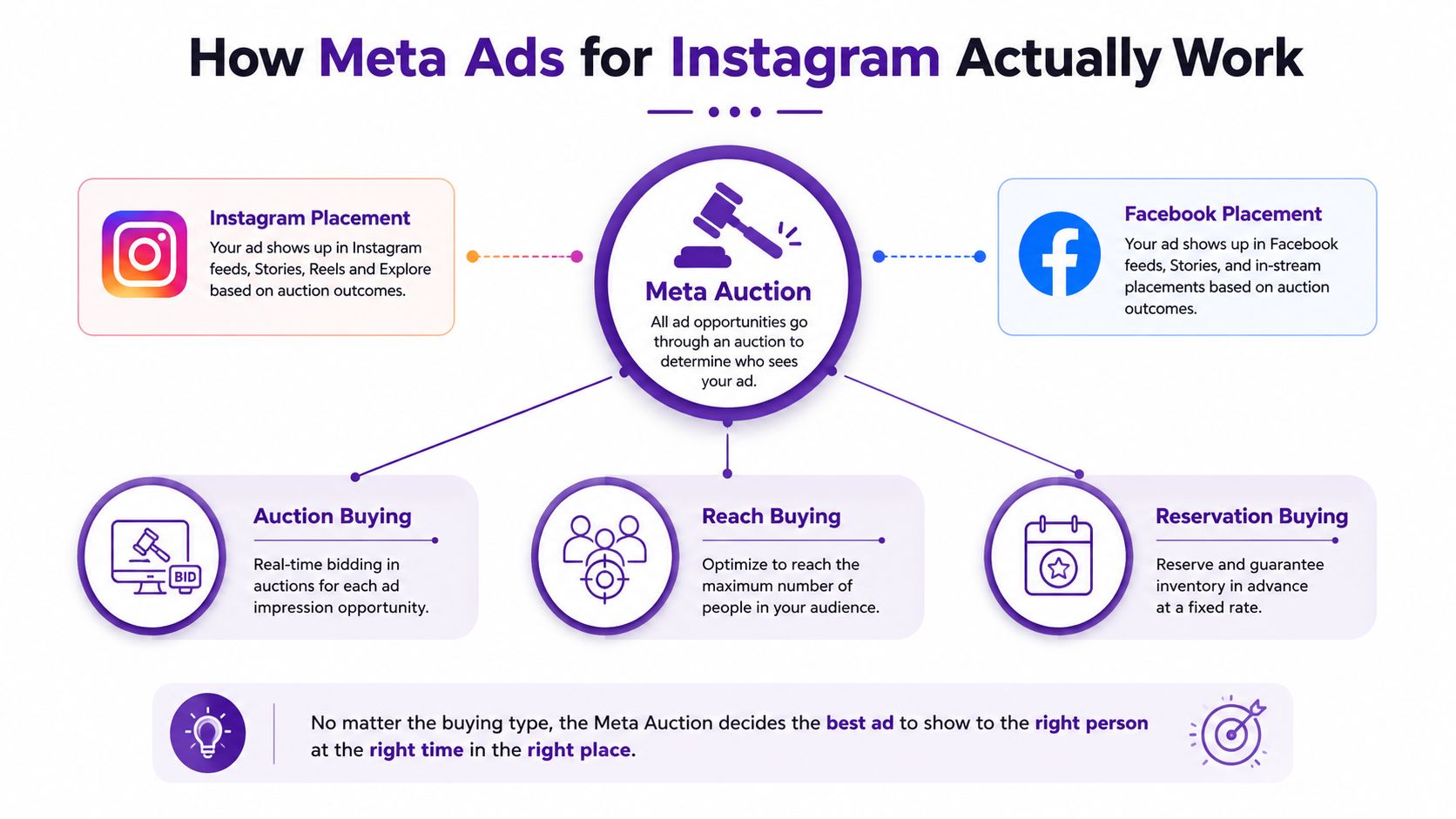
To explain delivery to a client, answer three questions: what action is the campaign optimising for, which placements are eligible, and what signal tells Meta that a person is valuable? If Reels isn't receiving delivery, check placement eligibility, aspect ratio, creative policy status, audience size, bid strategy, and whether stronger opportunities exist elsewhere in the selected inventory.
Choosing the Right Campaign Objective and Buying Type
Meta's auction determines which ads reach which people. Several advertisers may compete for the same viewer, while only one ad occupies each available position. The campaign objective tells the system which action matters, so it should reflect the commercial outcome rather than the ad format. A product video might support awareness, traffic, engagement, or sales. A lead form might produce casual downloads or serious enquiries. A mismatch can create activity without improving the metric the business needs.
A practical decision framework
Objective | Buying Type | Typical Budget Shape | Best Fit In Ireland |
|---|---|---|---|
Awareness | Auction or reach | Broad, steady delivery | Building recognition for a defined market |
Traffic | Auction | Test landing-page response before scaling | Content, research, and early consideration |
Engagement | Auction | Creative-led testing | Social proof, video interaction, and community activity |
Leads | Auction | Concentrated around qualified conversion signals | B2B enquiries, consultations, and SaaS trial interest |
App promotion | Auction | Automated delivery with strong event tracking | Apps with reliable install and in-app event signals |
Sales | Auction | Conversion-led structure with sufficient product and purchase data | E-commerce acquisition and remarketing |
Reach or reservation buying can suit a launch where controlled exposure matters. Irish SMEs usually gain more from feedback and conversion learning than guaranteed visibility. Auction campaigns provide that flexibility when the event signal is meaningful and the consented data foundation is sound.
Example one, a Dublin SaaS firm
A SaaS company offering a free trial should not optimise only for completed lead forms if the sales team qualifies every submission afterwards. A lead or website conversion objective may work better, supported by a clear qualification step and CRM feedback that separates a relevant business enquiry from a casual download. The creative needs to promise a specific outcome. The landing page should then explain who the product suits, what happens after submission, and how quickly the prospect can expect a response.
The strongest signal is not always the easiest action to record. If a form completion rarely becomes a sales conversation, feeding qualified outcomes back into the account gives Meta a more useful basis for delivery.
Manual controls can help during the initial diagnostic phase, particularly when the team needs a deliberate comparison of Feed, Stories, and Reels. Once the account has a dependable conversion signal, broader automation may find opportunities that a tightly segmented structure misses.
Example two, an Irish e-commerce retailer
A retailer promoting a seasonal sale should build around purchases rather than clicks alone. Product feeds, catalogue quality, event tracking, stock availability, and checkout performance determine whether sessions become revenue. Advantage+ Shopping can help when the retailer has clean purchase and product data for identifying likely buyers. Automation will not repair weak product photography, unclear delivery information, or a slow mobile checkout.
Manual structures remain useful when the commercial logic differs, such as separate margins, markets, or product groups. Automation suits accounts with reliable signals and a business willing to let Meta allocate delivery across available opportunities. The choice should connect the objective, creative promise, bid strategy, landing-page experience, and final conversion, rather than treating campaign setup as an isolated platform decision.
Building Audiences That Survive Irish Consent Rules
Audience planning in Ireland starts with a distinction many account audits miss: potential reach isn't the same as usable, consented reach. Meta's tools can estimate a broad population, but the portion available for behavioural targeting, matching, remarketing, or measurement depends on permissions, platform settings, data quality, and user behaviour.
The DPC decision on Meta Ireland changes the practical conversation. Meta Ireland can't rely on the “contract” legal basis for behavioural advertising on Instagram, and the related €180 million fine reinforces the need for a stricter consent and governance process. Advertisers shouldn't interpret that as a reason to abandon first-party data. They should treat first-party data as something that must be collected lawfully, documented, maintained, and transmitted with care.
Start with data you can defend
Core audiences use signals such as location, demographics, interests, and platform behaviour. They can be useful for prospecting, but they're broad assumptions rather than proof of buying intent. Keep the structure simple enough to learn, and avoid turning every job title, interest, and demographic into a separate ad set.
Custom audiences can use website activity, customer lists, app events, or engagement. Before uploading a CRM list, remove stale records, standardise fields, separate customers from prospects, and confirm that the relevant consent permits the intended advertising use. A clean, smaller audience is more valuable than a large list with unclear provenance.
Lookalikes can extend a strong customer or lead source. Build them from commercially meaningful groups, such as qualified opportunities or repeat buyers, rather than every contact in the database. If a lookalike performs poorly, check the seed quality before blaming the model.
Make the funnel narrower on purpose
Retargeting should be based on a clear action and time window, not a vague “all website visitors” group. Someone who viewed a pricing page deserves a different message from someone who watched a product video. Consent restrictions and signal loss can reduce the pool, so report the difference between estimated audience size, matched audience size, and actual delivery.
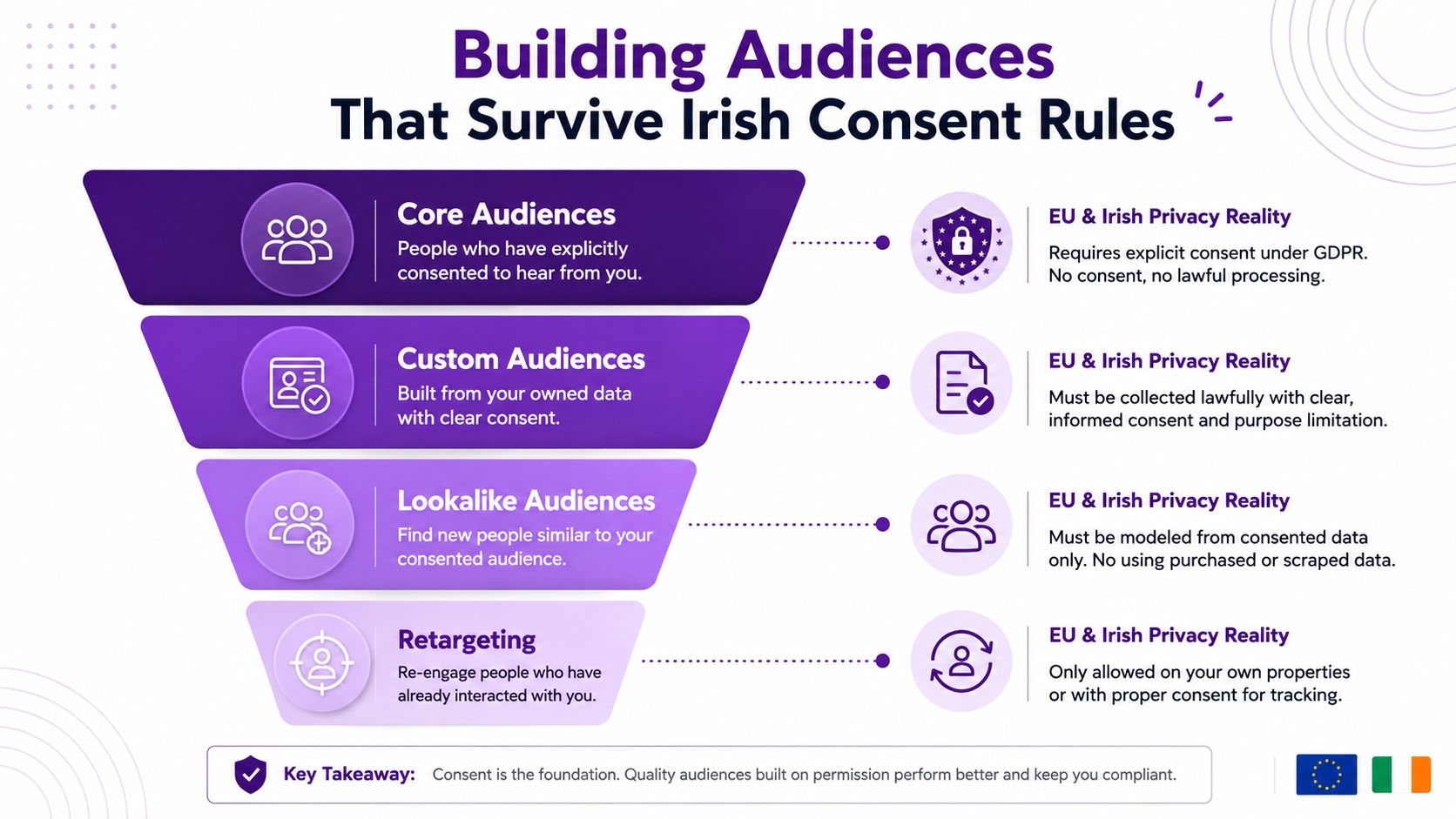
Implement the Meta ads targeting process alongside consent management, CRM discipline, and event tracking. Conversions API can help pass consented server-side events to Meta, but it isn't a workaround for missing consent. It improves signal handling when the business has a lawful basis and a properly configured data flow.
Consent changes the media plan. Treat match rates, audience availability, and event continuity as operating assumptions that need monitoring, not as fixed platform features.
Creative Formats and Placements That Win on Instagram
Instagram creative fails when the brief says “make it social” and leaves the designer to guess. Each placement creates a different attention environment, so the asset needs a job, a composition, and a first-frame decision that fits the context.
Feed supports considered browsing. A 4:5 image or video occupies more vertical space than a square asset while still feeling native to the scrolling feed. Use a clear product or problem visual, a short headline on screen, and a caption that adds proof or context rather than repeating the graphic.
Reels demand pace and immediate clarity. Use 9:16 video, show the outcome early, and assume the viewer may watch without sound. A SaaS example could open with a familiar reporting problem, show the product interface quickly, and finish with one action. A retailer might lead with the product in use, then show the offer and delivery information without forcing the viewer through a long brand introduction.
Stories are strong for direct response because the full-screen format gives the message focus. Build a sequence rather than a single poster: problem, proof, offer, action. Leave space for interface elements and keep the call to action obvious.
Explore suits discovery and visual curiosity. The content needs to earn the pause before it asks for a click. Shopping placements depend on catalogue accuracy, product naming, pricing, stock information, and a frictionless route to purchase.
A placement brief a creative team can use
Placement | Format | Creative instruction | Common failure |
|---|---|---|---|
Feed | 4:5 or square | Lead with the problem or product, then add proof | Treating the caption as the only explanation |
Reels | 9:16 | Hook immediately, use movement, keep the message understandable without sound | Reusing a polished landscape advert |
Stories | 9:16 | Sequence the message and reserve clear space for the action | Packing several claims into one frame |
Explore | 4:5 or square | Make the visual relevant to discovery and category interest | Using a corporate announcement with no visual tension |
Shopping | Catalogue-led | Keep product data, imagery, and destination aligned | Sending traffic to unavailable or mismatched products |
UGC can work because it demonstrates use rather than merely describing benefits. It still needs a credible brief, permission, brand safety checks, and a clear commercial message. Creator partnerships and branded content should be reviewed through Meta's visible activity tools. Meta's Ad Library documentation states that the library shows active public branded content on Facebook and Instagram carrying a paid partnership label, which gives advertisers a practical way to inspect competitor activity and partnership execution.
Measurement, Attribution and the Numbers That Matter
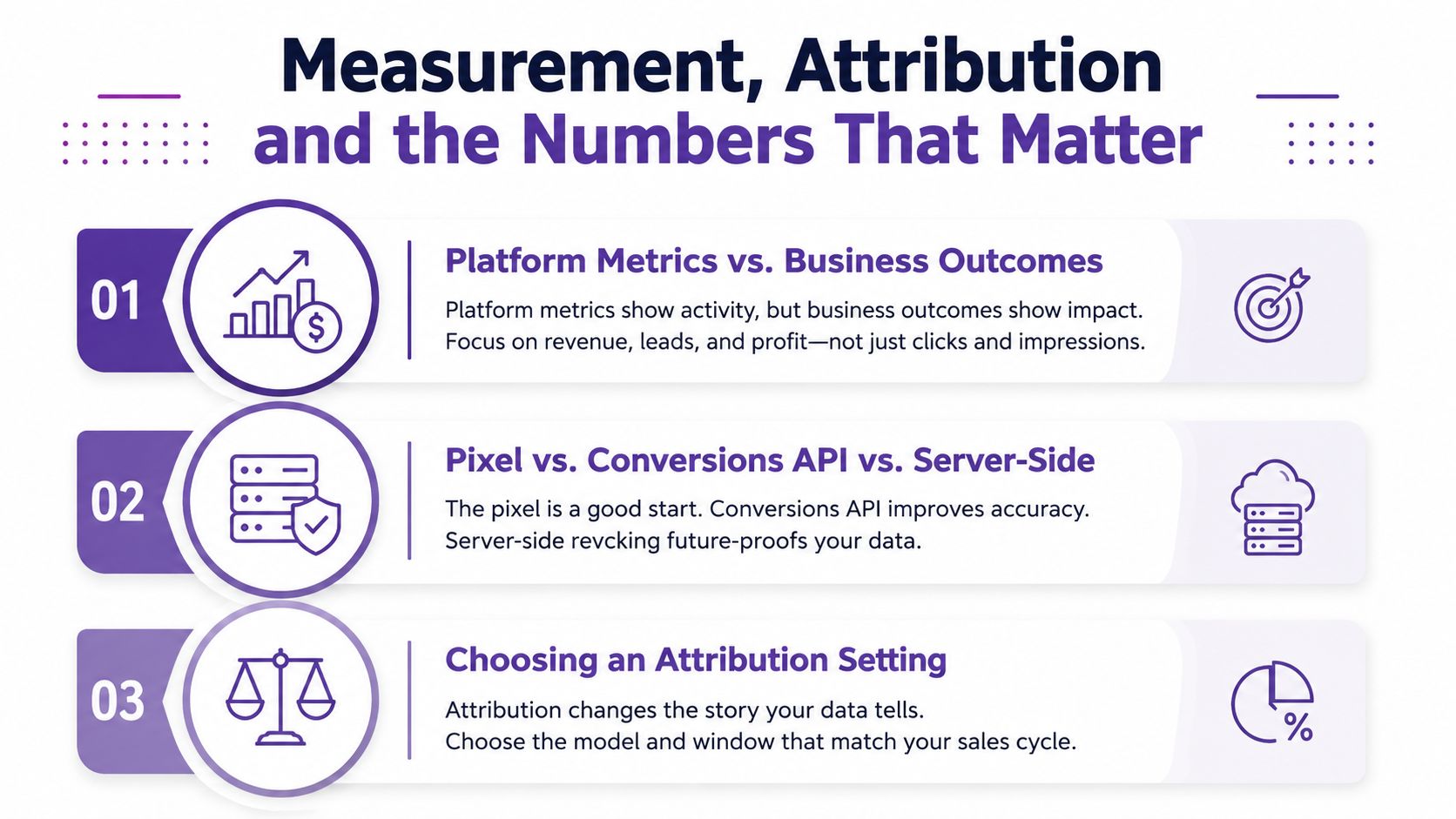
Meta reports what happened within its measurement environment. The business needs to know what happened after the click, across the full conversion path. Those are related views, not interchangeable ones.
The pixel remains useful for browser-based events, but browser restrictions and consent choices can interrupt the signal. Conversions API sends eligible events from a server or platform integration, while a broader server-side measurement setup can improve control over how consented events are processed. None of these systems makes an unconsented event lawful. Their value comes from better reliability and deduplication when the data collection and governance are correct.
Read each metric for its actual job
CPM tells you what delivery costs. It can indicate competition, audience constraints, or creative fatigue, but it doesn't tell you whether the leads are valuable.
CTR shows whether the message earns a click or interaction. A strong CTR with weak landing-page engagement can point to a promise that the destination doesn't support.
CPC is a delivery efficiency measure, not a commercial outcome.
CPA matters only when the conversion event represents a meaningful business action. A cheap form completion isn't useful if sales rejects the lead.
ROAS helps e-commerce teams compare tracked revenue with advertising spend, but it can miss margin, repeat purchase value, and untracked conversions.
MER compares total marketing investment with total revenue. It gives leadership a broader view when channel attribution is incomplete.
For B2B, choose an event that reflects progression, then connect it to CRM stages. A lead may take time to become an opportunity, so weekly decisions should combine platform metrics with qualified pipeline, sales feedback, and assisted activity. Don't force an instant purchase KPI onto a long sales cycle.
Use a compact dashboard with delivery, engagement, conversion quality, and commercial outcome views. Review tracking health and rejected events regularly, then make optimisation decisions on a consistent rhythm. If volume is too low for confident platform learning, avoid constant edits. Use holdout thinking, geo comparisons where appropriate, and a simple marketing-mix view rather than pretending a single attribution window explains everything.
Optimisation Tactics That Move the Needle
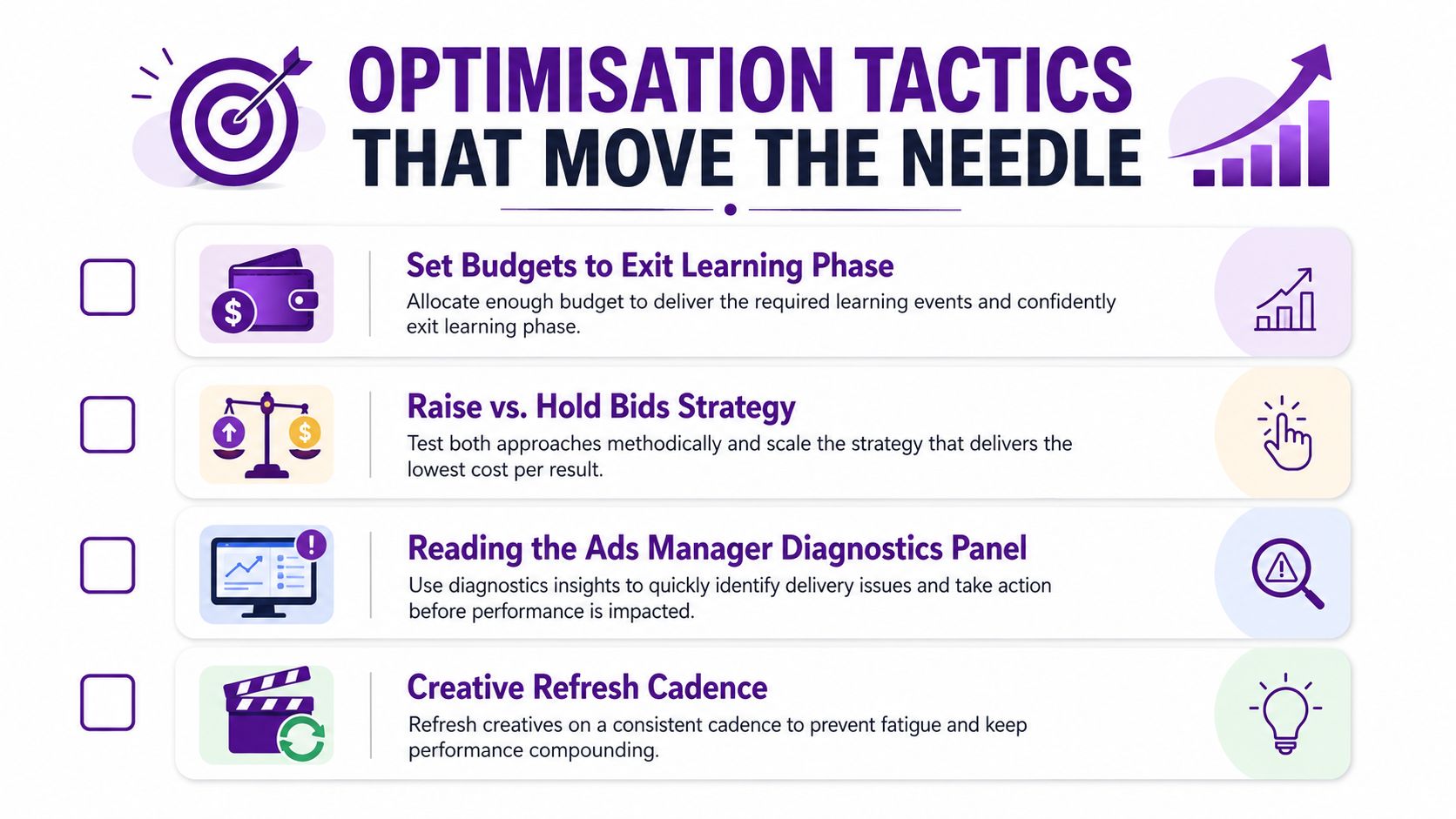
Optimisation should follow a written cadence. In the first phase, the job isn't to change everything each morning. It's to establish whether the offer, audience, creative, event signal, and landing page are aligned well enough for the account to learn.
A practical first-week test list
Hook test: Keep the offer and destination stable while testing different opening lines or first frames. For a B2B ad, compare a pain-led opening with a result-led opening.
Offer test: Compare a consultation, useful resource, demo, or direct product action without changing every other element.
Landing-page alignment test: Match the first screen of the page to the exact promise in the ad. Remove unnecessary navigation and make the next step obvious.
Qualification test: If lead quality is weak, add useful qualifying friction rather than celebrating cheaper submissions.
Review the diagnostics panel before making a decision. Delivery warnings, audience overlap, learning status, rejected assets, and event quality can explain performance changes more reliably than a single day's CPA. A creative with limited spend shouldn't be killed merely because it hasn't had the same opportunity as a mature control.
Scale without destabilising the account
Vertical scaling means increasing budget on a working structure. Large or frequent changes can disrupt delivery, so raise spend cautiously and watch whether the added volume preserves conversion quality. Hold when the campaign is still producing useful learning or when the business can't absorb additional leads.
Horizontal scaling means adding new creative angles, audiences, placements, or offers. It creates more routes to growth, but it also introduces more variables. For Irish accounts with limited data, horizontal expansion often works better when the original event signal is already trustworthy.
Creative fatigue needs a planned response. Build a library of hooks, demonstrations, objections, testimonials, and product contexts before performance drops. Refresh the angle, not just the colour or headline. Use the Meta ads optimisation guidance as a working reference, then apply commercial judgement from the CRM and sales team.
A useful review sequence is: tracking health first, delivery second, creative response third, conversion rate fourth, and qualified outcome last. If the final outcome is poor, don't automatically blame CPM. The leak may sit in the offer, form, response time, qualification process, or sales follow-up.
Connecting Instagram Ads to CRO, Lead Nurture and AI Workflows
Instagram ads become profitable when the business improves the whole journey, not when the media buyer finds a slightly cheaper impression. The ad creates a promise. The landing page confirms or contradicts it. The form sets expectations. The CRM decides what happens next. Each hand-off affects the value of the original click.
Fix the conversion path before adding complexity
Start with message continuity. If the ad says “reduce reporting time”, the landing page should lead with that problem and explain the mechanism, proof, audience fit, and next action. If the ad promotes a seasonal product offer, the destination should make price, availability, delivery, returns, and payment straightforward on mobile.
For B2B and SaaS, route every lead into a defined process. Capture the source and campaign context, check consent status, enrich only where the business has a lawful and transparent basis, score against firmographic and behavioural criteria, and assign the lead to the right owner. A response that arrives promptly is more useful than a complicated nurture sequence that no one monitors.
Nurture should reflect intent. A pricing-page visitor can receive a commercial follow-up, while an educational download may need proof, use cases, and objection handling first. Sales feedback should flow back into campaign decisions, especially when Meta is optimising to an early-stage event that doesn't represent revenue.
Use automation where it removes delay
AI can help turn campaign and CRM data into summaries, identify repeated objections in sales notes, generate creative variations for review, and organise test backlogs. It shouldn't invent claims, decide consent eligibility, or replace human approval for regulated or sensitive messaging. Automation adds noise when it creates more variants than the team can evaluate or routes every lead without a clear qualification rule.
For e-commerce, the next growth opportunity often sits after acquisition. Product education, post-purchase recommendations, replenishment reminders, and retention journeys can increase customer value without asking Instagram to solve every commercial problem through first-order acquisition.
A week-one operating checklist
Audit consent status, CRM fields, exclusions, and audience match behaviour.
Confirm pixel and Conversions API events, deduplication, and meaningful conversion definitions.
Map each placement to a deliberate creative format.
Review the landing page on a mobile device against the ad promise.
Connect lead routing to ownership, response expectations, and qualification.
Create a dashboard that includes qualified outcomes, not only platform metrics.
Schedule a weekly review covering delivery, creative, conversion rate, lead quality, and commercial progress.
Scéaled works with Irish businesses on Meta advertising, paid media, SEO, CRO, lead generation, measurement, and AI-supported process automation. If your Instagram campaigns need a connected strategy rather than another isolated ad-set adjustment, visit Scéaled to discuss the audience, creative, measurement, and conversion system around your growth goal.
Comments