Google Ads How Does It Work: A Practitioner's Guide

A Dublin SaaS founder increased her paid-search budget last year and saw only a modest lift in qualified pipeline. The problem wasn't that Google Ads had stopped working. She was applying a 2018 mental model to a market where more searches end without a click, competition is mature, and channel performance depends heavily on tracking quality.
That's the practical answer to Google Ads, how does it work? It combines an auction, relevance signals, audience and keyword targeting, automated bidding, and conversion data. The platform can place an ad in front of someone who has expressed clear intent, but it can't turn weak targeting, an unconvincing offer, or broken measurement into profitable demand.
For Irish businesses, the context matters. Google holds about 92% of Ireland's search engine market share, and one 2026 estimate places search advertising revenue at €1.2 billion. The same estimate says 78% of Irish businesses advertised in search in 2026, while average cost per click sits around €1.20 according to Ireland's search advertising market estimate. Google Ads is mainstream, not a specialist experiment.
But mainstream doesn't mean universally efficient. Irish search click-through rate fell from 3.62% to 2.67% across 175 million searches, while average ranking position moved only slightly, from 6.38 to 6.18, according to research on zero-click search in Ireland. Paid search also needs to earn its place in a wider mix. Irish digital advertising reached €1.146 billion in 2025, with paid search at €345 million and growing 4%, while several other channels grew faster, as documented in Ireland's digital advertising channel mix analysis.
The operating model is simple to state, but demanding to execute: auction plus quality, measurement, and optimisation. The rest of this guide applies that model to the decisions Irish SMEs, B2B teams, professional services firms, and e-commerce operators face.
Table of Contents
Why Google Ads Still Matters for Irish Businesses - The Irish channel decision
The Auction Mechanics Behind Every Click - What each lever does
Targeting Layers and Audience Composition - Build guardrails before adding reach
Quality Score and the Cost of Being Mediocre - Diagnose the mismatch - The practical checklist
Hidden Economics, Common Mistakes, and Next Steps - Mistakes that drain SME accounts
Why Google Ads Still Matters for Irish Businesses
A Dublin accounting firm can wait for organic visibility, build awareness on social, or bid on a search from someone actively looking for help. The third option captures demand at the point of need. A query such as “accountant Dublin small business” includes a service, a location, and a commercial problem. It does not guarantee a qualified lead, but it gives the campaign a clearer starting signal than an untargeted impression.
Google Ads remains relevant because Irish searchers still use Google to compare providers, check prices, and find local services. The opportunity is access to declared intent, not just access to traffic. The advertiser still has to match the query, offer a useful landing page, and measure whether the enquiry becomes revenue.
The market is competitive. A separate 2026 benchmark reports €1.25 average CPC, a 4.8% click-through rate, and a 3.2% conversion rate, alongside €950 million in Irish PPC spend and around 150,000 active PPC campaigns, according to Ireland's Google Ads benchmark. Those figures describe an established acquisition channel, not a guaranteed bargain.
Campaign economics depend on what the click represents. Search can perform well when the query signals a real need and the business separates qualified enquiries from low-value form fills. It performs poorly when campaigns buy broad informational traffic, leave negative keywords unmanaged, or optimise towards clicks that never reach a sales conversation.
The Irish channel decision
Irish search behaviour adds another constraint. The fall in organic search CTR identified in the zero-click search analysis suggests that more users receive answers directly on the results page. Featured snippets, People Also Ask results, local business panels, and other search features can reduce available clicks for both organic listings and paid campaigns. Query selection and commercial intent therefore matter more than chasing additional impressions.
Channel | Avg. Irish CPC/CPM | User intent | Best for | Watch out for |
|---|---|---|---|---|
Google Search | Varies by query and auction | Explicit, often high | Lead generation, local services, demand capture | Rising competition, zero-click behaviour, weak tracking |
Paid social | Varies by platform and objective | Interest and audience-led | Discovery, education, remarketing | Lower declared intent and creative fatigue |
Display and video | Varies by placement and buying model | Awareness and consideration | Reach, remarketing, visual education | Accidental clicks and limited immediate intent |
Retail media | Varies by retailer and placement | Product and category intent | E-commerce shoppers close to purchase | Walled-garden data and limited reach |
Google Ads should earn its budget against the alternatives. Paid and organic search results can work together, but they serve different jobs. Paid search offers control over visibility and message placement, while organic visibility can build longer-term coverage without a charge for each visit.
The practical question is whether the query expresses enough intent to justify paying for access, and whether the resulting action can be measured through to commercial value. For an Irish SME or B2B team, that distinction separates a demand-capture engine from an expensive traffic report.
The Auction Mechanics Behind Every Click
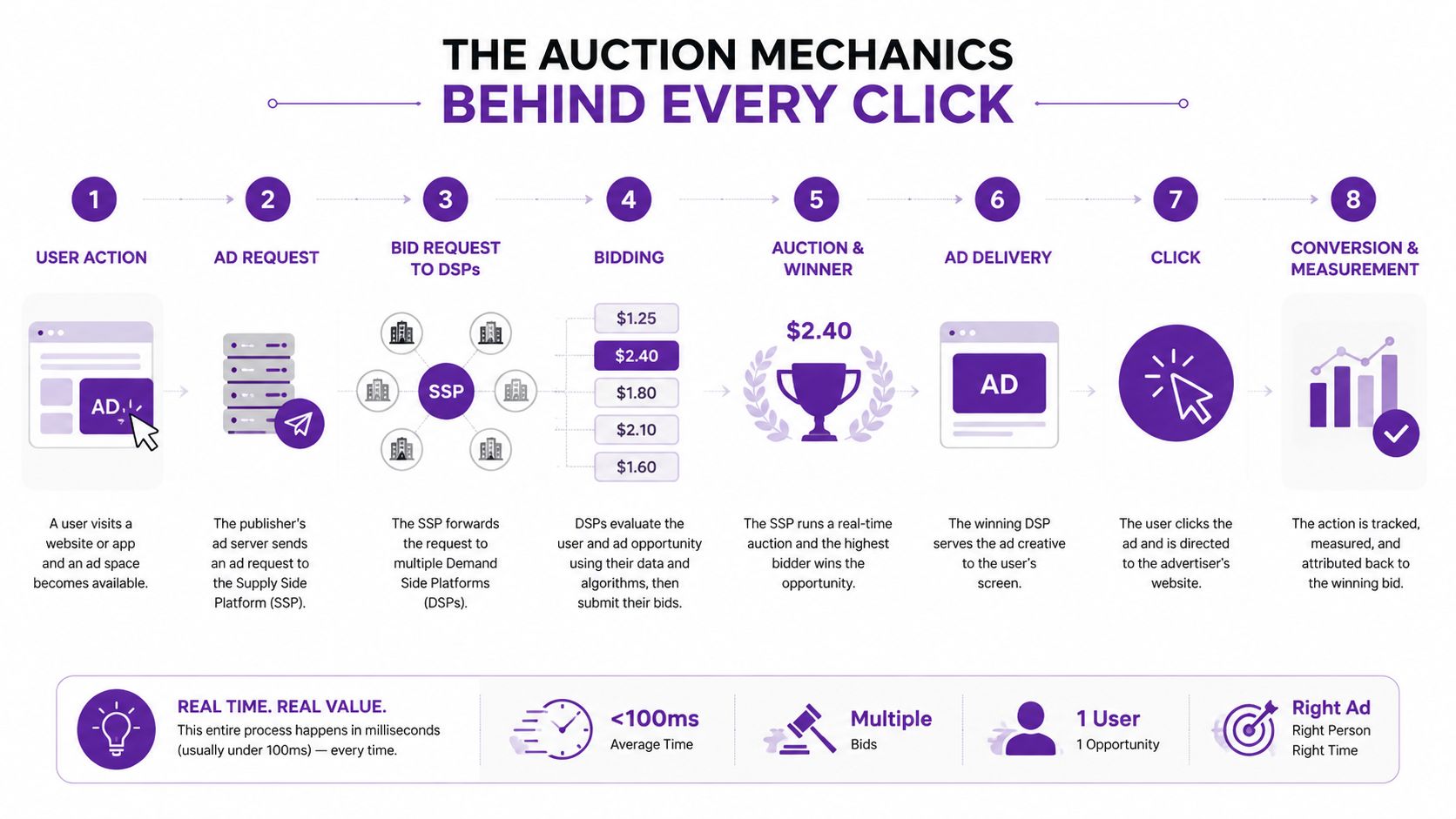
Google Ads runs an auction each time someone searches. It decides which eligible ads appear, their order, and whether they qualify for an impression. The process operates in milliseconds, so a high bid alone does not secure the top position.
Ad Rank combines the advertiser's bid, predicted ad usefulness, expected impact of assets and formats, and the thresholds set for that auction. A working model is:
Ad Rank = bid × quality signals × expected impact of ad assets and formats, subject to auction-time thresholds.
What each lever does
Your maximum bid is the most you are prepared to pay for a click or conversion under the selected bidding system. It is a ceiling, not necessarily the final charge. Raising it can improve competitiveness, but it cannot compensate indefinitely for an irrelevant advert, weak offer, or poor landing page.
Quality signals estimate how useful the full ad experience will be. Search relevance, predicted click-through rate, and landing-page quality all affect eligibility and position. Assets such as sitelinks and callouts can increase the expected usefulness and visibility of the result, provided they add information relevant to the search.
Rank thresholds determine whether an ad can appear at all. Google does not show every eligible advertiser in every auction. An ad can miss the impression because it fails the required quality or relevance threshold, even when the bid is aggressive.
The payment mechanism is often described as second-price, but that shorthand is incomplete. In practice, the charge reflects what is needed to clear the next competitor and the applicable threshold. If your bid is €4 and the next competitor's position implies a required payment of €2.10, you might pay roughly €2.30, rather than €4. This is an illustration, not a guaranteed billing formula. Auction conditions, thresholds, assets, and other signals affect the actual amount.
Practical rule: Increasing bids can buy more eligibility, but it will not repair a mismatch between the search term, advert, and landing page.
For Irish advertisers, auction access and conversion efficiency have to be assessed together. The Irish benchmark of €1.25 average CPC, 4.8% CTR, and 3.2% conversion rate in this Google Ads performance estimate provides context, but averages do not set your account's economics. A solicitor competing for urgent local intent faces a different auction from a retailer building broader demand.
Google's roughly 92% search share in Ireland makes paid search difficult to ignore, while rising zero-click behaviour limits the value of buying visibility without a measurable next action. Paid search also grows more slowly than some other channels, so increasing bids is a poor substitute for stronger query selection, tighter relevance, and reliable conversion tracking.
Choosing the Right Campaign Type for Your Goal
Campaign type should follow the kind of intent you need to capture, not the format your team happens to prefer. Search, Display, Performance Max, and YouTube can all support growth, but they operate at different points in the customer journey and give you different levels of control.
Search is the clearest demand-capture option. A Galway solicitor might build tightly themed campaigns around searches for a local legal service, separating urgent commercial queries from research terms. The advertiser controls keywords, ad messages, locations, landing pages, and search-term exclusions more directly than in most other campaign types.
Display reaches people across Google's Display Network and is useful for re-engagement or awareness. A tourism organisation could show adverts to users who visited accommodation or destination pages but didn't book. The trade-off is that a view or click often carries less declared intent than a search for a specific service.
Performance Max uses automation across Google inventory, including Search, Display, Shopping, Discover, and Maps. A Limerick fashion retailer can provide a product feed, conversion goals, creative assets, and audience signals, then allow Google to decide where to find likely purchasers. This can expand reach, but it reduces placement-level control and makes product-feed hygiene, exclusions, creative quality, and conversion values critical.
YouTube suits visual storytelling and consideration. A fintech brand might use video to explain a complex product to a defined audience before asking for a high-consideration action. It's a poor substitute for Search when the immediate goal is to intercept someone already looking for a solution.
Campaign type | Intent level | Best for | Key inputs | Main trade-off |
|---|---|---|---|---|
Search | High when query is commercial | Qualified enquiries and demand capture | Keywords, ad copy, landing pages, negatives | Limited scale for narrow demand |
Display | Low to medium | Awareness and remarketing | Audiences, creative, placements, exclusions | More exposure, less declared intent |
Performance Max | Mixed, automated | E-commerce and conversion-led scale | Product feed, assets, goals, audience signals | Less placement control |
YouTube | Low to medium | Storytelling and consideration | Video, audience strategy, measurement | Longer path to conversion |
Automation isn't better. It's useful when the business can supply clean inputs and tolerate less control. For regulated sectors, professional services, and brands with strict suitability requirements, the campaign must be designed around exclusions and review processes rather than accepting whatever inventory the system finds.
Targeting Layers and Audience Composition
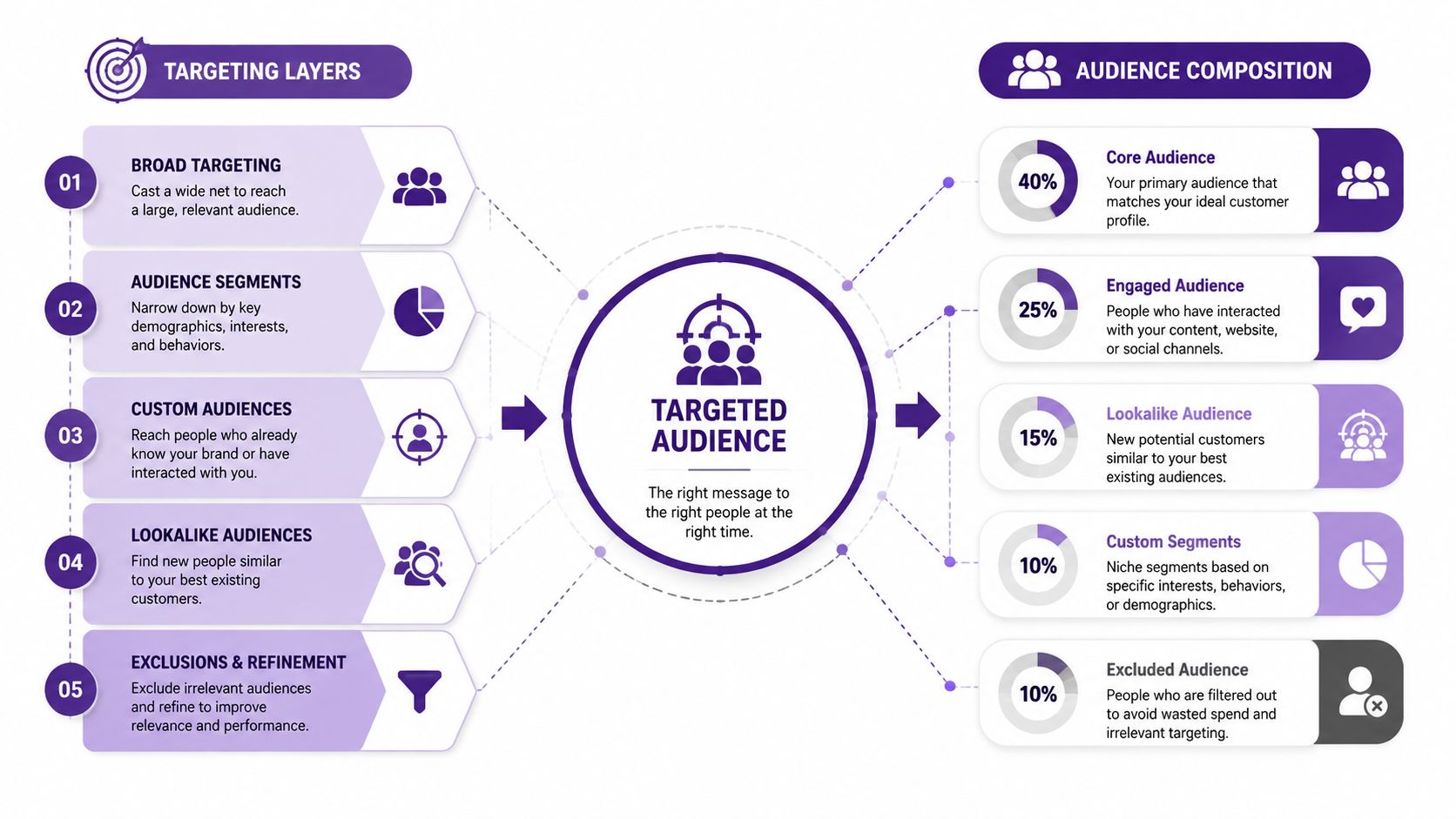
Google Ads targeting works as a composition of signals. Keywords describe what the user searches for, audiences describe relevant behaviours or relationships, demographics add characteristics such as age or household information where available, and placements define where ads can appear or which inventory should be excluded.
Take an Irish SaaS company selling corporate treasury software. Its Search campaign might begin with phrase-match terms such as “corporate treasury software”, focus geography on Dublin and Cork, and use relevant in-market audiences in observation mode. If the company has appropriate consent and sufficient first-party data, Customer Match can add known business contacts or existing account relationships. Existing customers should usually be excluded from acquisition activity unless the campaign has a separate expansion objective.
An e-commerce retailer selling running shoes needs a different mix. Broad match can help discover demand when conversion tracking is reliable, while demographic reporting may reveal a stronger response from a particular age range. Custom segments based on site visitors can support remarketing, and placement exclusions can reduce exposure on unsuitable comparison or low-quality content sites.
Build guardrails before adding reach
Three composition rules keep targeting useful:
Bid more selectively where intent is stronger. A high-intent query paired with a relevant audience signal can justify more aggressive bidding than a broad awareness placement.
Use negative keywords as budget protection. Exclude employment searches, free resources, definitions, irrelevant locations, and other patterns that repeatedly produce unqualified traffic.
Start new audiences in observation mode. Let the campaign collect performance evidence before restricting delivery. Targeting mode can narrow reach before the segment has proved its value.
The most common Irish SME mistake is over-narrowing. An advertiser combines a small geographic area, restrictive audience settings, tightly constrained keywords, and limited schedules, then wonders why Smart Bidding receives too little conversion data to learn. Tight targeting is valuable only when it preserves enough eligible demand and feedback.
A better approach is to control the variables that clearly damage economics, such as irrelevant searches and unsuitable locations, while leaving the algorithm room to identify useful patterns. Aim for tight but not suffocating.
Quality Score and the Cost of Being Mediocre
Quality Score is best treated as a diagnostic for the relationship between a query, an advert, and the landing page. Google presents three familiar components: expected click-through rate, ad relevance, and landing page experience. Each component is scored on a 1 to 10 scale, and the headline Quality Score also uses that scale.
The score isn't a direct discount coupon, and it doesn't determine every auction outcome. It's a practical indicator of whether the account is giving users a coherent answer. A low score often points to a structural issue, such as one ad group containing unrelated services, generic copy that doesn't reflect the query, or a landing page that forces the visitor to search for the promised information.
Diagnose the mismatch
Expected click-through rate asks whether users are likely to choose the advert. Ad relevance asks whether the wording matches the searcher's intent. Landing page experience asks whether the destination is useful, navigable, credible, and aligned with the advert.
A campaign selling employment law should not send every search to a generic legal-services homepage. The page should make the service clear, use language that reflects the query, provide a credible next step, and avoid asking the user to reconstruct the offer from a menu.
Quality Score can influence the amount needed to compete for a position, but advertisers should avoid promising a fixed saving from a particular score change. Auction thresholds, competitors, assets, geography, device, and query context all affect actual CPC. The sound operating principle is that relevance can reduce wasted spend and improve eligibility, while a higher bid alone only increases the price you're willing to test.
Quality Score | Relative CPC | What it means for an Irish campaign |
|---|---|---|
1 to 3 | Often inefficient | Investigate query grouping, ad relevance, and landing-page alignment |
4 to 6 | Mixed | Identify the weakest component and test a focused improvement |
7 to 8 | Generally healthier | Maintain relevance while testing stronger offers and assets |
9 to 10 | Strong signal | Don't assume perfection, monitor conversion quality and auction pressure |
The practical checklist
Start with the search term report, not the Quality Score column in isolation. Group queries by intent, rewrite ads to mirror the language and problem behind each group, and create landing pages that continue the same promise.
Then assess the post-click experience. If the page is slow, vague, difficult to use, or disconnected from the advert, improving the score won't solve the conversion problem. Treat Quality Score as a diagnostic instrument, not a vanity metric.
Bidding Strategies That Match Your Stage
Bidding strategy should reflect account maturity. Google's automation needs reliable conversion signals, and a low-volume account can produce unstable decisions when it asks Smart Bidding to learn from sparse or inconsistent outcomes.
Manual CPC is useful as a learning lab. It gives a new advertiser a clearer view of which queries, devices, locations, and times generate meaningful engagement. That doesn't mean manual bidding is always superior. It means the advertiser can use it while validating tracking, search terms, lead quality, and basic economics.
Maximise Conversions becomes more useful once the account has enough dependable conversion activity for the system to identify patterns. Set the conversion action carefully. If every low-quality form submission counts equally, the strategy may pursue cheap enquiries rather than commercially valuable ones.
Target CPA fits a more stable account. It works best when the conversion definition is trustworthy, lead quality is reasonably consistent, and the target reflects actual market conditions. A target that's set below what the auction and sales process can support will restrict delivery or push the system towards undesirable conversion types.
Target ROAS belongs primarily in e-commerce accounts with reliable transaction values. It's a poor fit for lead generation when the advertiser can't map lead quality or downstream revenue back into Google Ads. Feeding the system inaccurate values creates a precise-looking optimisation target with little commercial meaning.
Account situation | Suitable starting point | Reason |
|---|---|---|
Tracking is being validated | Manual CPC | Read the data before automating decisions |
Conversion data is dependable and growing | Maximise Conversions | Allow the system to seek the chosen action |
Lead volume and quality are stable | Target CPA | Optimise towards a commercially realistic acquisition cost |
E-commerce values are clean | Target ROAS | Connect bidding to revenue efficiency |
Mixed maturity across campaigns | Portfolio or hybrid approach | Apply automation selectively rather than forcing one rule everywhere |
Enhanced CPC and portfolio bid strategies can provide middle-ground options. The important comparison with Meta is not that one algorithm is universally better. Search often has less room to learn when campaigns are split across narrow services, locations, and match types, so account structure and conversion volume matter greatly.
For practical guidance on turning campaign activity into qualified enquiries, see Google Ads lead generation.
The following video gives another visual explanation of the bidding-strategy decision:
Measuring What Drives Revenue
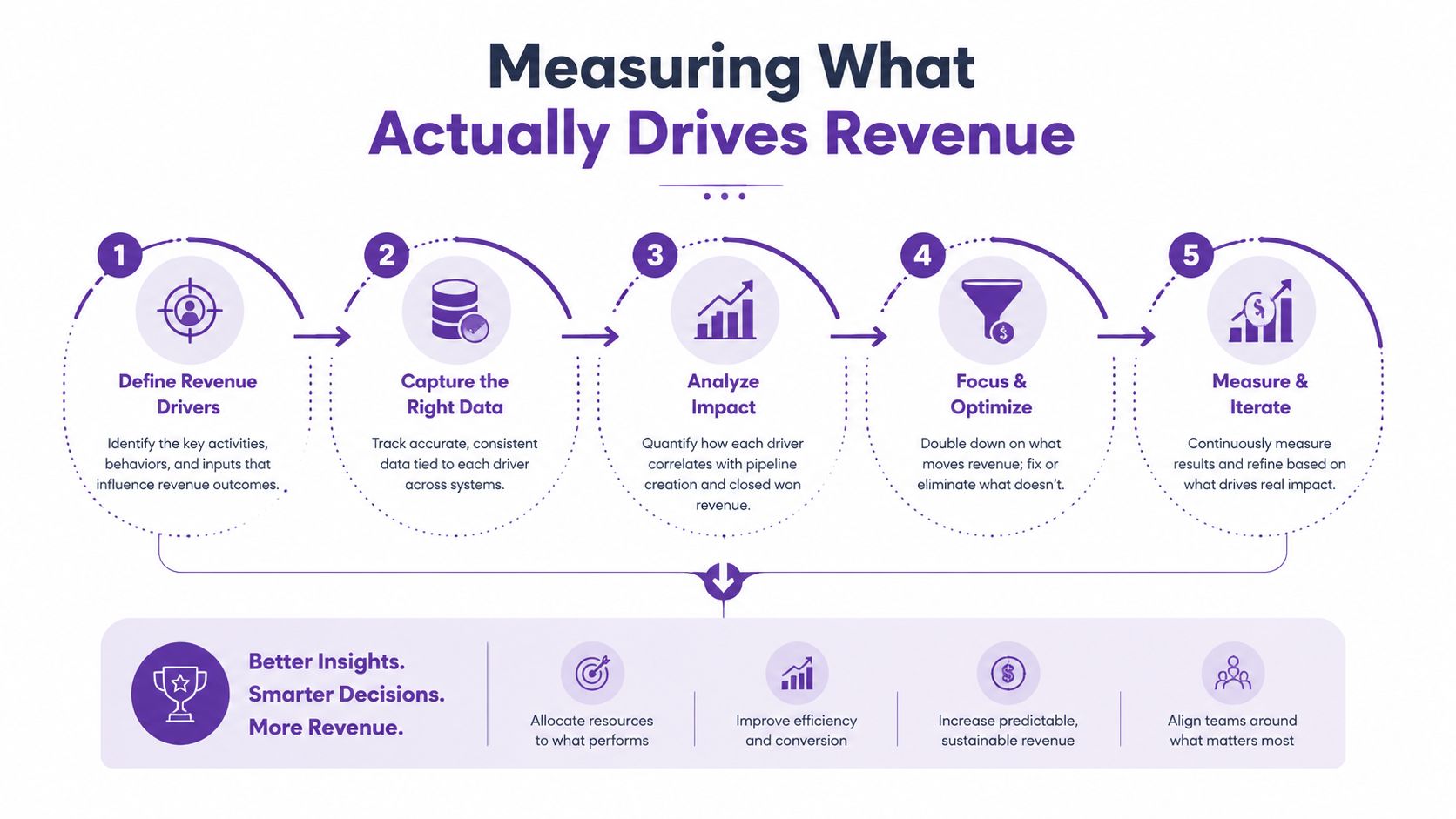
A paid click has no commercial meaning until the business can connect it to an action, a qualified opportunity, or a sale. The measurement chain should run from the ad interaction to the tracked website event, from that event to the CRM outcome, and from the CRM outcome to revenue where the sales cycle allows it.
For B2B, one conversion action is rarely enough. A useful hierarchy can include a completed form, a qualification call, a sales-accepted opportunity, and a closed deal. Earlier actions provide volume for optimisation, while later stages show whether Google is finding suitable buyers. E-commerce can send purchase value back to Google more directly, provided refunds, tax treatment, duplicate orders, and transaction identifiers are handled correctly.
The tracking stack
GA4 events, the Google Tag, enhanced conversions, and offline conversion imports each address a different part of the measurement problem. GA4 describes user behaviour. The Google Tag supports advertising measurement. Enhanced conversions can improve matching where consent and implementation permit it. Offline imports connect lead records and sales outcomes back to the advertising platform.
Attribution changes the decisions made from the same campaign data. Last-click gives the final interaction all the credit, which is easy to explain but can undervalue earlier discovery. Position-based attribution distributes credit according to a defined interaction pattern. Data-driven attribution uses available interaction data to estimate the contribution of different touchpoints, which can change how analysts assess branded Search, generic Search, remarketing, and assist activity.
Changing the model does not create revenue. It changes the explanation in the reports and may shift budget towards campaigns that assist conversion rather than close it. Document attribution changes and review them alongside CRM outcomes, rather than treating a reporting change as a performance improvement.
When reporting breaks: Pause bid changes. Check consent coverage, tag firing, event naming, duplicate conversions, transaction values, CRM imports, and time-zone settings before drawing a performance conclusion.
Cookie consent can reduce observable activity. iOS restrictions can create attribution gaps, while server-side implementations may disagree with browser-side tagging when event definitions or identifiers differ. If the numbers stop adding up, compare Google Ads conversions with GA4 events, CRM records, and sales activity over the same period. Fix the data path before asking an algorithm to optimise against it.
For an analytics-focused view of paid search reporting, use paid search in Google Analytics.
Hidden Economics, Common Mistakes, and Next Steps
The hidden cost of Google Ads is the opportunity cost of a marginal click. The same budget might improve email retention, strengthen organic visibility, fund creative testing, or reach buyers earlier through another channel. In Ireland, Search works best when it captures clear existing demand. It is a weaker choice when the objective is to create demand or explain a complex offer.
Zero-click behaviour makes query selection more important. Informational searches can produce visibility without a visit, while explicit commercial searches still deserve close review. Separate campaigns and budgets by intent, then judge them by qualified enquiries, sales, or revenue rather than clicks alone.
Irish advertisers should also decide where the next euro can do more work. Search may capture demand efficiently, but paid social, video, email, SEO, or partner activity can contribute earlier in the buying process. Compare incremental revenue and sales quality across channels, allowing for different conversion lags and assisted activity.
Mistakes that drain SME accounts
Broad match without negatives: Discovery becomes budget leakage when the account does not regularly review search terms and exclude irrelevant intent.
Shared budgets across mismatched campaigns: A branded campaign, high-value service campaign, and low-intent prospecting campaign should not compete for one undifferentiated pool of spend.
Conversion lag ignored: A lead may take time to qualify or close. Changing bids before that lag is understood can reward the wrong signals.
Landing pages built before the offer is tested: A polished page can still fail if the proposition, proof, or call to action does not address the buyer's concern.
Impression share treated as the objective: More visibility does not automatically mean more qualified pipeline, especially when query intent is weak.
Attribution treated as truth: A reported conversion can hide consent gaps, duplicate events, CRM delays, or sales that never close.
A sensible optimisation order is deliberately practical:
Audit conversion tracking first. Confirm that Google Ads, GA4, the CRM, consent handling, and revenue records describe the same actions.
Fix negatives and match types second. Remove obvious waste before expanding reach or changing bids.
Test one landing-page variant third. Change a meaningful element, such as the offer, proof, form friction, or call to action, and keep the test interpretable.
Compare channel roles before reallocating budget. Check new-customer quality, sales lag, margin, and assisted value rather than moving spend on last-click volume alone.
Layer automated bidding last. Give automation clean conversion definitions and enough useful feedback to make decisions.
The fastest route to better Google Ads performance is usually better information, not a more complicated campaign setting.
Scéaled helps Irish businesses connect Google Ads management with campaign structure, conversion tracking, SEO, paid media, and conversion optimisation. If your account needs a commercial audit rather than another round of unexplained bid changes, visit Scéaled to discuss the search, measurement, and growth work that should come next.
Comments