Google Ads Agency: Maximize ROI & Growth in 2026

You're probably looking at your Google Ads account and wondering why the numbers don't feel as healthy as the dashboard suggests. Clicks are coming in, costs are creeping up, and the leads, if they arrive at all, don't always look like the right fit. That's the moment most Irish marketing managers start asking whether a Google Ads agency can turn spend into something more reliable, more measurable, and more profitable.
That question makes sense in Ireland's market. The Advertising Agencies industry here has a market size of €1.1 billion in 2026, includes 946 businesses, and grew at a 2.2% CAGR between 2021 and 2026 (IBISWorld industry overview). In a market that crowded, the difference between a generic media buyer and a specialist partner is rarely about who can launch campaigns. It's about who can read the account, the audience, and the local market properly.
Table of Contents
Understanding what a Google Ads agency does - The role is orchestration, not just activation - Why specialist support usually beats DIY
Core services and outcomes from a Google Ads agency - What each service actually changes - What outcomes to expect by business type
Pricing models for Google Ads agency services - Pricing Models Comparison
Local Ireland checklist for choosing a Google Ads agency - Ten things to ask before you sign
Red flags when selecting a Google Ads agency - Warning signs that should slow you down
Introduction to Google Ads agencies
A lot of businesses arrive here after the same frustrating pattern. The account was launched, the ads looked tidy, and the first reports seemed encouraging, but the monthly spend kept climbing while lead quality stayed patchy. That's especially painful for Irish SMEs, where every euro needs to work harder and the margin for wasted budget is thin.
The reason a Google Ads agency matters is simple, it gives structure to what often becomes guesswork. Instead of judging campaigns by surface-level activity, a good agency connects keywords, ads, landing pages, and tracking into one commercial system. That matters more in Ireland because search behaviour is often local, practical, and intent-heavy, so the difference between a broad campaign and a well-built one can show up quickly in enquiry quality.
Ireland's agency market is large enough to create choice, but that doesn't mean every provider solves the same problem. Some teams are strong on automation, some on creative, some on measurement, and some on local nuance. The best fit is usually the one that understands how your buyers search, what a qualified enquiry looks like, and how to keep spend tied to actual business outcomes.
Understanding what a Google Ads agency does
A Google Ads agency is less like a vendor and more like a performance garage. You don't bring it in just to “run the engine”, you bring it in to tune the whole machine, from the fuel mix to the tyres to the brakes. In advertising terms, that means keywords, ads, landing pages, conversion tracking, and budget allocation all have to work together.
The role is orchestration, not just activation
A lot of in-house teams can launch campaigns. What they often can't do, at least not consistently, is interpret where the account is leaking value. A specialist agency looks for those leaks, maybe the ad copy promises one thing while the landing page says another, or maybe search terms are attracting interest that never turns into a proper lead.
That's why experienced agencies often act as a bridge between paid search and the rest of growth marketing. They don't treat Google Ads as a silo. They use it to reveal which messages convert, which queries signal buying intent, and which pages need work before more budget goes live.
Practical rule: if the agency only talks about clicks, they're looking at the dashboard, not the business.

Why specialist support usually beats DIY
The advantage of specialist support is pattern recognition. A good team has seen enough accounts to know when a “good” click is a poor fit, or when a campaign needs a message change rather than a bid change. That becomes especially important in B2B, where one irrelevant lead can consume sales time without producing pipeline.
It also matters because search behaviour is rarely generic. A person in Dublin, Cork, or a smaller town may use different wording for the same need, and the agency has to recognise that difference before automation does. If you want a deeper look at that operational mindset, the publisher's blog covers broader growth marketing thinking around paid media and conversion work.
Core services and outcomes from a Google Ads agency
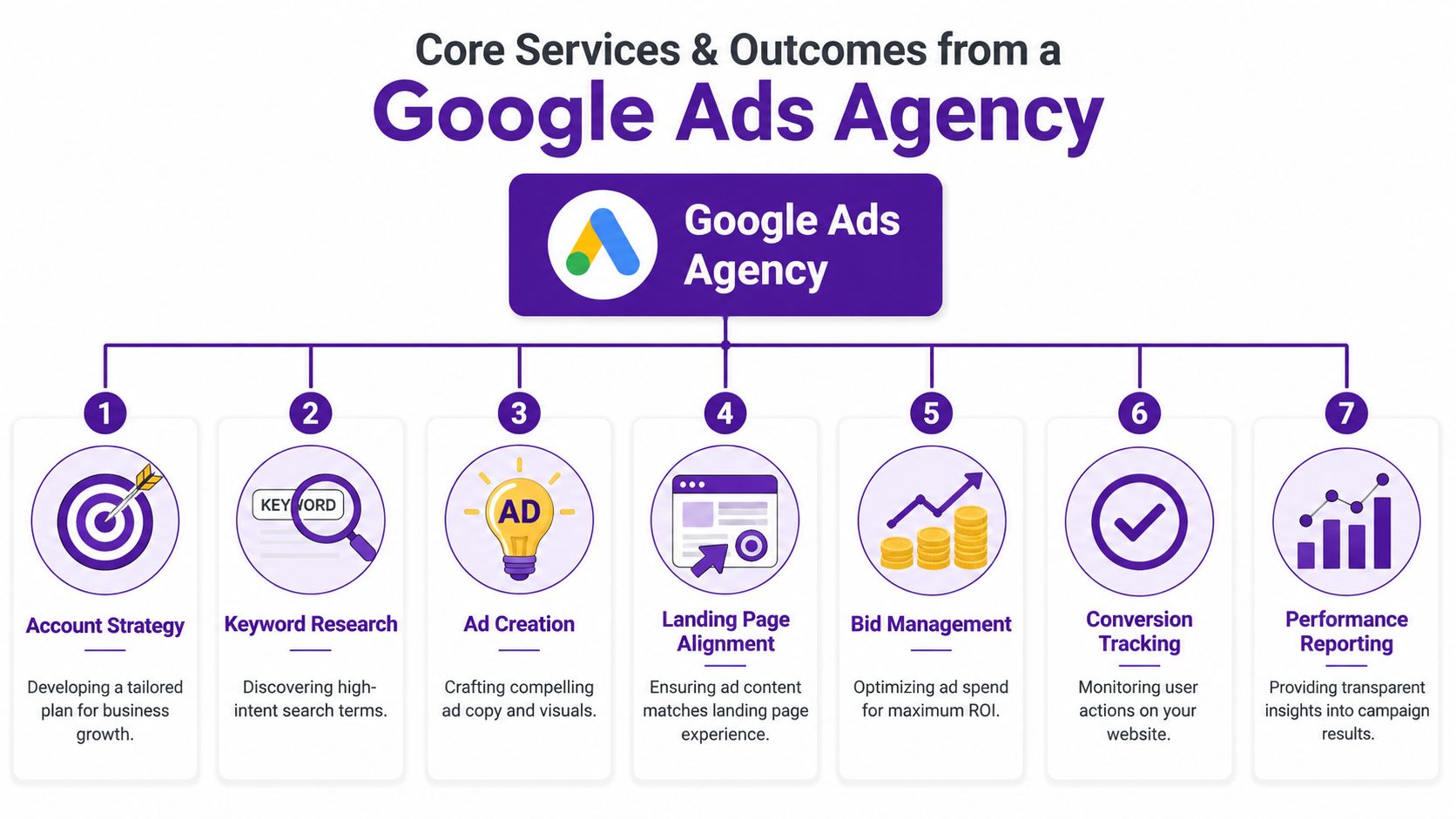
A strong agency normally works through seven connected jobs. The wording may vary from one provider to another, but the work itself tends to be consistent: strategy, research, ad creation, landing page alignment, bid management, tracking, and reporting. If one of those is missing, the whole system becomes harder to trust.
What each service actually changes
Account strategy sets the commercial target, who you want, what counts as success, and what shouldn't be chased. Keyword research separates real buying intent from casual curiosity. Ad creation shapes the promise, while landing page alignment checks that the page keeps it.
Bid management matters because it controls where the budget goes when competition gets messy. Conversion tracking tells you whether form fills, calls, or purchases are real. Performance reporting then turns all of that into a decision layer the marketing team can use.
For Irish B2B and SaaS clients, the best agencies tend to judge campaigns by profit-based metrics such as Profit on Ad Spend and Cost per Qualified Lead, rather than vanity measures like CTR or CPC, and they aim for Quality Scores above 7 (Swydo metrics guide). That shift matters because a campaign can look busy and still fail commercially.
What outcomes to expect by business type
For a B2B SaaS company, the practical goal is usually better lead quality and more predictable pipeline, not raw traffic. For an e-commerce shop, the priorities often shift towards tighter product-query matching and better return from shopping or search spend. For a local service business, the win is often fewer wasted enquiries and more calls that turn into booked work.
Strong agencies don't promise every click will convert. They build a system that makes the right clicks more likely to happen.
The same service pillars can produce different outcomes depending on the business model, but the logic stays the same. A well-run account reduces friction, improves relevance, and gives the sales team better conversations to work with.
Pricing models for Google Ads agency services
A Google Ads agency in Ireland will usually price its work in one of three ways, percentage-based management, flat monthly retainers, or one-time setup work. The right model depends on how mature the account is, how much spend is already planned, and how much hands-on support the business needs during the early stages.
For Irish SMEs targeting local audiences, a monthly budget of €1,000 to €2,000 is a common starting point, with management fees of 10% to 20% of ad spend and setup fees of €500 to €1,500 (Nexora budget guide). That does not mean every business should begin there, but it gives a practical baseline when a marketing manager is comparing proposals and trying to separate realistic planning from sales talk.
Pricing Models Comparison
Pricing Model | Typical Fees | Ideal Budget | When to Choose |
|---|---|---|---|
Percentage of ad spend | 10% to 20% | Higher or scaling spend | When the account is active and spend changes often |
Flat monthly management | €400 to €1,500 per month | Predictable monthly spend | When you want budget certainty and steady support |
One-time setup | €500 to €1,500+ | New account or audit phase | When tracking, structure, or campaign build needs fixing first |
The spend itself matters too. For local SMEs, €0.11 to €5 per click is the broad range, while many Irish SMEs land around €1 to €2 per click (Nexora budget guide). That is why a modest budget can disappear quickly if the account is poorly targeted or if keywords are too broad for the local market.
For B2B or tech companies in competitive sectors, €2,000 to €5,000 per month is often needed to gather enough data for useful optimisation, and meaningful results usually emerge after 60 to 90 days of active management, with strong campaigns reaching 3x to 5x ROAS after the first 90 days of optimisation (Nexora budget guide). Those figures are not a promise. They illustrate why many agencies treat the first phase like setting up a market stall before active trading starts; the structure has to be right before performance can be judged fairly.
A human-led agency with former-Google experience, such as Scéaled, can also help Irish teams decide where AI belongs in the workflow and where it does not. AI can speed up research, pattern spotting, and reporting, but it does not replace judgment on local intent, lead quality, or the signals that matter in a Dublin, Cork, or county-wide campaign. That kind of oversight matters when the goal is not just activity, but better commercial decisions.
Local Ireland checklist for choosing a Google Ads agency
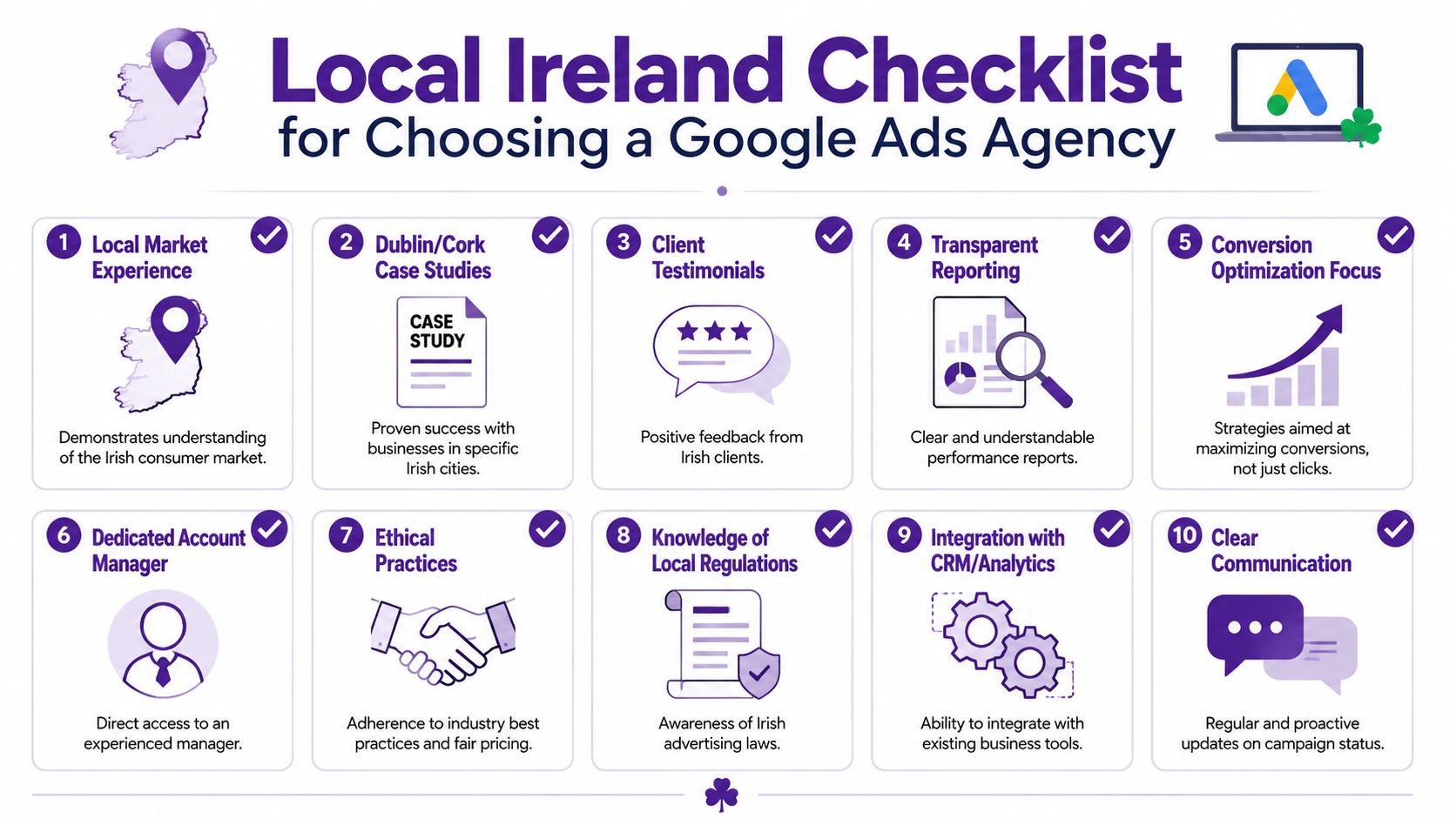
Ireland-specific vetting matters because a polished sales deck doesn't tell you whether the agency understands local search intent. You need more than platform fluency. You need someone who can work with regional language, buyer behaviour, and the practical differences between a Dublin market, a Cork market, and a county-wide local service business.
Ten things to ask before you sign
Local market experience: Ask how they adjust messaging for Irish search behaviour and whether they've worked on accounts aimed at Irish buyers.
City-level proof: Ask for examples from Dublin or Cork, because a campaign that worked in one urban market may need rework elsewhere.
Hyper-local keyword thinking: Ask how they handle searches like “plumber near me” for a specific town, not just generic national terms.
B2B buying journey understanding: Ask how they distinguish a research click from a sales-ready enquiry.
Reporting clarity: Ask what you'll see each month, and whether the report explains business meaning or just platform activity.
Conversion focus: Ask how they improve lead quality, not only traffic volume.
Dedicated ownership: Ask who personally manages the account day to day.
Communication habits: Ask how often you'll hear from them when performance changes.
Tool integration: Ask whether they can connect Google Ads with CRM or analytics systems already in use.
Accessibility and compliance awareness: If they build or audit pages, their accessibility statement should show they think carefully about user experience and inclusivity.
Practical rule: if they can't explain their Irish keyword approach in plain English, they probably don't have one.
Local Services Ads are another useful test. Adoption in Ireland remains below 15% among eligible businesses, even though LSAs are reported as 40% more cost-efficient than traditional click-based campaigns for local lead generation (Wolfgang Digital on LSA adoption). If the agency never mentions LSAs for trades, clinics, or dentists, they may be missing a local opportunity.
Red flags when selecting a Google Ads agency
A lot of bad hires happen because the pitch sounds modern. The agency says it's AI-driven, automated, or performance-focused, and the buyer assumes that means intelligently managed. In practice, some of the worst accounts are the ones that look the most advanced on paper.
Warning signs that should slow you down
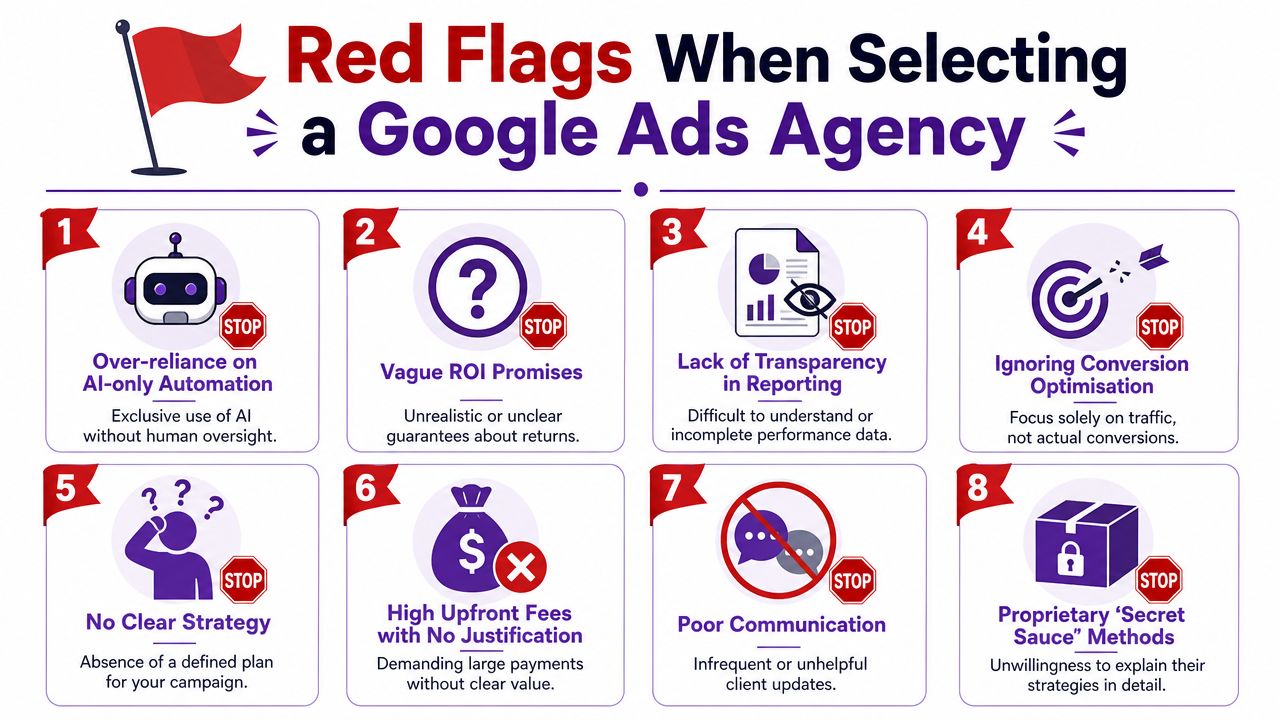
AI-only automation: Irish small businesses using fully automated Google Ads without human oversight see 30% higher cost-per-lead than hybrid models, so ask where human judgment enters the process (Befound survey).
Vague ROI promises: If they can't say how they measure success, they're selling confidence, not accountability.
Opaque reporting: If the report is mostly screenshots and platform jargon, ask for a plain-English business summary.
Traffic obsession: A campaign can drive clicks and still fail to create qualified demand.
No clear strategy: If the account setup sounds templated, the optimisation will usually be templated too.
Unexplained fees: The fee structure should make sense in relation to the work being done.
Weak communication: If updates only happen when you chase them, problems usually surface too late.
“Secret sauce” positioning: Good operators explain their method clearly enough for a marketing manager to challenge it.
The AI question matters in particular for Irish SMEs with tighter budgets. A fully automated account can look efficient while overlooking local search nuance, regional wording, or negative keyword discipline. That's why a hybrid model, where machine speed is paired with human review, is often the safer choice.
If an agency's answer to every problem is “let the automation handle it”, you're not buying strategy, you're buying a shortcut.
There's a second warning sign that doesn't always get enough attention, unclear cost logic around the account itself. If the agency can't show why campaign changes happened, or why performance moved, you're left guessing whether the budget was managed well or just spent quickly.
How Scéaled sets itself apart as a Google Ads agency
A marketing manager comparing Google Ads agency options often finds the same promise repeated in different words. Scéaled stands apart because it treats paid media as part of a larger commercial system, not as a channel to optimise in isolation. Its team combines former Google marketers, connected thinking across paid media, SEO, content, and conversion optimisation, and a human-led understanding of how Irish demand behaves.
That matters because campaigns rarely fail for one simple reason. A keyword list can be tidy, the ads can be well written, and the reporting can still miss the commercial point if the work is split into isolated boxes. Many agencies separate paid search, SEO, content, and conversion work until one area underperforms, then try to fix the problem after the fact. Scéaled's approach joins those pieces earlier, then uses AI and automation where they save time, while keeping judgement with the people who understand the account.
The benefit becomes clearer in practical terms. A SaaS company does not need more clicks, it needs better-fit prospects and a cleaner handoff into sales. A professional services firm does not need traffic from everyone, it needs enquiries from the right people. An e-commerce business does not need a stream of generic visits, it needs profitable demand that can scale without breaking the numbers.
Irish market nuance adds another layer. Search terms, buying behaviour, and regional wording do not always behave the same way across Dublin, Cork, Galway, or smaller county markets, and a campaign that ignores that can waste budget quickly. Scéaled's Dublin base and its experience inside Google's ecosystem help the team read platform behaviour with less guesswork, while still checking for the local details that AI-only workflows often miss. That is the gap many automated agencies leave behind, speed without enough human context.
For a closer look at the agency's approach, visit the main site on the Scéaled website.
Conclusion and next steps
Choosing a Google Ads agency comes down to fit, not hype. You want a partner that understands your budget, your buyer, your local market, and the difference between busy reporting and actual commercial progress. In Ireland, that usually means favouring human-led strategy, clear measurement, and local nuance over automation alone.
The smartest next move is to compare agencies on how they think, not just what they promise. Ask for their reporting approach, their keyword logic, and their view on local search behaviour. Then use that to decide whether they're helping you buy clicks, or helping you build growth.
A CTA for Scéaled.
Comments