Digital Marketing Lead: Complete Guide and Strategies 2026

You can have traffic, forms, and a healthy-looking dashboard, and still hear the same complaint from sales every week: the leads aren't worth chasing. That's the messy reality for a lot of Irish SMEs and B2B teams. The problem usually isn't that lead generation is broken, it's that lead quality, consent, routing, and visibility aren't working as one system.
A digital marketing lead isn't just someone who filled in a form. It's a person or account that has shown enough online intent, and enough fit, to justify a real sales follow-up. That distinction matters more now because broad web traffic is less dependable, privacy expectations are higher, and AI answer surfaces can intercept discovery before someone ever clicks through.
Table of Contents
What a Digital Marketing Lead Actually Means - The practical definition - What the label should capture
Prospects, MQLs and SQLs Explained - A simple SaaS ladder - Why labels fail in real teams
Where Digital Leads Come From - Channel roles and failure modes - A quick view of source mix
Qualifying and Scoring Leads That Convert - Rule-based first, model-based later - A workable SaaS example
KPIs and Tracking That Actually Predict Revenue - What to track first - Attribution without overengineering it
Practical Tactics That Move the Needle - Start with one offer per audience - Match channel to funnel stage
Applying This to Irish SMEs and B2B Teams - A sensible rollout order
What a Digital Marketing Lead Actually Means
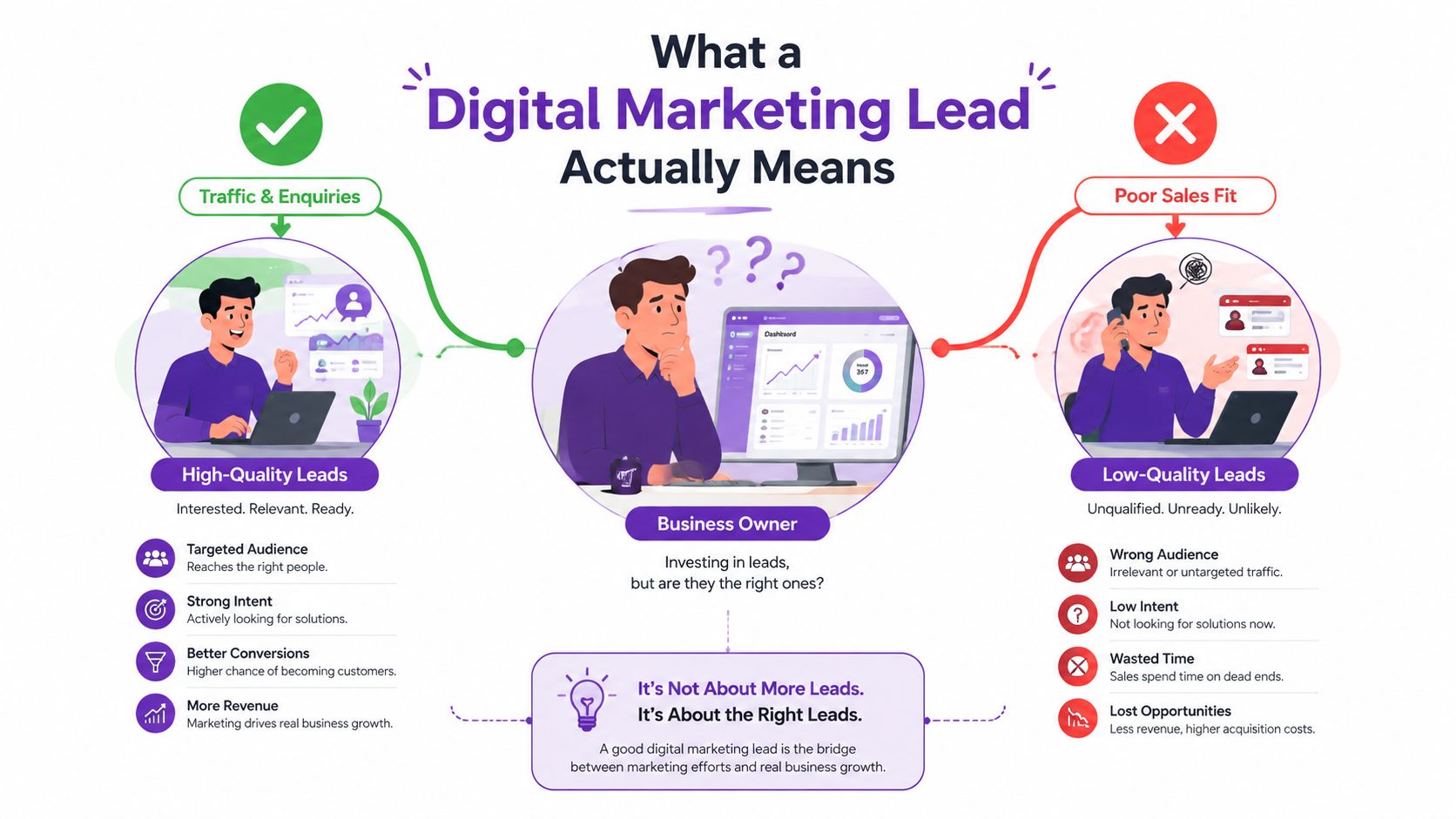
An Irish SME can run a decent campaign, get a steady trickle of enquiries, and still watch sales reject most of them. That doesn't mean the campaign failed. It usually means the business confused traffic, interest, and sales-ready demand.
The practical definition
A digital marketing lead is a contact that has raised their hand online and matches the business's target profile well enough to deserve a response. That could mean a form submission, a demo request, a callback, a qualified chat, or a high-intent event that the team has agreed counts as sales-worthy.
A click is not a lead. A subscriber is not automatically a lead either. A click says someone noticed the message, a subscriber says they wanted future updates, and a sales-ready enquiry says they're close enough to a buying conversation that follow-up is worth the effort.
Practical rule: if sales would be annoyed to receive every contact in that bucket, the bucket is too broad.
The distinction matters because lead programmes often overvalue volume. Benchmark guidance on lead management shows that organisations generate an average of 1,877 leads per month, but about 80% never convert to customers, while only 10–15% of MQLs typically become genuine opportunities, which is why raw form fills can make a campaign look healthier than it really is (Cirrus Insight lead generation statistics). For Irish teams spending money on paid media, that gap can eat margin fast if the business treats every enquiry as equal.
What the label should capture
The label should answer one commercial question, which is whether this person is worth active follow-up now. If yes, the contact is a lead. If not, they may still be a useful subscriber, visitor, or nurture contact, just not a sales priority yet.
That sounds simple, but it clears up a lot of confusion. Marketing is responsible for creating demand and capturing it cleanly. Sales is responsible for deciding whether the lead is worth pursuit. When those jobs blur, the pipeline gets noisy and everyone argues about the wrong metric.
Prospects, MQLs and SQLs Explained
A B2B SaaS buyer rarely moves from first touch to purchase in one step. Someone reads a checklist, someone else attends a webinar, then a manager asks for pricing, and only later does sales decide the account deserves active pursuit. The language around those steps matters because it prevents marketing and sales from talking past each other.
A simple SaaS ladder
A prospect is anyone who has entered the orbit of the brand. That might be a newsletter subscriber, a content downloader, or a visitor from paid social who hasn't shown enough intent yet. A Marketing Qualified Lead, MQL, is a prospect who looks like a fit and has shown meaningful engagement. An Sales Qualified Lead, SQL, is a lead that sales has accepted as worth direct follow-up.
Use a concrete example. A mid-market Irish SaaS company targeting finance teams might see three different contacts:
A junior analyst downloads a budgeting checklist.
A finance manager visits the pricing page, reads a comparison article, and returns two days later.
A head of finance requests a demo after comparing integrations.
Those are not the same thing, even if all three came through the website. The first may be a useful prospect. The second could be an MQL if the fit is strong. The third is the strongest candidate for an SQL conversation.
Why labels fail in real teams
The main mistake is treating lead type as a judgement of human worth rather than a triage decision. A prospect can be highly interested and still not be ready for sales. A lead can be well qualified and still lose to timing, budget, or internal process.
Sales and marketing alignment improves when the team agrees on three things, who the buyer is, what counts as intent, and when a contact moves from nurture to handoff.
That agreement doesn't need to be complicated. A good internal checklist usually covers role, company size, geography, buying stage, and trigger actions. If the teams can't define those five items cleanly, the funnel is already leaking.

Where Digital Leads Come From
A strong funnel doesn't rely on one source, because different channels produce different types of demand. In Ireland, that point matters even more now. The Digital Marketing Institute reports that social media helped generate leads for 68% of marketers, 59% used social platforms specifically to generate leads, and paid social accounted for 14.9% of lead-generation share in one 2025 benchmark dataset (ScrapeLead benchmark summary). The implication is straightforward, social, paid social, and search need to work together, not compete for blame.
Channel roles and failure modes
Organic search is usually the trust-builder. It tends to produce researchers, comparison shoppers, and buyers who are trying to validate a shortlist. The mistake is expecting SEO alone to carry short-term pipeline without a clear conversion path.
Paid search captures people already showing intent. It tends to produce warmer enquiries, especially for commercial queries, but it can get expensive if campaigns drift into broad, curious, low-intent terms.
Paid social is different. It reaches specific audiences before they raise their hand, so it's good for shaping demand and re-engaging known prospects. The mistake is asking it to behave like search and measure it only by immediate form fills.
Content and AEO, meaning answer engine optimisation, help your expertise surface on Google and AI answer layers. That usually produces earlier-stage demand, not always an instant enquiry, so the channel needs patience and strong internal linking to conversion pages.
Partnerships, events, and referrals create warmer pathways. They often bring higher trust into the conversation, but teams sometimes neglect tracking, which makes it hard to know which partner is helping pipeline.
A quick view of source mix
Channel | Typical lead stage | Common pitfall |
|---|---|---|
Organic search | Research to consideration | Treating informational traffic like sales demand |
Paid search | High intent enquiry | Bidding on terms that attract window shoppers |
Paid social | Early to mid funnel | Measuring it only by last-click conversions |
Content and AEO | Discovery and trust building | Publishing without a clear next step |
Partnerships and referrals | Warm introduction | Failing to track the originating source |
Events and community | Relationship-led demand | Letting follow-up slip after the event |
If you want a deeper look at how SEO can support this mix, Scéaled's SEO programme is a useful example of how search visibility and lead capture can be connected.
Qualifying and Scoring Leads That Convert
Lead scoring works best when teams stop guessing and start defining. The score should combine explicit attributes, such as role, company size, and industry, with implicit behaviour, such as pricing-page visits, repeat sessions, and downloads. That gives sales a better signal than counting every form fill as equal.
Rule-based first, model-based later
Small Irish teams should usually start with rule-based scoring. It's simpler, easier to explain, and easier to fix when the model goes wrong. If a contact is a decision-maker in the target sector and has visited the pricing page twice, they get a higher score. If they're a student, a competitor, or outside the target market, the score drops.
Model-based scoring is more advanced. It can uncover patterns that humans miss, but it only works well when the team has enough clean data and enough consistency in how leads are handled. For most SMEs, that's a later step, not a starting point.
A workable SaaS example
A B2B SaaS business selling to Irish mid-market accounts might set the following logic:
MQL if the contact matches the target geography, works in a relevant function, and has shown repeated engagement.
Sales Accepted Lead, SAL if sales confirms the account is in scope and worth outreach.
SQL if the prospect agrees to a meeting, demo, or discovery call.
The exact thresholds matter less than consistency. If marketing marks every webinar attendee as an MQL and sales rejects half of them, the scoring model is too generous. If sales only wants demo requests, the model is too strict for top-of-funnel nurture.
The fastest improvement often comes from handoff speed, not scoring complexity. A strong score is wasted if the lead sits untouched.
Advanced benchmark guidance points to sub-five-minute lead routing as the strongest operational move, because fast handoff preserves intent while it's still fresh (SalesHive B2B lead benchmarks). That's the point many teams miss. They spend weeks tuning score weights, then lose the lead because nobody responded while the buyer was still active.
KPIs and Tracking That Actually Predict Revenue
A dashboard can look busy and still tell you very little. The metric that matters depends on which part of the funnel is leaking. CPL, or cost per lead, tells you what it cost to capture interest. It does not tell you whether the interest was worth capturing.
What to track first
For a small Irish team, the first three numbers should usually be:
MQL rate, to see whether marketing is attracting the right people.
SQL rate, to see whether sales agrees with the definition.
Lead-to-customer rate, to see whether the funnel is producing revenue.
That trio is more useful than a wall of impressions, opens, and clicks. Clicks can rise while pipeline weakens. Opens can look healthy while follow-up is slow. CPL can fall while the channel fills with low-quality traffic that never gets through qualification.
Benchmark guidance on lead metrics recommends stage-by-stage dashboards, quarterly contact-data audits, and baselining around clicks, replies, and meetings booked rather than opens or raw CPL (ClickMinded digital marketing metrics guide). That's a better way to see where the money moves.
Attribution without overengineering it
Last-click attribution still gets used because it's easy, not because it's accurate. In a privacy-first, multi-device journey, buyers often touch content, search, email, and social before they convert. A simple weighted or position-based model gives enough signal for a small team without pushing them into enterprise tooling.
The goal isn't perfect truth. The goal is decision-making that reflects how buyers behave. If a LinkedIn ad introduces the brand, a blog post builds trust, and a search ad closes the lead, the credit should not go only to the final click.
Practical Tactics That Move the Needle
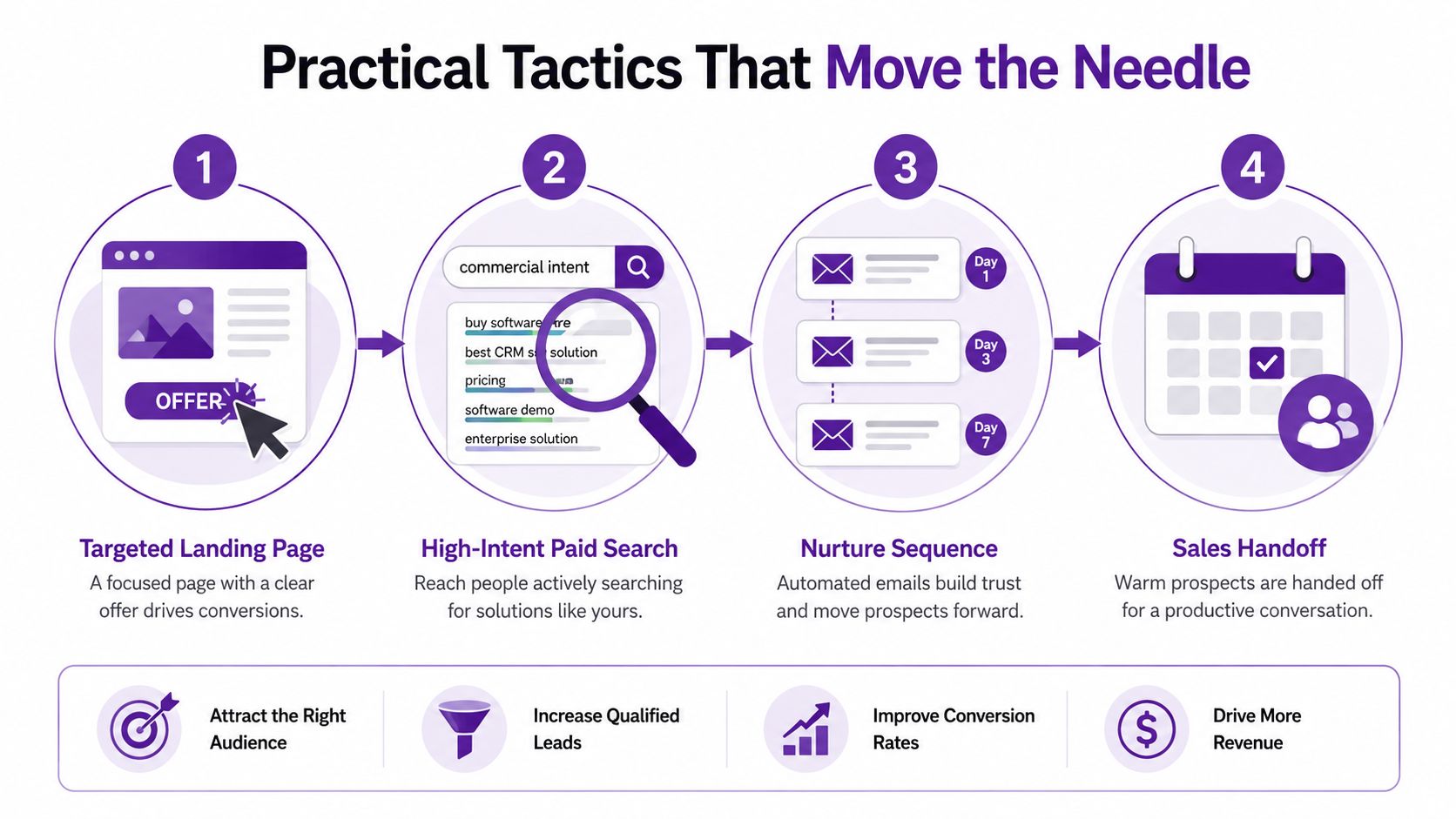
A useful lead system rarely starts with more channels. It starts with better offers, cleaner paths, and faster follow-up. The team that fixes those three things usually sees more value from the traffic it already has.
Start with one offer per audience
A landing page should speak to one buyer, one problem, and one next step. If a page tries to sell SEO, paid media, CRO, and automation at once, it often converts none of them well. A finance director in Cork doesn't need a brand story on the page, they need a reason to act.
Paid search works best when the account structure follows commercial intent. A team selling accounting software might separate high-intent terms from research terms, then send each group to a different landing page. That makes the message match the query instead of forcing one page to do everything.
For a tighter look at how that kind of campaign structure is built, Scéaled's paid search strategy is a relevant reference point.
Match channel to funnel stage
Paid social should usually do different work from search. Search captures active demand. Social can create and shape it. If the creative is too hard-sell too early, the audience tunes out. If it stays too broad for too long, the lead never matures.
SEO and AEO should support the same journey. A comparison article, a practical guide, and a pricing page answer different questions, so they should not all try to do the same job. CRO then picks up the slack by removing friction from forms, calls-to-action, and page layout.
Useful rule: if a campaign can't explain what happens after the click, it's not ready to scale.
Automation sits between all of this and the sales team. It routes leads, triggers nurture, and keeps reporting from becoming manual busywork. Scéaled also applies AI and process automation to streamline workflows and improve customer journeys, which is useful when a team needs better handoff without adding headcount.
Applying This to Irish SMEs and B2B Teams
Irish SMEs face three realities that generic lead-gen advice usually glosses over. Consent and data handling matter more than ever, discovery is less linear because AI answer surfaces can intercept the journey, and attribution is messy when the buying process moves between online research, phone calls, meetings, and referrals.
That means the starting sequence should be practical, not ambitious. First, agree on what counts as a lead, MQL, and SQL. Then pick two or three channels that fit the buyer journey. After that, instrument the conversion chain from visit to enquiry to sales handoff, so the team can see where leads drop out.
A sensible rollout order
Define the lead: write down what sales will accept.
Pick the mix: choose channels that reflect demand stage, not agency trend.
Track the handoff: monitor routing speed, acceptance, and conversion.
Layer AEO and automation: build visibility and follow-up once the basics work.
If you need a practical starting point for structured demand generation, Scéaled's digital marketing lead generation approach reflects that connected view of paid media, SEO, and conversion work.
A realistic six-month target is not “more traffic”. It's cleaner qualification, faster response, and a healthier proportion of enquiries turning into sales conversations. If the team can tighten definitions, improve handoff, and reduce wasted follow-up, the pipeline usually becomes easier to trust.
If you want help turning this into a lead system that feeds sales, Scéaled plans and runs connected paid media, SEO, CRO, and automation programmes for Irish businesses. Visit Scéaled to see how that approach can improve lead quality, routing, and pipeline visibility for your team.
Comments