Digital Marketing Group: How to Choose the Right Partner

You've sat through three agency pitches. Each one promises “full-service growth”, yet the proposals don't resemble one another. One focuses on SEO and paid search, another leads with brand and social content, and the third wants responsibility for your CRM, website, analytics, and every channel in between. The prices vary, the deliverables sound impressive, and nobody defines exactly who owns revenue performance.
That's the problem Irish SMEs and scale-ups face when choosing a digital marketing group. You're not buying channel execution. You're choosing an operating model for demand generation, measurement, and commercial decision-making. Ireland's digital advertising market reached €1.06 billion in 2024, up 11% year on year, after growing from €615 million in 2019 to more than €1 billion, according to the IAB Ireland and IRM Online Adspend Study. The budget is there, but so is the cost of choosing a disconnected partner.
Table of Contents
What a Digital Marketing Group Actually Does - The operating model matters more than the label
Core Services That Drive Measurable Growth - Paid media needs architecture - SEO and content should build an asset - CRO and automation expose weak partners
Why Connected Strategy Beats Fragmented Channels - Shared intelligence creates better decisions - Attribution needs commercial honesty
How to Evaluate and Choose the Right Agency - Ask questions that force specificity - Match the pricing model to the work
Common Pitfalls and Red Flags to Avoid - Watch the contract, not just the proposal
AI Readiness and the Future of Agency Partnerships - Test the agency's technical depth
Your Next Steps to Find the Right Partner - Start with your own evidence - Shortlist with discipline - Score the decision, then pilot it
What a Digital Marketing Group Actually Does
A genuine digital marketing group connects strategy, execution, data, and optimisation across the customer journey. It may manage paid media, SEO, content, conversion rate optimisation, email, and automation, but the defining feature isn't the size of its service menu. It's whether those activities operate from one commercial model.
A founder might ask a paid search specialist to generate leads, an SEO freelancer to publish content, and a social contractor to increase engagement. Each supplier can perform its assigned task competently. The trouble starts when nobody shares audience signals, landing page findings, sales feedback, or a consistent definition of a qualified opportunity.
A connected group works differently. The paid media team can identify search terms that convert, the SEO team can prioritise those themes for long-term visibility, and the CRO team can use landing page evidence to improve both ad traffic and organic visitors. Marketing automation then routes, scores, and nurtures the leads instead of leaving them in a form inbox.
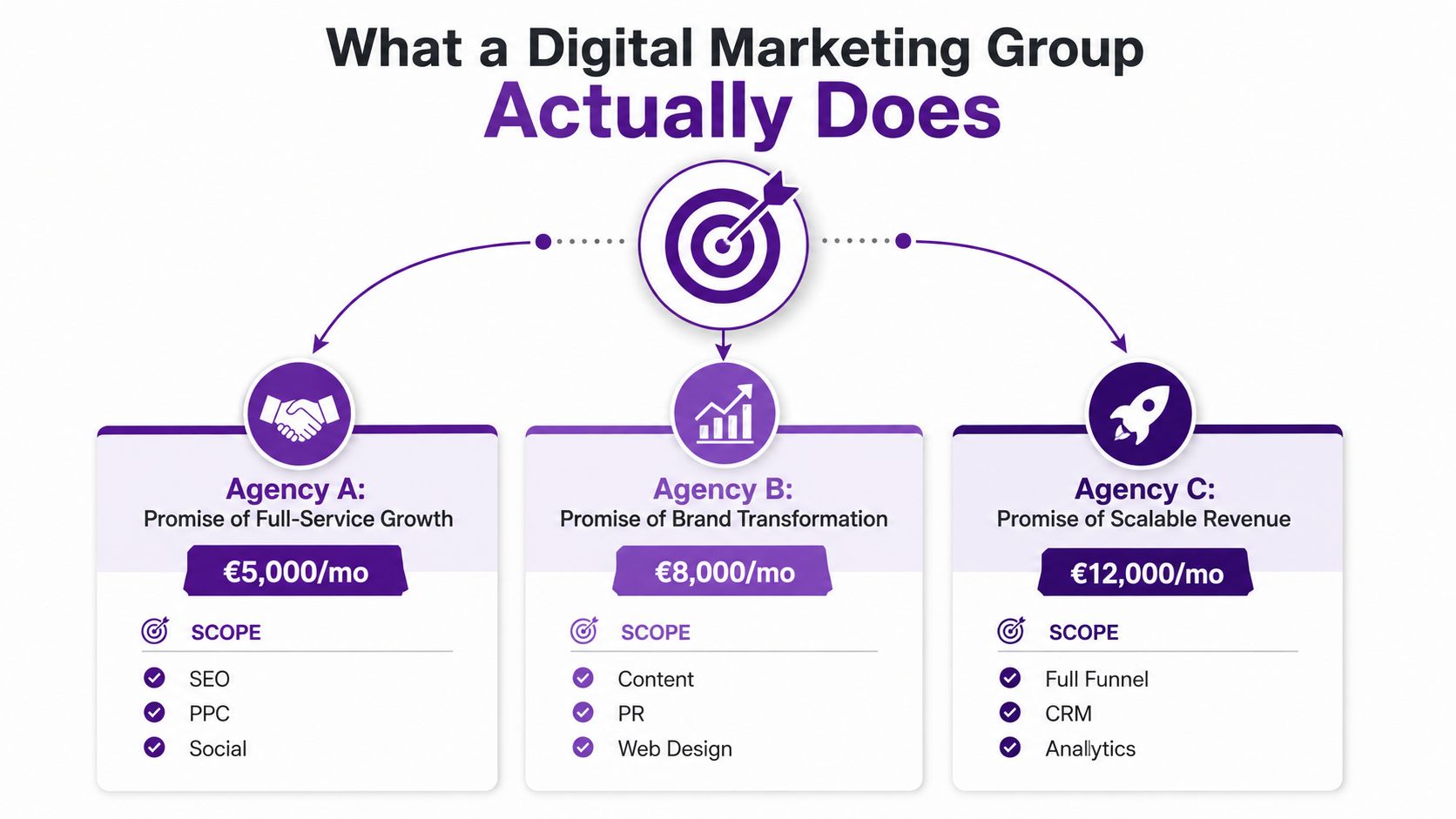
The operating model matters more than the label
Look for four practical signs:
Shared measurement: The team works from connected analytics, CRM, and conversion definitions rather than separate channel dashboards.
Commercial strategy: A senior strategist understands margin, sales cycle, customer value, lead quality, and capacity constraints.
Cross-channel accountability: Reporting explains how channels work together, not just whether each platform delivered impressions or clicks.
Outcome-based service levels: Meetings, testing, reporting, and response times support agreed commercial priorities.
That model suits Irish businesses because a misaligned engagement can absorb attention for months while the internal team waits for results. An agency might deliver every promised blog, campaign, and report while sales sees no improvement in qualified pipeline. The work exists, but the operating system is broken.
A freelancer or specialist can still be the right choice. If you need a narrowly defined technical audit or a short-term creative project, specialist expertise may be efficient. It becomes risky when you expect separate vendors to behave like an integrated growth team without shared systems, ownership, or incentives.
The definition of digital marketing is broad, but your agency brief shouldn't be. Ask how the partner will connect acquisition, conversion, and follow-up. The answer will tell you whether you're buying a group or just assembling a supplier list.
Core Services That Drive Measurable Growth
A digital marketing group should make every service answer one question: what commercial decision does this work improve? If the answer is “visibility” or “engagement” without a connection to demand, pipeline, sales, or retention, the service is probably being reported in isolation.
Service | What Good Looks Like | Key KPIs |
|---|---|---|
Paid media | Structured campaigns, segmented audiences, disciplined testing, accurate conversion tracking, and budget decisions based on marginal return | Cost per qualified lead, customer acquisition cost, conversion rate, pipeline value |
SEO and AEO | Technical fixes, search-intent clusters, useful content, clear authorship, structured data, and pages designed for both search engines and answer platforms | Qualified organic conversions, non-brand demand, assisted pipeline, ranking movement for priority themes |
Content marketing | Assets mapped to buyer questions and funnel stages, with clear next actions rather than a publishing quota | Engaged sessions, assisted conversions, lead quality, content-influenced pipeline |
CRO | Research-led hypotheses, landing page improvements, testing discipline, and feedback from sales outcomes | Conversion rate, form completion, qualified conversion rate, revenue per visitor |
Marketing automation | CRM integration, lead routing, scoring, nurture journeys, and response workflows | Speed to lead, sales acceptance, nurture progression, pipeline contribution |
Paid media needs architecture
A mature team doesn't begin with “How much reach can we buy?” It starts with audience quality, offer economics, tracking, and the point at which a lead becomes valuable. Google Ads, Microsoft Advertising, Meta, and LinkedIn each require different campaign structures and creative approaches, but the account should still support one commercial measurement framework.
A junior vendor often optimises to platform conversions without checking whether those enquiries become opportunities. That creates polished dashboards and poor decisions. Require the agency to explain negative keywords, audience exclusions, creative testing, landing page alignment, and how CRM feedback will influence bidding.
SEO and content should build an asset
SEO isn't a monthly blog quota. It's technical access, information architecture, search intent, authority, and content that answers a real buyer question better than competing pages. A serious team will separate foundational fixes from content expansion and will tell you which outcomes need time to accumulate.
Content should support the buying process. An educational page can create awareness, a comparison guide can help evaluation, and a proof-led service page can capture demand. The agency should show the connection between each asset and the action it's designed to generate.
CRO and automation expose weak partners
CRO is a testing discipline, not a redesign preference. The agency should record the problem, state the hypothesis, identify the audience, define the success metric, and document what happens next. “The new page looks cleaner” isn't evidence.
Automation completes the chain. Lead scoring, CRM routing, nurture sequences, and sales alerts prevent paid and organic acquisition from ending at the form submission. Ask to see the proposed workflow, including ownership when a lead is unresponsive or falls outside the ideal customer profile.
Practical rule: If an agency can't explain how its work changes a sales decision, it's reporting activity rather than managing growth.
Why Connected Strategy Beats Fragmented Channels
Ireland's channel mix makes integration a commercial requirement. In 2025, total digital advertising spend reached €1.146 billion, with display at €735 million, search at €345 million, social at €576 million, and publisher or broadcaster video at €45 million, according to AdWorld's coverage of Irish digital advertising spend. Those channels reach people at different stages, so a company that plans each one separately is choosing to ignore useful context.
Search captures existing intent. Social and video can create or shape demand. Content helps buyers understand the problem, while email and CRM workflows continue the conversation after the first visit. A connected digital marketing group treats those interactions as a system rather than a collection of media buys.
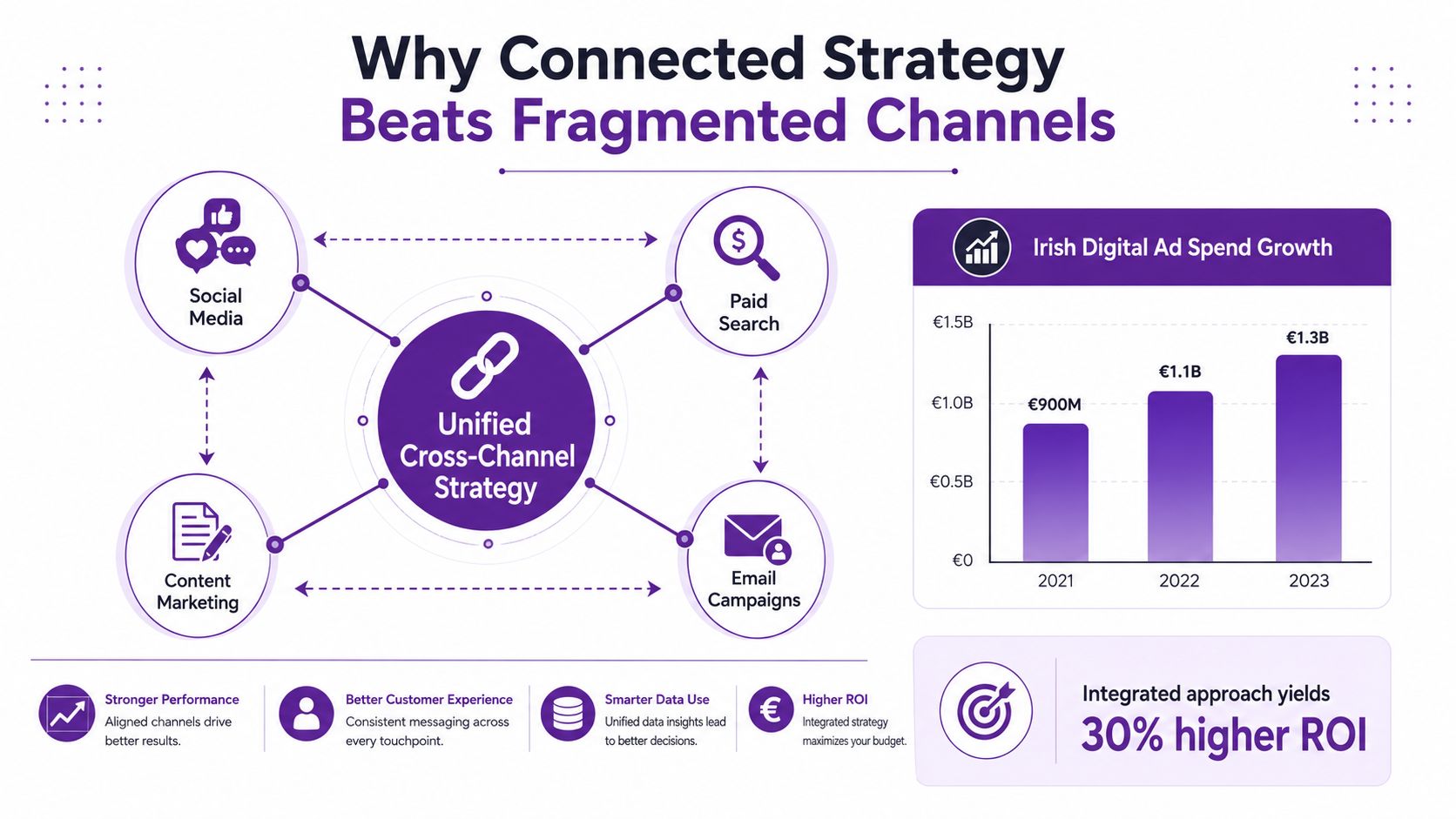
Shared intelligence creates better decisions
Paid search data can reveal language that customers use when they're ready to act. SEO can turn that language into durable topic coverage. CRO can show which objections stop visitors from enquiring, and creative teams can use those objections to improve ads and landing pages.
The fragmented model loses those loops. A PPC supplier reports clicks, an SEO freelancer reports rankings, and a social contractor reports engagement. The business owner still has to determine whether the combined activity produced qualified demand. That isn't strategic integration. It's administrative consolidation.
The different types of digital marketing can each work independently, but the strongest planning assigns every channel a role. The question isn't whether one specialist can outperform a generalist on a particular task. A specialist may well have deeper expertise in one platform. The question is whether the business gains more from isolated excellence or from shared intelligence across the buying journey.
Attribution needs commercial honesty
No attribution model is perfect. That's why your partner should explain assumptions, compare platform reporting with CRM outcomes, and use blended measures where user-level tracking is incomplete. If an agency claims every conversion for the channel that recorded the final click, it's encouraging budget decisions that may overvalue intent capture.
A connected partner should also be willing to reduce activity that looks successful but produces weak customers. That willingness matters more than a complex dashboard. You're paying for better allocation of resources, not for every channel to defend its own existence.
How to Evaluate and Choose the Right Agency
Choose an agency through evidence, not presentation quality. A polished pitch proves that a team can sell its service. It doesn't prove that the delivery team can understand your economics, improve your funnel, or communicate bad news early.
Start with a written brief that contains your commercial context. Include your priority products, target customers, sales process, current acquisition sources, CRM, reporting limitations, internal capabilities, and the decisions you need the partner to improve. Don't hide your constraints. A good agency needs them to design a realistic plan.
Ask questions that force specificity
Use the first conversation to test how the agency thinks:
Relevant proof: Can you show work for a similar sector, sales cycle, market, or growth stage?
Team structure: Who will do the work, who owns strategy, and how often will senior people participate?
Measurement: Which conversions will you track, how will you connect them to the CRM, and how will you distinguish a lead from a qualified opportunity?
Prioritisation: What would you fix first if resources were limited?
Failure handling: What happens when a campaign misses its target or a test produces no improvement?
Access and ownership: Will your team retain access to accounts, analytics, creative, content, and campaign data?
Ask for channel-specific evidence, but don't accept screenshots without context. You need the starting problem, the work performed, the measurement method, and the commercial result. If confidentiality prevents disclosure, the agency should still explain the methodology and provide a reference where possible.
Match the pricing model to the work
Pricing Model | Best For | Typical Range | Key Trade-offs |
|---|---|---|---|
Retainer | Ongoing multi-channel strategy and execution | Varies by scope | Predictable planning, but weak scope control can create passive delivery |
Project-based | Audits, implementations, technical work, or defined campaigns | Varies by project | Clear output, but limited continuity after completion |
Performance-based | Offers with reliable tracking and a controllable sales process | Varies by agreement | Incentive alignment, but disputes can arise over attribution and lead quality |
Hybrid | Businesses needing strategic continuity with defined delivery and shared incentives | Varies by structure | Flexible, but the contract must define responsibilities precisely |
No legitimate partner can quote a universal “typical range” without understanding scope, team seniority, media budget, technical complexity, and reporting requirements. Treat a low fee as a possible scope limitation, not an automatic bargain.
Use the questions to ask a digital marketing agency to prepare your shortlist, then run a paid pilot. The pilot should test communication, strategic judgement, execution quality, reporting, and responsiveness. Agree the review cadence, escalation route, access requirements, and exit terms before work starts.
Common Pitfalls and Red Flags to Avoid
The biggest agency isn't automatically the safest choice. Large firms can offer substantial expertise, but they may also place your account behind layers of account management and junior delivery. Ask who will build campaigns, review data, write recommendations, and attend performance meetings.
The opposite mistake is choosing a small vendor because the founder gives an impressive pitch, then discovering that delivery depends on one overloaded person. Capacity matters. You need to know what happens during holidays, busy periods, staff changes, or a sudden performance problem.
Watch the contract, not just the proposal
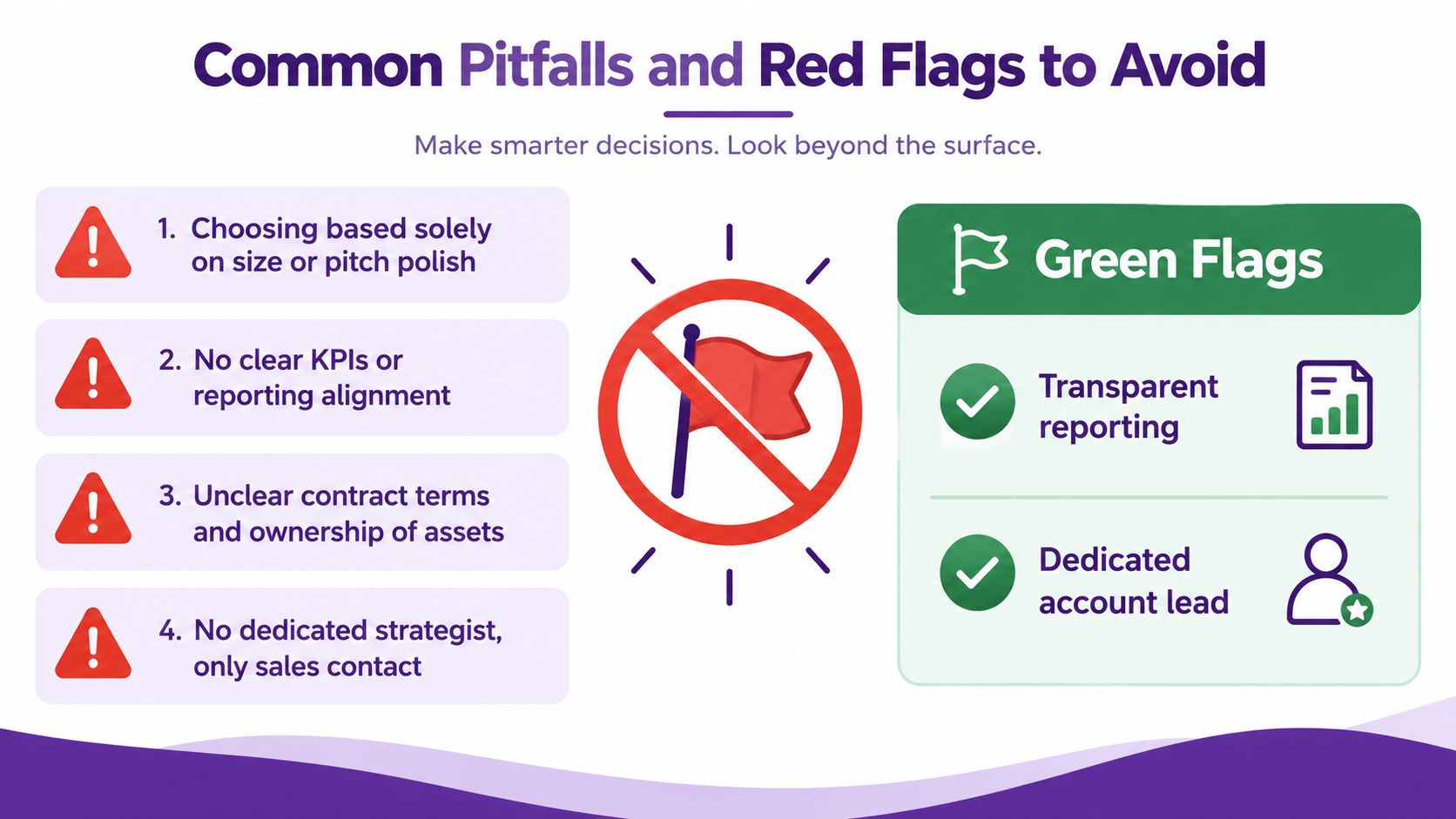
Common warning signs include:
Unclear ownership: The agreement doesn't state who owns ad accounts, landing pages, creative, copy, tracking configurations, or data.
Opaque reporting: You receive a presentation rather than direct access to relevant platforms and meaningful commercial views.
Single-channel bias: The agency recommends its preferred service before understanding your customers, funnel, sales cycle, or constraints.
Vanity-led KPIs: The plan centres on impressions, follower growth, or traffic without defining lead quality and revenue relevance.
Sales-to-delivery gaps: The senior person who sold the engagement disappears after signing.
No economic questions: The agency never asks about margins, customer value, close rates, capacity, or the difference between an enquiry and a sale.
A serious group won't promise a specific Google ranking or guaranteed revenue outcome without controlling the full commercial process. It will explain dependencies, establish a baseline, and identify what your internal team must provide.
Don't let an agency force its preferred tools into an unaudited stack. Existing analytics, CRM fields, consent settings, feeds, forms, and automation may contain structural problems that affect every channel. Technical discovery should precede aggressive budget recommendations.
The same principle applies to communication. Agree what gets reported, when it gets discussed, who can approve changes, and how urgent issues are escalated. Without that agreement, disappointment appears months later as a dispute about what “full service” was supposed to mean.
AI Readiness and the Future of Agency Partnerships
AI readiness isn't a slogan on an agency credentials page. It's the practical ability to use automation, structured data, first-party signals, and human judgement without weakening accuracy or trust.
Irish businesses need to take the shift seriously. Daily GenAI use in Ireland rose from 2% in 2023 to 11% in 2025, and 64% of Irish adults actively use GenAI tools, according to Irish AI search guidance from BBMM. That changes how people discover information and how agencies should prepare content. A page built only to rank for a keyword may be less useful than a well-structured resource with direct answers, clear authorship, update dates, structured data, and consistent business information.
The same source reports that 61% of Irish SME websites fail Google's Core Web Vitals on mobile, while only 11% of regional SMEs use marketing automation. These are not abstract technology issues. A slow mobile page can waste paid traffic, and a weak follow-up process can leave qualified enquiries waiting while competitors respond.
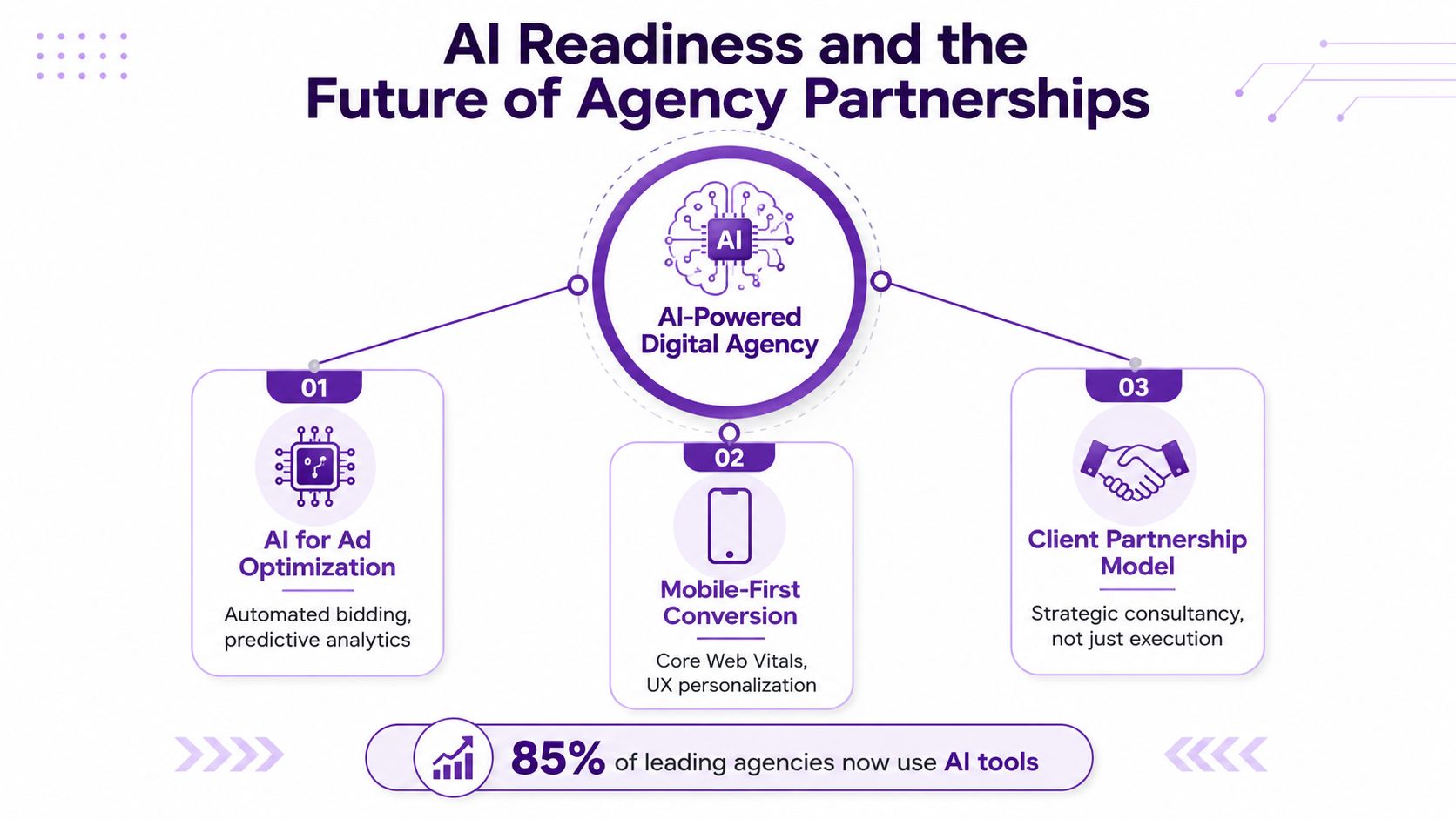
Test the agency's technical depth
Ask how the team uses AI in real workflows. Useful answers may include predictive audience analysis, bid management, creative variation, research support, internal quality checks, and lead classification. Weak answers rely on generic language about “leveraging AI” without naming the data inputs, approval controls, or business outcome.
Your evaluation should cover:
Search readiness: Can the agency improve crawlability, structured content, authorship signals, update discipline, and consistent business information?
Mobile conversion: Does it inspect real mobile journeys, forms, speed, accessibility, and friction between ad click and enquiry?
Data infrastructure: Can it connect advertising platforms, analytics, CRM, consent management, and reporting?
Human oversight: Who checks AI-generated recommendations, copy, audience logic, and customer communications?
Privacy discipline: How does the team handle first-party data, permissions, platform changes, and sensitive customer information?
AI won't rescue a broken funnel. It can make a coherent system faster, but it can also multiply poor targeting, weak messaging, and inaccurate reporting. Choose a partner that treats AI as an operating capability inside a clear strategy, not as a substitute for strategic thinking.
Mobile-first delivery is an especially useful litmus test. Open the agency's recommended landing pages on a phone, complete the forms, inspect the follow-up, and ask what happens in the CRM. The future-facing partner will care about the complete journey from discovery to response.
Your Next Steps to Find the Right Partner
You can create a credible shortlist in one week if you control the process.
Start with your own evidence
On the first day, review current spend, lead sources, conversion points, CRM stages, and sales feedback. Identify the two performance gaps that matter most, such as poor lead quality, weak organic visibility, slow follow-up, or low mobile conversion. Don't ask an agency to diagnose a business you haven't defined.
On the second day, write your must-haves. Separate essential capabilities from useful extras. You might require paid search, technical SEO, CRO, CRM integration, or AI search readiness. Include access, ownership, reporting, and communication requirements alongside channel expertise.
Shortlist with discipline
Request relevant case evidence from several agencies, but take no more than three discovery calls. Give each one the same brief and the same questions so you can compare thinking rather than presentation styles.
Use this opening script:
“Our commercial priority is ____. Our current acquisition challenge is ____. We need to improve ____. Our existing tools are ____. Explain what you'd audit first, which channels you'd prioritise, how you'd define a qualified outcome, how you'd report it, and where AI or automation would be appropriate. Also explain what you'd need from our team and how you'd test the relationship before a longer engagement.”
Ask each agency to outline its first phase, dependencies, expected learning, and decision points. You're not looking for a guaranteed result. You're looking for a clear method that makes learning and accountability visible.
Score the decision, then pilot it
Create a simple scorecard for strategic alignment, transparency, technical depth, relevant experience, team quality, and commercial fit. Weight the factors that reflect your risk. A specialist partner may score highly on one channel, while a connected group may offer stronger measurement and coordination.
Choose a paid pilot with defined access, deliverables, reporting, success criteria, and an exit decision. Review whether the agency found the right problem, communicated clearly, acted on evidence, and improved the quality of your decisions. The right digital marketing group earns trust through useful work and measurable early progress, not through a larger slide deck.
Scéaled helps Irish businesses connect paid media, SEO, content, conversion optimisation, lead generation, and automation around commercial goals. If you're comparing agency models or need a practical growth plan, visit Scéaled to start the conversation.
Comments