Digital Marketing by Google: A 2026 Guide for Ireland

You've probably seen this in your own business. A Galway retailer gets regular calls from their Google Business Profile, yet the website produces very few enquiries. The ads account is active, Search Console contains plenty of impressions, and someone has installed Google Analytics 4, but nobody can explain which activity creates profitable customers.
That's the problem with treating digital marketing by Google as a list of products. Google Ads, Business Profile, YouTube, Analytics and Search Console only become commercially useful when they operate as one system, with a clear route from visibility to qualified action.
Table of Contents
What Digital Marketing by Google Means for Irish Businesses - The three layers behind the platform - Why this stack suits smaller Irish teams
The Core Google Marketing Products Every Irish Team Should Know
How Irish Ad Spend and Search Behaviour Shape Your Google Strategy - Budget decisions should follow intent
Measuring What Matters When Zero-Click Searches Are Rising - Build measurement around three layers - Fix the measurement architecture
Why Former-Google Experience Changes How an Agency Delivers - The recommendations worth challenging
A Practical 30-Day Plan to Get More From Google - Week one and measurement foundations - Week two and search hygiene - Week three and controlled paid search - Week four and commercial review
What Digital Marketing by Google Means for Irish Businesses
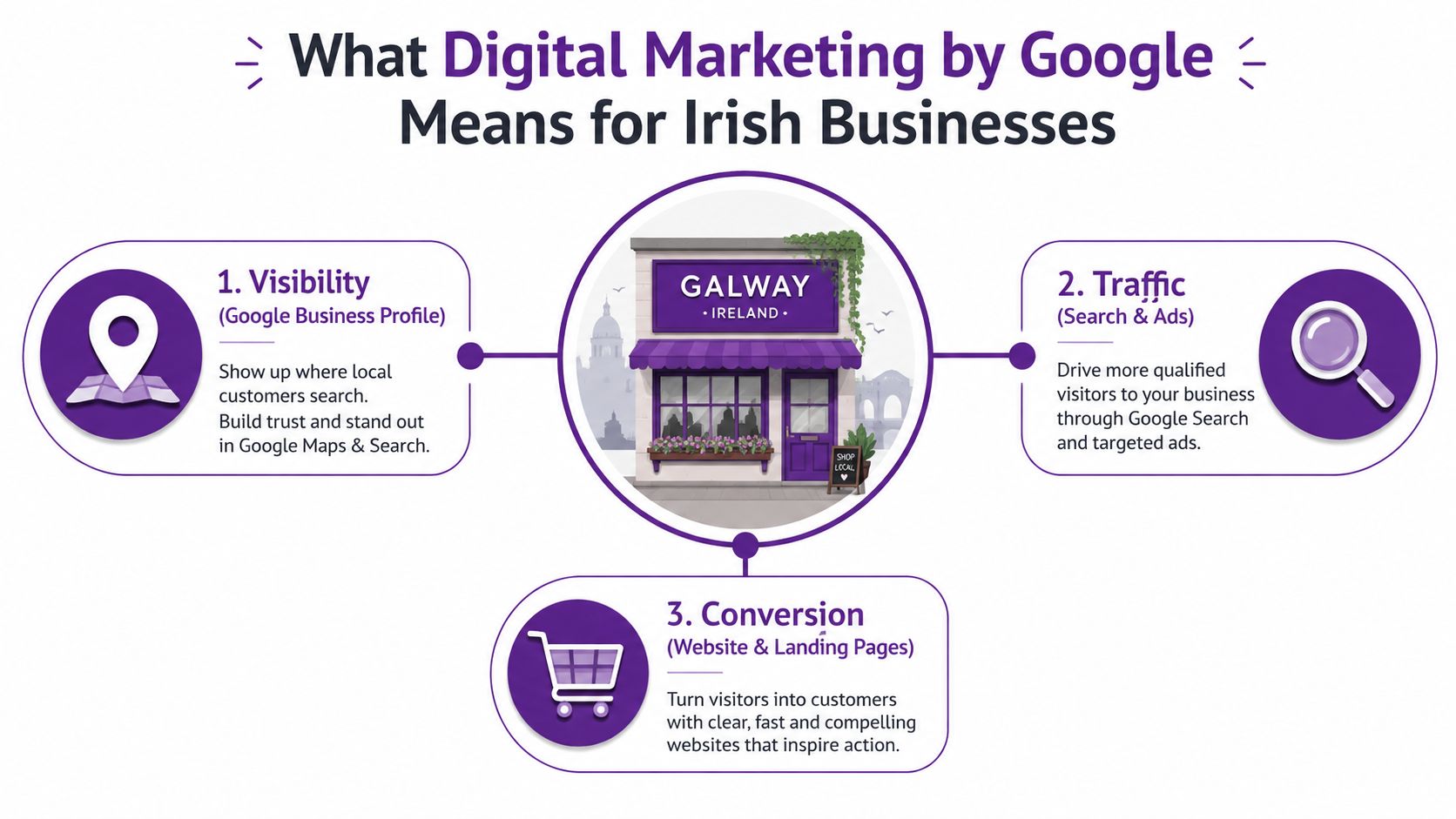
For an Irish SME, digital marketing by Google is a three-layer system: training, products and measurement. Training gives your team the knowledge to make sound decisions. Products create visibility and capture demand. Measurement shows whether that attention produces calls, bookings, sales or pipeline.
The three layers behind the platform
Training begins with Google's free resources, including Digital Garage and Skillshop. They do not replace hands-on campaign experience, but they give an owner or marketing manager the language to challenge an agency brief, question bidding choices and spot weak reporting. Your team should understand conversion actions, search terms and the effect a landing page has on campaign performance.
Products are the Google surfaces where customers discover, compare and contact businesses. They include Google Search, Google Ads, YouTube, Gmail, Display, Maps, Shopping and Google Business Profile. A restaurant may rely heavily on Maps and local search. A Dublin software company may use Search to capture active demand, then YouTube to build familiarity before a sales conversation.
Search behaviour is changing, too. More queries are resolved on Google's results page without a website visit, so appearing in the right result features and maintaining accurate business information matters alongside driving clicks.
Measurement provides the operating discipline. Google Analytics 4 records website behaviour, Search Console reports organic visibility, Google Tag Manager manages tracking events, and Looker Studio turns connected data into a working dashboard. Without this layer, teams end up judging performance through impressions, clicks or platform recommendations rather than commercial results.
Why this stack suits smaller Irish teams
Google should not replace every other channel. LinkedIn, Meta, email, partnerships and offline activity can all support growth. For a smaller business with a limited budget, Google is often the most practical starting point because it sits close to existing customer intent.
Search remains a major part of Ireland's digital advertising market, according to IAB Ireland's annual adspend study. That keeps Google relevant in budget planning, but spend alone is not a strategy. Irish SMEs still need to decide which searches matter, which customers they want and which actions count as a result.
The practical definition is straightforward: digital marketing by Google combines Google's education, marketing surfaces and analytics tools to help a business get found, attract suitable visitors and measure commercial outcomes. The value comes from connecting the three layers around one customer journey, not from opening every available account.
Practical rule: Do not add another Google product until you can name the business outcome it supports and explain how you will measure it.
The Core Google Marketing Products Every Irish Team Should Know
Google's products work better as a connected stack than as isolated channels. Start with the customer's intent, then select the surface that can answer it.
Google Ads Search is the direct-response layer. A Dublin accountant can target searches such as “accountant Dublin”, while a specialist builder can focus on service and location combinations. Search campaigns are strongest when the keyword, advert and landing page all reflect the same need. For a straightforward explanation of the platform, see this guide to what Google Ads is.
Performance Max extends activity across Google's inventory using assets, audience signals and conversion data. It can support a retailer with product feeds or a service business with strong creative and reliable lead tracking, but it shouldn't become an excuse to abandon search-term scrutiny.
Demand Gen is useful for visual prospecting across YouTube and other Google-owned discovery environments. A Cork B2B software company could use it to introduce a category problem before a prospect searches for a supplier. It plays a different role from Search, because the audience may not be expressing immediate buying intent.
Shopping and Merchant Center form the retail engine. Product titles, images, availability, pricing and landing-page quality all affect how effectively an ecommerce catalogue can compete. For a Limerick retailer, product feed hygiene often matters as much as the ad copy.
Organic surfaces complete the picture:
Google Business Profile: Supports local discovery, calls, directions and reputation signals for shops and service-area firms.
Google Maps: Helps location-led businesses appear when customers compare nearby options.
YouTube Search: Gives brands a way to answer product, service and how-to questions through video.
Organic Search and Discover: Build non-paid visibility when the site consistently demonstrates relevance and usefulness.
Gmail and Display: Support remarketing and broader awareness, provided audience exclusions and frequency controls are handled properly.
Supporting tools make the system manageable. Keyword Planner helps with initial demand research, Ads Editor speeds up structured changes, Merchant Center organises retail data, and Looker Studio connectors bring campaign and analytics information into one view.
Google product | Best Irish fit | Primary KPI |
|---|---|---|
Search Ads | High-intent local and commercial queries | Qualified leads or sales |
Performance Max | Retail and multi-surface conversion activity | Value or qualified conversions |
Demand Gen | Visual prospecting for considered purchases | Engaged visits and assisted demand |
Business Profile | Local shops, hospitality and service areas | Calls, directions and enquiries |
YouTube | Demonstration, education and brand discovery | Engaged view and assisted action |
Search Console | Organic visibility and query coverage | Relevant impressions and conversions |
Analytics 4 | Website and journey measurement | Commercial conversion quality |
AI Overviews and other generative search outputs belong in this product map as a changing discovery surface, not as a replacement for every existing channel. Your business still needs accurate pages, clear entities and useful answers that Google can understand and potentially reference.
How Irish Ad Spend and Search Behaviour Shape Your Google Strategy
An Irish SME can spend heavily on Google and still miss the market if its targeting, content and measurement work separately. Treat Google as a three-layer system: training gives the team practical control, products capture demand, and measurement shows which activity produces qualified business. The market figures support disciplined allocation, not blanket spending.
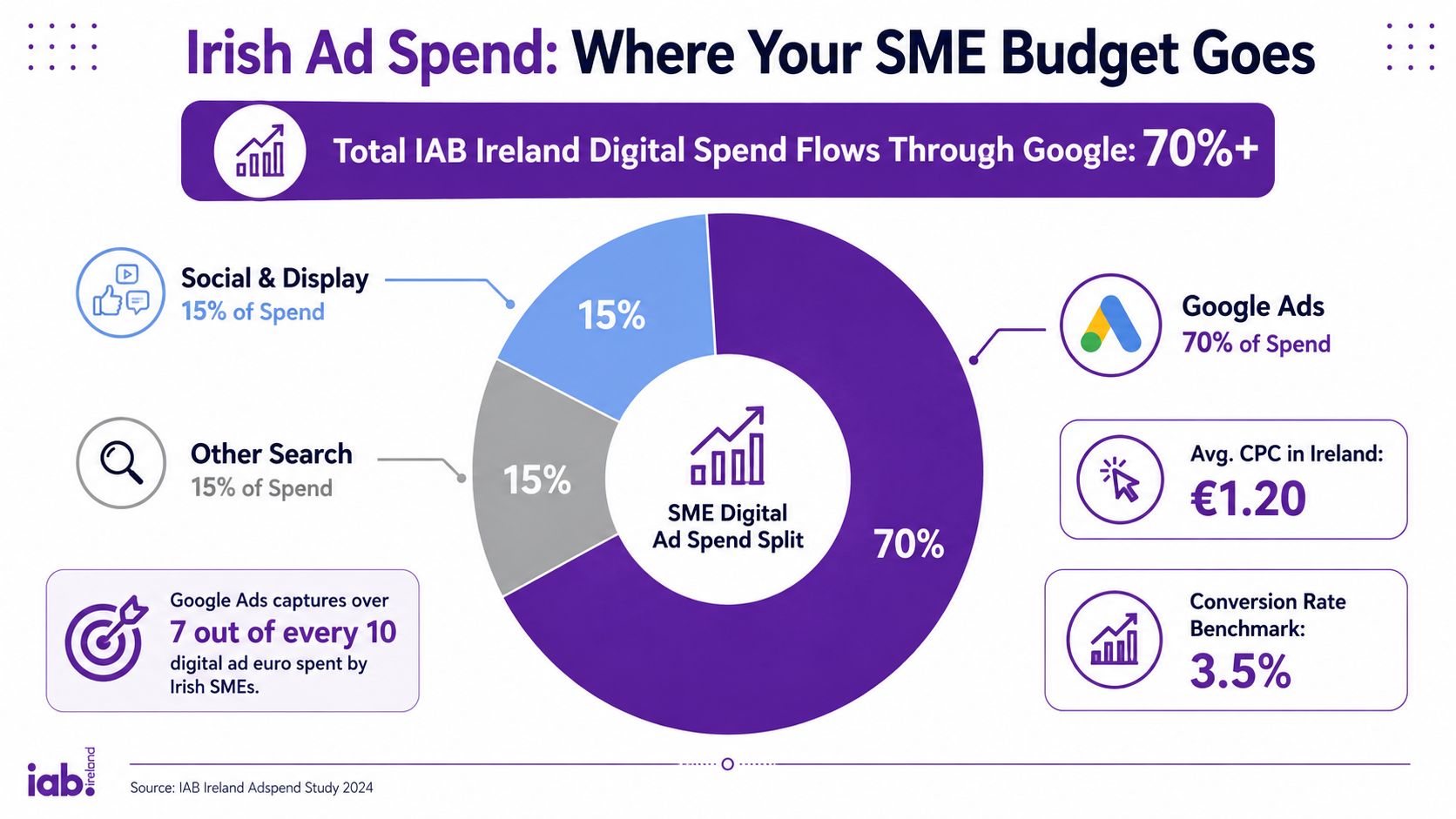
Paid search reached €345 million in 2025, while the wider Irish digital advertising market reached €1.146 billion, according to the Irish market study. A separate market reference records roughly €1.06 billion in 2024, with digital channels at 65.5% of total advertising revenue. Google and Meta together account for about 80% of digital ad spending, as outlined in this Ireland Google Ads market context. The practical conclusion is clear: competition is high, and irrelevant queries can waste an SME's budget quickly.
Budget decisions should follow intent
Do not copy another company's channel split. A B2B firm selling into a narrow Irish market may need Search to capture urgent commercial demand, then SEO and content to support a longer sales cycle. A consumer brand with strong products and visual assets may put more budget into Shopping, organic product discovery and remarketing.
Answer these questions before setting an allocation:
Is the customer already searching? Prioritise tightly controlled Search when the query signals a near-term need.
Does the product need explanation? Add YouTube, useful content and remarketing when buyers need confidence before contacting you.
Does location decide the purchase? Strengthen Business Profile, Maps, local landing pages and call measurement.
Can you prove lead quality? Import qualified outcomes instead of optimising only for form completions.
Ireland had 5.26 million internet users and 98.9% online penetration at the end of 2025, according to Digital 2026 Ireland data. YouTube's potential Irish advertising reach also increased by 150,000 people, or 3.6%, across late 2025. Reach is not the main constraint. Message quality, first-party audience design, conversion tracking and landing-page relevance now decide whether that reach produces value.
Search behaviour is shifting as well. Independent Irish analysis of 175 million Irish searches recorded aggregate click-through rate falling from 3.62% to 2.67%, a 26% decrease, while AI Overviews appeared on 12% of tracked Irish queries in November 2025. The findings appear in the Irish AI Overview visibility analysis. Your Google strategy must therefore protect traditional search performance while building visibility for answers that receive no click.
Start with training on query controls, negative keywords, audience signals and conversion definitions. Then configure the products around genuine intent, and use measurement to remove spend that produces activity without qualified outcomes. Broad Display campaigns should not be the default response. Improve search controls, local relevance and commercial content first.
Choosing Between Google Ads, SEO and AI Search Optimisation
The right choice depends on intent, not on which channel has the loudest industry conversation. Irish businesses usually face three useful tiers.
Transactional intent sounds like “emergency plumber Dublin” or “book hotel near Galway”. Google Ads can create immediate, measurable exposure for competitive terms, particularly where organic results compete with adverts, directories and local features. SEO still matters, but it may not deliver the fastest response.
Comparative intent sounds like “best CRM for Irish wholesalers”. Strong landing pages, comparison content, reviews and structured product information work together here. Ads can capture the active buyer, while SEO builds a durable asset that continues to answer the question.
Informational intent includes searches such as “how to track GA4 conversions”. Organic content is usually the better foundation because the business can explain the problem in depth and earn trust before the buyer is ready. AI search optimisation strengthens that content by making the company's expertise, identity and evidence easier for answer systems to interpret.
Intent Tier | Google Ads | SEO | AI Search Optimisation |
|---|---|---|---|
Transactional | Fast testing and direct response | Builds authority around valuable commercial pages | Protects clear brand and service references |
Comparative | Captures buyers already evaluating options | Supports comparison, proof and trust | Makes differentiators easy to extract accurately |
Informational | Usually expensive if used alone | Compounds useful educational reach | Structures concise, credible answers for AI surfaces |
The trade-off is straightforward. Ads provide speed and testing control, but visibility stops when spend stops. SEO takes longer, yet it can build reach and trust across a wider set of queries. AI optimisation helps defend discoverability as more answers appear directly on the results page. This comparison of paid and organic search results is useful when deciding how the surfaces interact.
Decision rule: If you need pipeline next month, fund Search and suitable Performance Max activity. If you can't measure a meaningful return within thirty days, fund SEO. If competitors already dominate answer-led results, start entity, content and schema work immediately.
A Dublin ecommerce business shouldn't pick only one. It can use Shopping and branded Search for active demand, SEO for category and product education, and consistent product, business and review information for AI-led discovery. The landing page remains the commercial centre, regardless of where the customer first encounters the brand.
Measuring What Matters When Zero-Click Searches Are Rising
Organic traffic is no longer a complete performance story. A customer can see your brand, service information or answer on the results page and never visit the website, so a click-only report may understate visibility while overstating the importance of the visits that do arrive.
Build measurement around three layers
The first layer is SERP presence. Track impression share where paid activity applies, branded search demand, relevant organic impressions and the appearance of your business across local and answer-led results. AI Overview citation rate is harder to collect consistently, so record it through a documented sample of priority queries rather than presenting an unsupported number as a precise dashboard metric.
The second layer is on-site behaviour. Configure GA4 to distinguish meaningful engagement from passive sessions. Review landing-page paths, form starts, phone interactions, booking events, scroll behaviour and the quality of assisted journeys. For B2B, a useful visit may not convert immediately, but it should contribute to a path that sales can recognise.
The third layer is pipeline outcome. Connect marketing data to the CRM and report qualified lead cost, sales progression, revenue and customer value. Many Irish accounts fall short here. A low-cost form submission isn't a success if the sales team rejects it.
For technical guidance on connecting paid activity with analytics, use this resource on paid search in Google Analytics.
Fix the measurement architecture
Use one agreed event definition across Google Ads, GA4, Tag Manager and the CRM. Track cross-domain journeys when a .ie website sends a buyer to a separate booking, payment or application tool. Import offline outcomes, such as qualified opportunities or closed sales, so bidding receives a signal closer to commercial value.
Don't pretend attribution is exact. First-click gives too much credit to discovery, while last-click often rewards the final branded visit and ignores the earlier work. Position-based and data-driven models in GA4 can provide a more defensible view when combined with HubSpot or Salesforce source information.
A considered B2B purchase may involve a long gap between first visit and closed business. Model that lag in your reporting rather than judging every campaign on same-day conversions. Then test incrementality with paused-account comparisons or geographic holdouts where the business can do so responsibly.
Use a simple cadence:
Weekly: Review spend, search terms, budget pacing and obvious tracking failures.
Monthly: Compare attribution, qualified lead quality and landing-page drop-off.
Quarterly: Run an incrementality test for channels such as SEO or YouTube.
The objective isn't to make every touchpoint look successful. It's to identify which Google-led activity creates demand that the business can serve and sell.
Why Former-Google Experience Changes How an Agency Delivers
The former-Google badge only matters if it changes the work. An operator who has built, damaged and rebuilt campaigns inside Google Ads and Analytics environments brings pattern recognition that a course certificate can't provide.
For an Irish SME, that experience should show up in practical execution. The operator can diagnose a disapproval without turning every policy warning into a crisis, structure keywords around actual match behaviour, and separate high-intent queries from exploratory traffic. They'll also understand how quality signals, bidding inputs and Performance Max assets interact, rather than treating every platform recommendation as an instruction.
The recommendations worth challenging
Google's automated recommendations can be useful prompts. They aren't a strategy. Broad match, audience expansion and budget increases may help an account with reliable conversion volume, but they can also pull a tightly defined SME into irrelevant searches and weaker leads.
A strong operator asks:
What signal is the system using? Is it a qualified opportunity, a basic form fill or an unverified page view?
What traffic will expand? Does the change open useful demand or broaden the query pool?
What is the commercial safeguard? Are exclusions, location settings and lead-quality feedback ready?
How will we reverse it? Can the team compare the change against a clear baseline?
For B2B teams, the difference becomes more obvious in measurement. Offline conversion imports, MQL-to-SQL definitions and CRM feedback need careful structure before Smart Bidding can optimise towards them. A platform specialist should also know when not to automate, particularly when the account has limited data or inconsistent sales follow-up.
The useful advantage isn't access to Google. It's knowing which platform behaviour deserves trust, which needs testing and which should be rejected.
Choose support based on outcomes: fewer disapprovals, less wasted budget, cleaner attribution, sharper search structure and recommendations grounded in account evidence. Scéaled, a Dublin-based growth agency led by former Google marketers, offers Google Ads management covering audits, keyword strategy, account restructuring, conversion tracking, landing-page recommendations and budget and bidding strategy.
If your annual Google Ads budget is substantial, secondhand training isn't enough on its own. You need someone who can explain what changed, why it changed and how the change will be judged against qualified commercial results.
A Practical 30-Day Plan to Get More From Google
A bigger budget won't repair broken tracking, vague landing pages or an account that targets every possible query. Start with a controlled month, establish a baseline and make the next decision from evidence.
Week one and measurement foundations
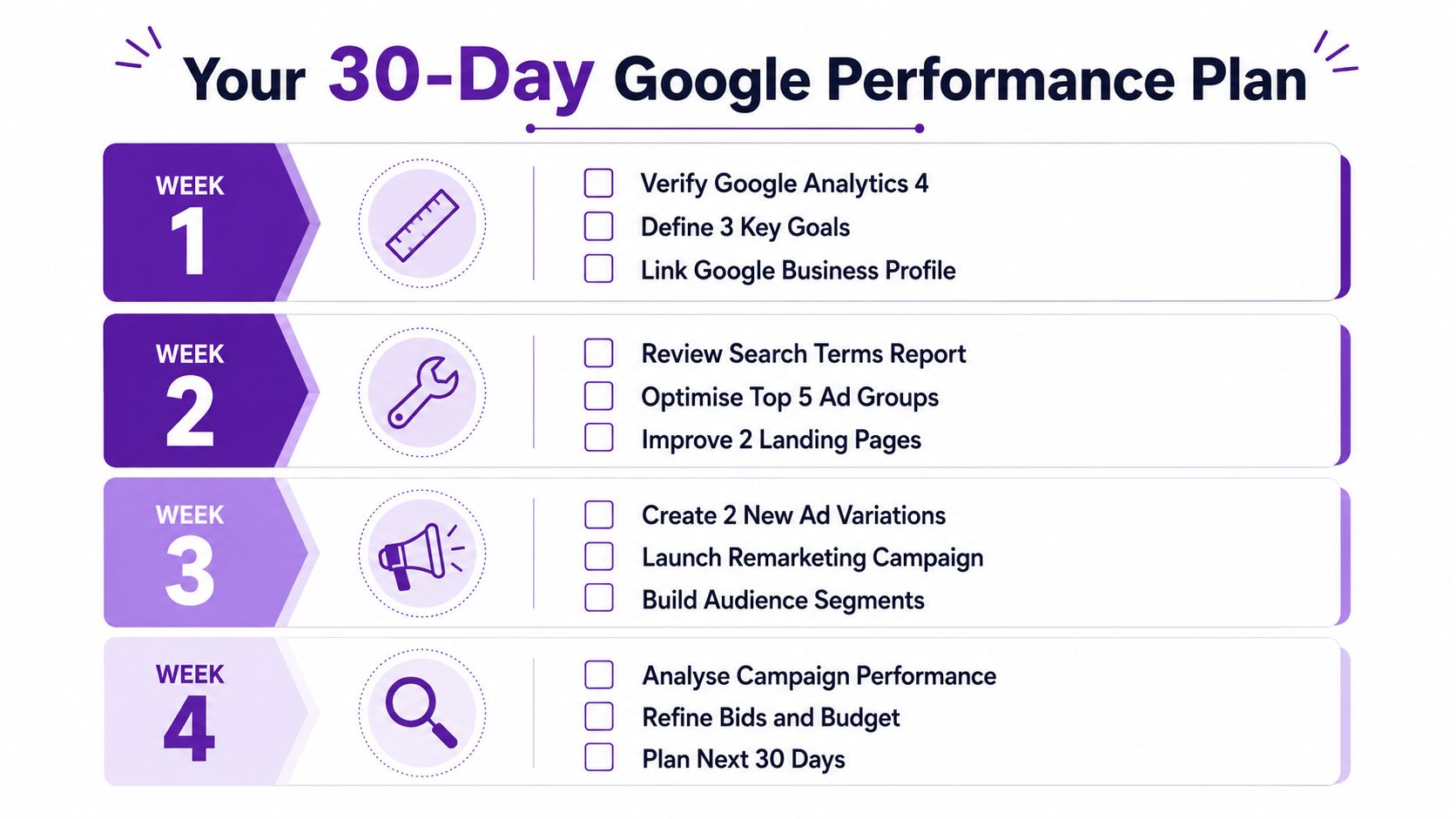
Verify the GA4 property, remove internal traffic where appropriate, and confirm that Tag Manager fires on the events that matter. Define three commercial goals, such as qualified enquiry, phone call and completed booking, then link the Google Business Profile and map the .ie site correctly in Search Console.
Week two and search hygiene
Review technical crawl issues and align pages with five priority commercial queries. Check titles, headings, internal links, service detail and conversion paths. For a Dublin business, audit local-pack accuracy across the Business Profile, address information, service areas, categories, reviews and landing pages.
Week three and controlled paid search
Build one tightly themed Search campaign. Start with exact and phrase match, a deliberate negative-keyword list and adverts that mirror the landing page. Add sitelinks that send users to relevant commercial pages, not a generic home page.
Week four and commercial review
Compare assisted conversions, poor-performing landing pages and cost per qualified lead with the previous reporting period. Ask sales which leads were usable, which were misaligned and which progressed. Then commit to the next thirty-day cycle with one clear test, not a long list of simultaneous changes.
Set a hard stop at €1,500 in ad spend for this initial exercise, and treat that amount as a controlled test budget rather than a promise of performance. The point is to learn which queries, messages and conversion actions deserve more investment.
This video can help your team frame the practical work before making account changes:
Assign one owner to each deliverable, record every change and review lead quality with the person responsible for sales. Growth comes from a repeatable operating system, not from increasing spend before the system works.
Scéaled helps Irish businesses connect Google Ads, SEO, content, conversion optimisation and measurement around qualified demand rather than vanity metrics. Visit Scéaled to discuss an evidence-led Google growth plan for your SME, B2B pipeline or ecommerce operation.
Comments